
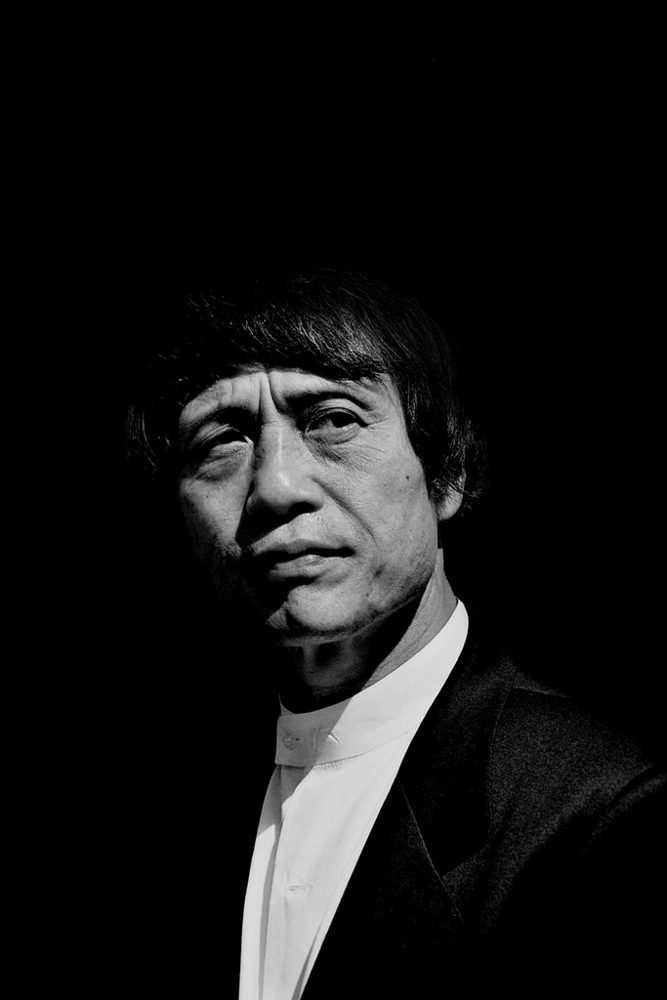
Tadao Ando earns third place because he makes the basic elements of architecture feel newly consequential: a wall, an opening, a route and the light that changes their relationship. The 1995 Pritzker laureate is associated with the Church of the Light, the Church on the Water, housing at Rokko and museum work on Naoshima. The prize archive dates the two churches to 1989 and 1988 respectively. These are useful historical anchors, not promises about present-day access. Our argument for Ando concerns the concentration of spatial experience rather than the number of monumental objects a viewer can recognize from a skyline photograph.
The Church of the Light provides a particularly clear starting point. A cross-shaped opening gives light an unusually direct role in the perception of enclosure. The interpretive question is not merely whether the image is beautiful. Ask how an opening changes the apparent solidity of a wall and how the surrounding surfaces make that change perceptible. A photograph records one moment under one set of conditions; it cannot establish every visitor's experience at every hour. Keeping that limit in mind allows a stronger description. Light is part of the architectural material, but its behavior must be understood through time and position as well as a single reproduced view.
Landscape and collective housing
The Church on the Water shifts attention toward the relationship between built space and landscape. Compare it with the Church of the Light without assuming that the two projects deliver the same effect through different scenery. One useful question is how the boundary between inside and outside is staged. Another is what a route prepares the visitor to notice before arriving at the principal space. These are ways to analyze the projects, not claims that we personally experienced every room. Readers can use the linked documentation to test the comparison and distinguish an observation about a photograph from a statement about the full arrangement.
Rokko housing prevents the account from remaining inside a pair of religious buildings. Housing on a difficult site introduces relationships among repeated units, ground and collective form. The Pritzker archive documents several phases, which should not be compressed into a single completion date. The important lesson for this ranking is that restraint does not mean the absence of complex organization. A quiet surface can coexist with substantial decisions about movement, privacy and the meeting of individual dwellings. Those questions do not become less architectural because they are harder to summarize in a dramatic facade image. They broaden the case for treating Ando as more than a maker of photogenic concrete rooms.
Concentration versus public image
Third place is the clearest challenge to the top two. If influence means changing how a reader perceives ordinary spatial elements, Ando can reasonably win. Gehry and Hadid make the expansion of formal possibility more immediately public, while Ando asks the viewer to slow down. Our preference for the first kind of public legibility gives him third, but the distinction is not a universal hierarchy. Neither expressive form nor restraint automatically guarantees a successful building. Both require interpretation in relation to a particular place and purpose. Ando's work is useful precisely because it exposes how much a ranking depends on what kind of attention it rewards.
For a simple exercise, describe one opening before naming its shape. Where is the light coming from, what surface receives it and how does your position change the relationship? Then compare that description with a second project. This makes admiration for minimalism more specific and avoids treating an entire career as a fashionable material palette. The strongest argument for Ando is about the organization of experience, not the claim that using less always means achieving more. If that organization matters more to you than a building's public image, third place is too low. Explain the move through a spatial relationship and the debate becomes useful.
Source: The Pritzker Architecture Prize.
Photo: Christopher Schriner from Köln, Deutschland · CC BY-SA 2.0. Tadao Ando — Langen Foundation opening, 2004. Resized and recompressed without new cropping; existing source edits and license retained.
