
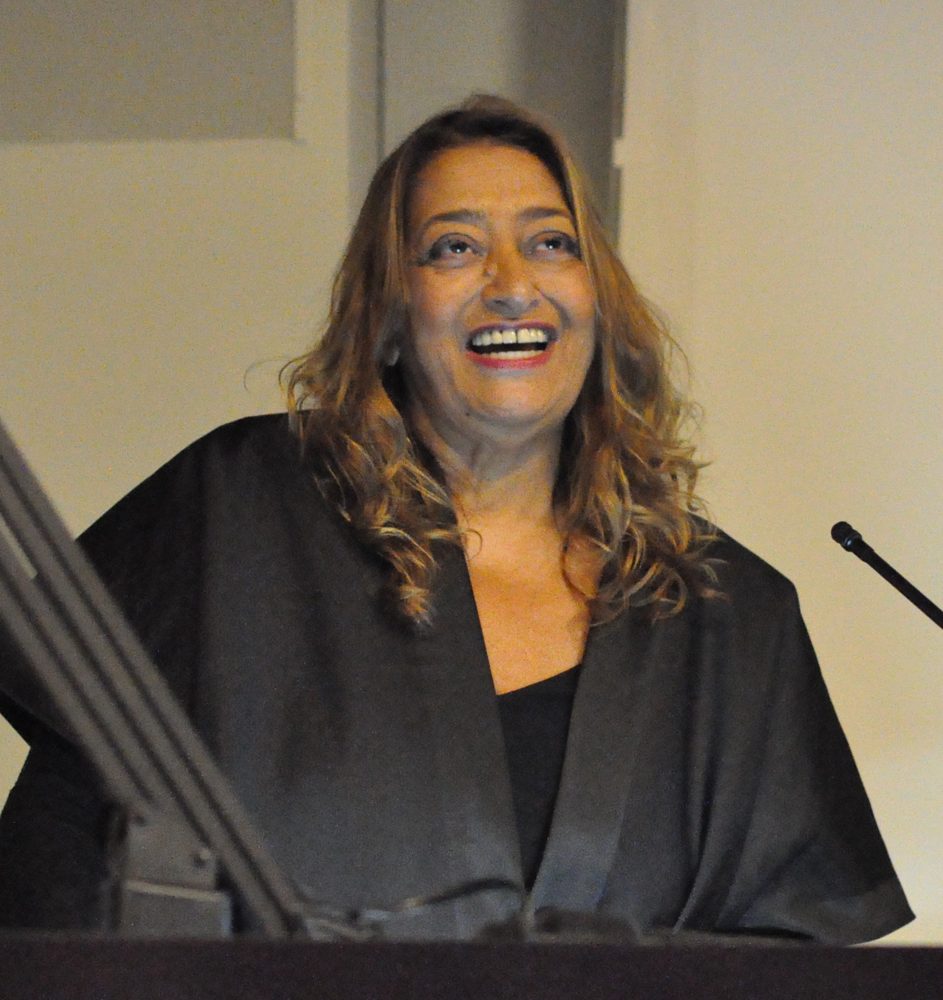
Zaha Hadid ranks second for expanding what architectural space could be imagined to do before a project became an easily recognized finished object. She received the Pritzker Prize in 2004, the first woman to receive it. The prize archive connects her early built work with the Vitra Fire Station, the Bergisel ski jump and the Rosenthal Center for Contemporary Art in Cincinnati. These examples matter because they show different programs within a developing architectural language. Our argument does not depend on treating every later building by a continuing practice as the work of one person alone. Dates, collaboration and the distinction between an architect and a firm remain important.
The Vitra Fire Station, dated 1993 in the Pritzker record, is a useful place to start because its planes and directional tensions challenge the expectation of a building as a calm, upright box. Rather than calling it futuristic and stopping there, ask how the composition directs attention and how its forms relate to movement. The term futuristic describes an impression, not a technical explanation. A stronger account identifies edges, overlaps and changes of direction, then asks what those choices do for a particular architectural encounter. That method allows disagreement without reducing the project to either admiration for novelty or automatic rejection of an unfamiliar shape.
Movement across different programs
The Rosenthal Center, dated 2003, brings those questions into an urban arts institution. A museum is not only a container for galleries; it also mediates between street, entrance and the movement that connects different spaces. Hadid's place in this ranking rests partly on making that sequence a central part of the architectural proposition. We do not infer an exact visitor response from promotional language or a photograph. Instead, the project offers a basis for asking how internal movement and external form are related. That is a more durable question than whether the building happens to look like what a viewer expects an art museum to resemble.
Bergisel introduces a program where movement is already explicit in the brief. The prize archive dates the ski-jump project to 2002. Its inclusion shows that an architectural idea can be tested outside the museum world, although the projects do not become equivalent because they share an author. A sports structure, a fire station and a cultural center have different users, requirements and relationships to their surroundings. Comparing them helps explain the scope of Hadid's experimentation without inventing a single formula. The interest lies in how a strong design ambition changes when it encounters another kind of task, not in assuming that every project proves the same point in the same way.
The strongest challenge to Gehry
Hadid has a compelling claim to first place if the standard is expanding the repertoire of spatial thinking. We place Gehry slightly ahead for the accessibility of his public architectural argument across several scales, but the gap is editorial rather than measurable. Her work also reminds us that a career includes drawings, competitions and projects that were not immediately built. Those forms of practice can matter to architectural discussion without being described as completed buildings. The distinction is especially important in a field where a celebrated proposal may circulate more widely than the final project, and where a later photograph can conceal the length of the design process.
To test second place, compare the route through one Hadid project with the exterior view that first attracted your attention. Does the image prepare you for the sequence of spaces, or does it conceal the more interesting part of the design? Then ask the same question of Gehry and Ando. The comparison gives three different answers to the relationship between public form and lived movement. Hadid can win when the transformation of spatial expectations carries the greatest weight. A strong case for moving her to first should identify that transformation in a specific project, while keeping the people and collaborations behind the finished architecture visible.
Source: The Pritzker Architecture Prize.
Photo: Columbia GSAPP · CC BY 2.0. Zaha Hadid — Columbia GSAPP presentation, November 2011. Resized and recompressed without new cropping; existing source edits and license retained.
