
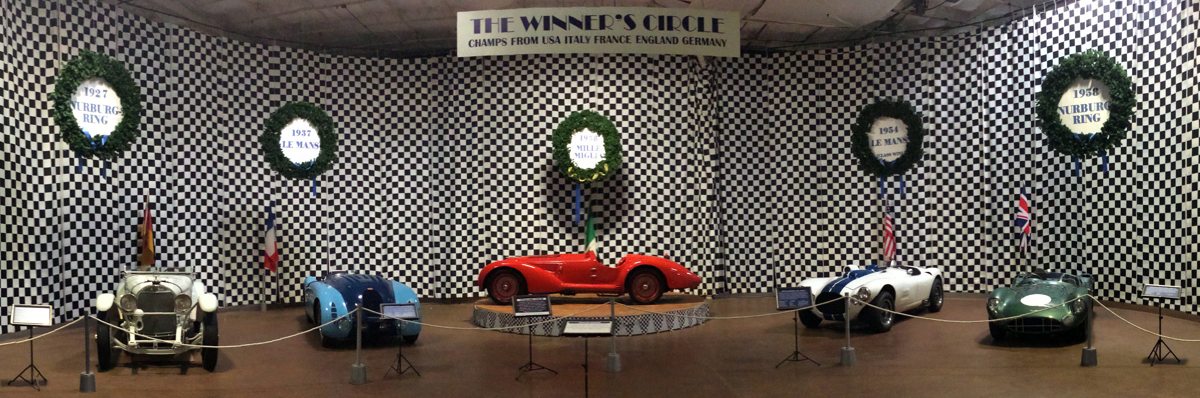
The Simeone Foundation Automotive Museum in Philadelphia takes ninth place with a proposition more concentrated than LeMay's: competition as a driver of automotive design. Its official collection description centers on racing sports cars and the development of ideas through rivalry. That gives a newcomer a useful thread through unfamiliar names. Instead of asking which car is the most glamorous, ask what problem each generation tried to solve within the conditions of a particular kind of racing. The museum's strength lies in making those relationships worth investigating, even if your knowledge of race results is limited.
Begin with what the cars allow you to compare visually. The location of the passenger compartment, the shape of the nose and the treatment of the wheels can raise questions about airflow, cooling and packaging. None of those features alone proves why a race was won. Results depend on rules, reliability, drivers, teams and circumstances as well as shape. Use the museum's object histories to establish the specific story before making a general claim. Two cars that look alike may have been built for very different events; two that look unrelated may be responses to the same constraint at different moments.
What to look for and plan
The collection page includes a range of European and American manufacturers, so this is not simply a celebration of one badge. A productive comparison follows the task rather than the nationality. Consider how a designer balances speed with the need to keep a machine working over time. Where a label discusses a particular competition record, distinguish that documented achievement from a broad reputation for being “the best”. A preserved vehicle is a historical object with an individual story. It does not automatically represent every example of its model, every stage of its development or the configuration in which it competed throughout its life.
Simeone's Demo Days are a major reason to check the calendar before choosing a date. The institution describes taking selected cars out for exercise during these programs and other special events. That is different from a promise that every visitor will see a running demonstration. A regular gallery visit and an event visit can have different schedules, expectations and opportunities for questions. Consult the current program rather than assuming a demonstration happens daily. If hearing a machine operate is the main purpose of your journey, verify the specific event and its conditions before committing to travel or treating an old video as a current schedule.
The ranking and alternatives
Ninth place reflects our mixed-audience criteria. A group interested primarily in domestic travel, everyday transport or the social experience of car ownership may find Reno or Dearborn a more immediately broad entry point. For someone absorbed by sports-car history, Simeone's focused explanation of competition can be more valuable than those alternatives. That is a credible case for moving it much higher on a personal list. The tradeoff is depth in a particular story versus the number of different starting points available to a visitor who has not yet developed an automotive interest. We favor the latter in the overall order.
A good final exercise is to select one car and write down the question its design appears to answer, then use the collection history to test that first impression. Perhaps you notice a compact cockpit or an unusually shaped body; the important next step is the documented context. Keep a distinction between a running demonstration and a modern road test, since preservation, controlled operation and present-day performance measurement serve different purposes. Simeone rewards patient comparison and informed questions. It earns its place as a museum where competition can become a clear interpretive theme rather than a row of famous winners presented without explanation.
Source: Official museum research and visitor information 1 · Official museum research and visitor information 2 · Official museum research and visitor information 3.
Photo: JosephChiaccio · CC BY-SA 4.0. Simeone Winners Circle display, 10 March 2015; historical layout, not current inventory. Resized/recompressed with orientation corrected; framing retained, no AI or added color treatment. Image remains under the linked original license; no endorsement.
