
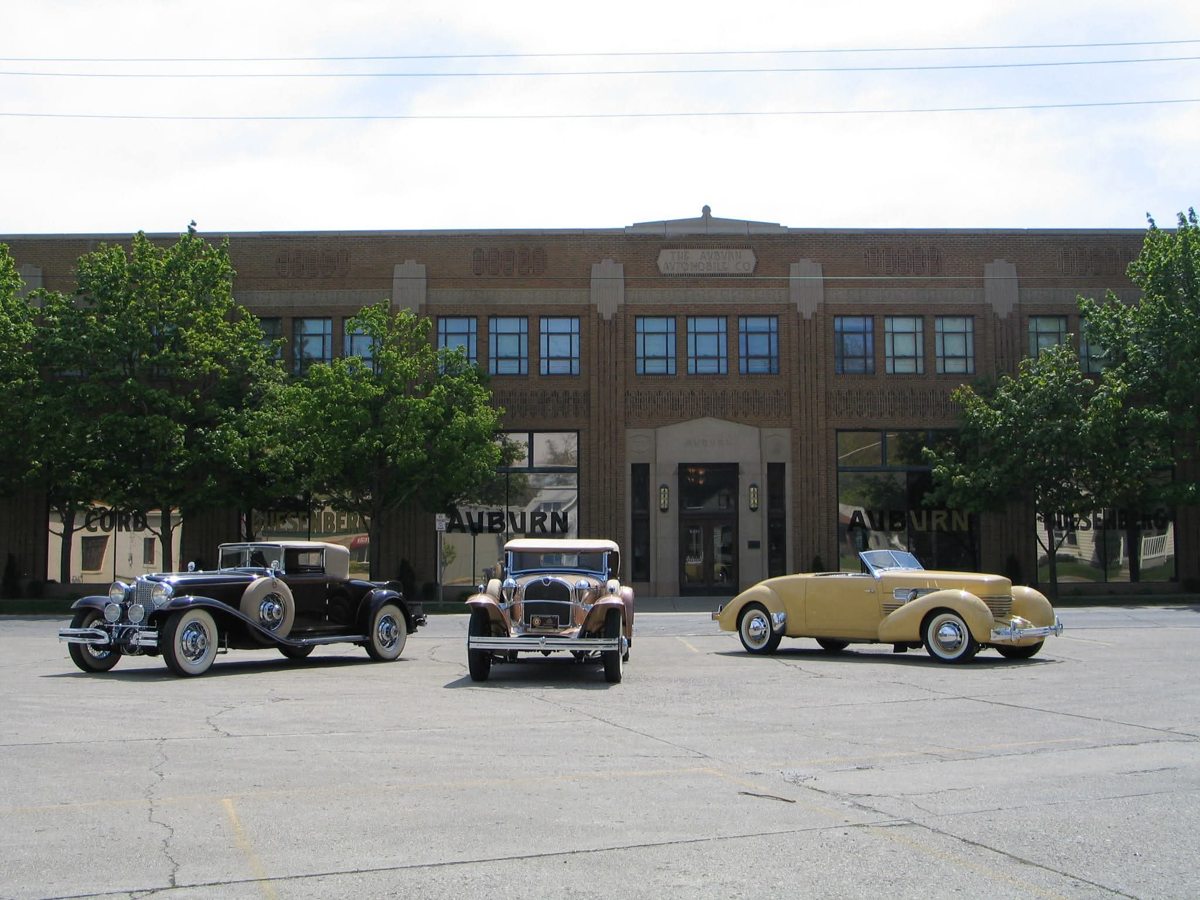
The Auburn Cord Duesenberg Automobile Museum in Auburn, Indiana, takes sixth place because its setting is part of the historical argument. The museum's own history describes rescuing the Auburn Automobile Company's 1930 administration and showroom building, then opening the museum in 1974. Visitors therefore encounter automobiles in a place connected to the business that presented and developed them. That relationship gives the building more than decorative value. It invites a question that a neutral modern gallery cannot pose in quite the same way: how did this company want customers, employees and the wider public to understand its ambitions?
Begin by looking at the showroom as a designed environment. The museum's history identifies the restored Art Deco setting, with its geometric floor, stair and ornamental detail. Read those features alongside the cars rather than treating architecture as something to photograph before the “real” visit begins. A car's proportions and finish form one message; the room in which it was displayed forms another. Neither proves that the company was financially successful or that every owner enjoyed the same experience. Together, however, they offer evidence for how a manufacturer represented modernity, quality and aspiration to people encountering its products.
What to look for and plan
The museum's current information also includes original company offices and themes involving design, engineering and Indiana-built vehicles. That makes it possible to move from the public face of a car to the work behind it. A useful comparison asks what changes when you consider the vehicle as a product of a business rather than an isolated masterpiece. Someone had to develop drawings, organize production, communicate with buyers and maintain a recognizable identity. Look for the specific evidence supplied by the exhibits. It is easy to tell a romantic story about lost luxury marques; the more valuable task is to see how the museum supports or complicates that story.
Do not reduce Auburn, Cord and Duesenberg to three interchangeable names for expensive old cars. The museum is a place to investigate their differences and relationships through the objects and interpretation. Compare body layout, presentation and intended role before deciding which design speaks most clearly to you. Read the label for the individual vehicle's history, since restored appearance is not a complete record of its working life. A highly polished car can help explain craftsmanship without proving that it looked exactly that way at every stage. Preservation and interpretation are choices that deserve attention alongside the original design.
The ranking and alternatives
Sixth place recognizes the museum's exceptional coherence while reserving the highest positions for wider first-visit reach. Someone interested in architecture, industrial history or the interwar period could easily prefer Auburn to several museums above it. A visitor primarily seeking modern performance or unusual experimental vehicles may find Lane or Petersen a better match. Consult the official visit and event pages before planning around a special tour, and check access arrangements for the different levels. Nearby automotive attractions should be evaluated as their own destinations; the presence of another museum in the same town does not establish shared admission or identical opening conditions.
At the end of the visit, return mentally to the showroom. Has seeing the offices and engineering material changed your interpretation of the cars displayed there? That question captures Auburn's strongest advantage: it helps connect an appealing object to the organization that made it possible. Our guide to Europe's car museums provides other examples of automotive heritage in distinctive settings, but Auburn offers a particularly direct American case. You do not need to know every model name to appreciate the relationship between design, sales and place. The museum earns sixth because it gives those relationships a physical setting that visitors can read with their own eyes.
Source: Official museum research and visitor information 1 · Official museum research and visitor information 2 · Official museum research and visitor information 3.
Photo: ElleFire87 · CC BY-SA 4.0. Auburn museum exterior, 30 September 2025. Resized/recompressed with orientation corrected; framing retained, no AI or added color treatment. Image remains under the linked original license; no endorsement.
