
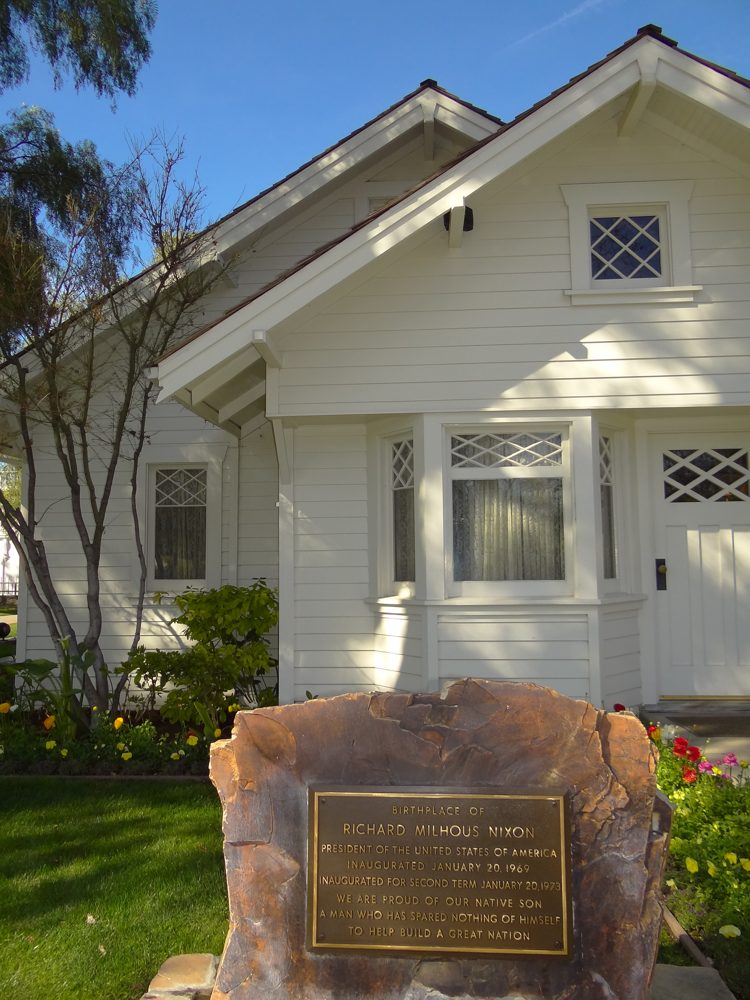
The Richard Nixon Presidential Library and Museum in Yorba Linda, California, ranks eighth for bringing a birthplace setting into direct conversation with a much larger public career. The museum occupies the original site of Nixon's childhood home and combines permanent galleries with gardens and the birthplace. That arrangement gives visitors two different scales of history: a domestic place associated with an early life, and an exhibition that explains events and institutions far beyond it. The useful question is how the museum builds the connection between those scales. A small house can make a biography tangible without, by itself, explaining the choices a later president made.
Begin by noticing what kind of source each part of the site offers. A preserved place, a document, a photograph and a museum narrative do different work. The house can help you think about physical setting and the way a life is remembered in a particular locality. A gallery can organize a sequence of public events and give you sources with which to examine it. Moving between the two is productive when the distinction remains clear. Try describing one observation from the home setting and one from the galleries, then explain how the second adds information that the first could not establish alone.
Choose a historical question
Nixon's public record also makes this a natural setting for questions about evidence and accountability. The library preserves presidential materials, including recorded conversations, and provides research guidance for them. A recording can sound immediate, yet its meaning still depends on date, participants and context. The same care applies to an excerpt used in an exhibition. Ask what happened before and after the passage, whose interpretation accompanies it and what another source might contribute. This is a method for reading political history rather than an invitation to invent allegations or assume that one brief quotation supplies a complete explanation of an administration.
For a mixed group, choose a question that can be discussed without requiring everyone to share the same political judgment. How does an exhibition show the difference between private deliberation and public communication? How does a timeline explain the relationship between a personal decision and institutional response? These are meaningful observations for a student, a regular museumgoer or a companion with little prior knowledge. Write down the exact title of a source that caught your attention. The visit then offers a path toward further reading, rather than ending with a general impression that is difficult to explain or compare with another account of the period.
Plan around current access
Current availability deserves particular attention. On 19 October 2026, the official visitor page states that the presidential helicopter has been removed from exhibition for restoration. Do not plan around boarding or seeing it on display. The same page explains that birthplace interior tours can be affected by weather and recommends checking their status on the day. The museum galleries and the home tour should therefore be treated as distinct planning interests. An archive photograph may introduce the site or its historic subject, but it cannot guarantee that an object or an interior route will be available when you arrive for your own visit.
Eighth place reflects a distinctive combination whose best value comes from careful comparison between place, sources and public narrative. It can rank higher for readers interested in the relationship between records and political accountability. Choose it for that inquiry, rather than expecting a photograph of a birthplace to resolve a historical argument. A useful outcome is an explicit distinction between what an object shows, what the exhibition explains and what remains a question for further investigation. That habit can improve the next presidential museum visit too, because every institution selects and arranges material while the historical record remains larger than any single route through its galleries.
Source: Richard Nixon · Richard Nixon · Richard Nixon.
Photo: Adam Jones from Kelowna, BC, Canada · CC BY-SA 2.0. Archive photograph; current exhibitions and access may differ. Resized and recompressed without cropping; source image license retained.
