
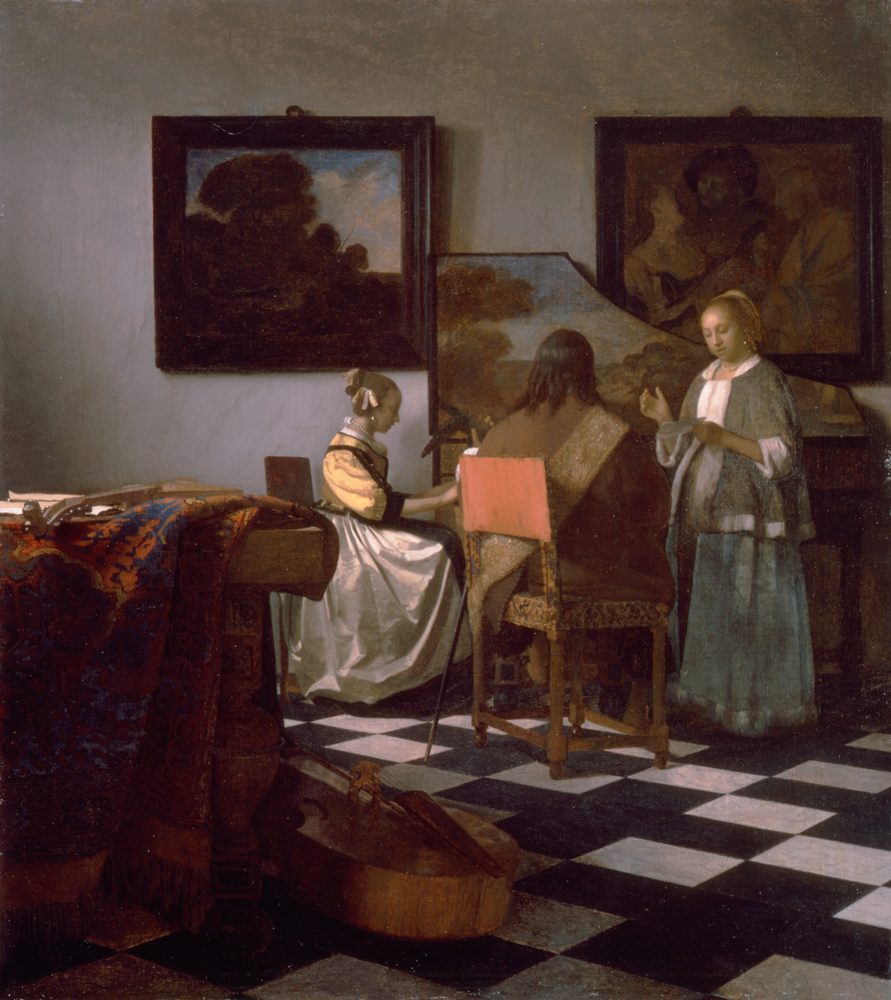
The Concert takes first place because its apparent calm contains an exceptionally rich arrangement of relationships. The Gardner catalogue dates Johannes Vermeer’s painting to 1663–1666. Three figures make music in an interior: a woman at a keyboard instrument, a seated man seen largely from behind and a standing woman with a sheet in her hands. Nothing in the reproduction demands a dramatic climax. Instead, the painting invites sustained attention to the way people, objects and intervals occupy a shared room. Its achievement is to make that organization feel natural while continually offering another connection to notice.
Begin with the foreground rather than the musicians. The table and draped fabric create a substantial near zone, while the patterned floor carries the eye toward the figures. These layers establish distance without isolating the viewer completely from the room. You seem close enough to observe, yet the group’s attention does not revolve around you. That independence is part of the picture’s appeal. Unlike the interrupted man in Chez Tortoni, the musicians appear to continue an activity whose coherence belongs to them. The viewer is invited to look carefully without being made the event’s central participant.
How to look and compare
The three figures form a relationship that is both social and visual. Their positions create a sequence across the room, while the instruments and paper connect their separate tasks. We can interpret this as coordinated attention, but we should not invent identities, a documented performance or a specific piece of music. The painting’s meaning does not depend on knowing those details. A useful way to look is to follow the hands and the direction of bodies, then step back and consider the whole group. Individual actions become parts of an arrangement larger than any one face or gesture.
The paintings on the rear wall complicate the interior further. They introduce additional images within the main image, and their rectangular boundaries echo other structures in the room. Rather than treating them as a code that must unlock one definitive message, first examine how they distribute darker and lighter areas above the figures. Their presence makes the room feel culturally inhabited, while also helping organize the surface you are viewing. The distinction between a depicted object and a compositional device is not absolute. A single detail can contribute to both the imagined setting and the balance of the actual painting.
The ranking and its alternatives
Our first-place decision favors this integration of spatial order and human concentration. Rembrandt’s storm has the stronger immediate shock and may sustain the most compelling dramatic narrative. Vermeer’s advantage is the way a relatively quiet activity keeps the eye moving through many related forms without an obvious break in mood. Readers who prefer exposed artistic process might still put a Degas sheet above both. These are meaningful alternatives because the criteria concern experiences of looking, not a supposedly objective scale of greatness. Nor do we justify the result with an estimate of the painting’s financial value.
The museum describes the work as removed from its frame during the theft; it does not describe it as one of the two Rembrandt canvases cut out. Keeping that distinction correct is part of respecting the history rather than embellishing it. The digital reproduction lets us revisit the arrangement, but the original’s return would restore a material presence that a screen cannot provide. After the entire countdown, return to the space between the musicians. Does the room’s quiet coordination now feel more powerful than the storm’s urgent struggle? Or would you change the order to favor drama, portraiture, landscape or the visible experimentation of the drawings?
Source: Museum object record · Documented theft facts.
Photo: Johannes Vermeer · Public domain / faithful 2D reproduction. Vermeer: The Concert — historical reproduction; not evidence of the original’s present condition. Full source composition retained; resized and recompressed without new crop, colorization or upscaling.

