
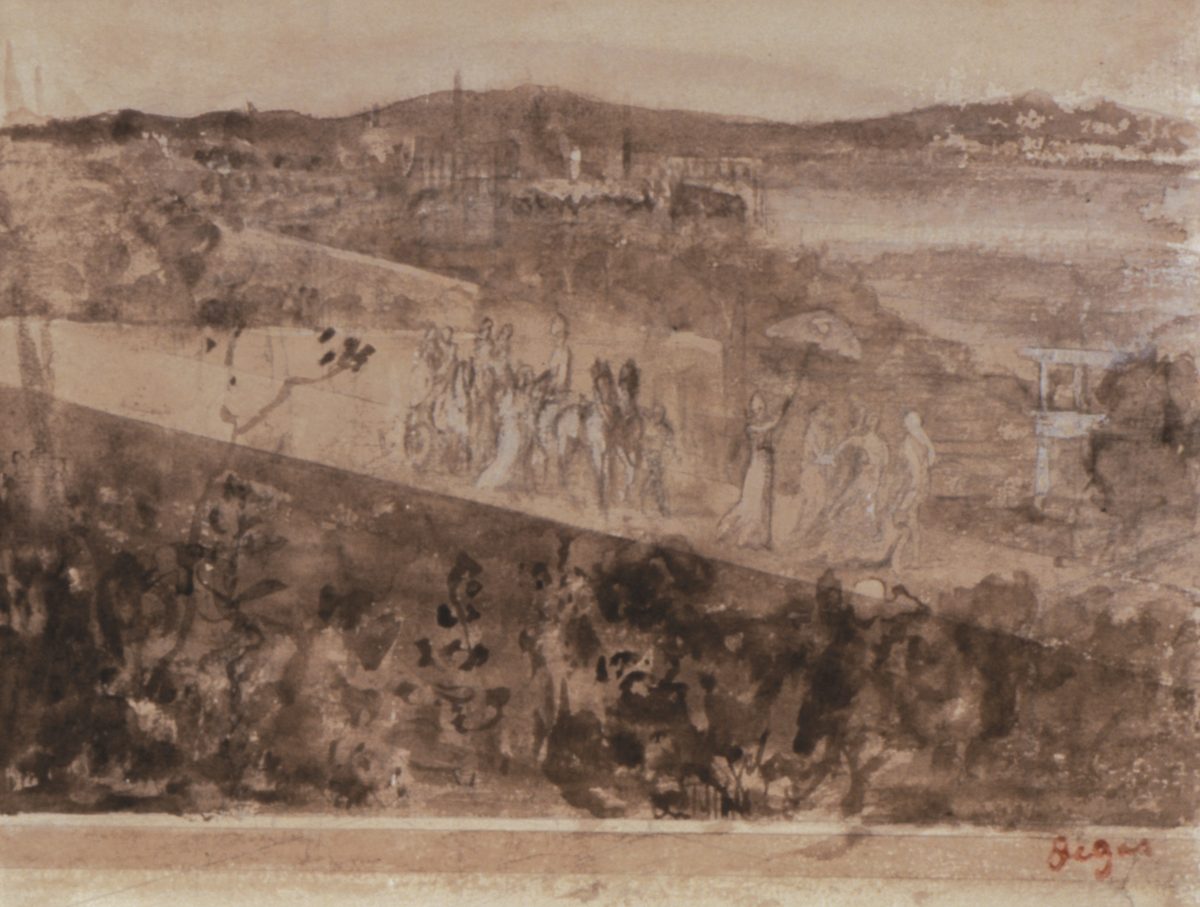
Procession on a Road near Florence changes the kind of attention this guide asks of you. After two crowded programme designs, Degas presents a broader landscape organized around a moving group. The museum dates the work to 1857–1860. Its title provides a location and a collective action, but it does not identify every person or explain the purpose of the gathering. That restraint is useful. Rather than inventing a festival, ceremony or historical incident, we can begin with the visible relationship between the procession, the road and the surrounding terrain. The scene’s strength lies partly in that relationship.
Look at the procession as a shape before attempting to count figures. It forms a band that connects different portions of the landscape. Individual bodies are small enough that their collective movement matters more than a succession of portraits. The road becomes an organizing device: it gives the group somewhere to go and gives your eye a route through the image. Nearby vegetation and more distant buildings establish a larger setting, so the event does not float against an empty backdrop. You can read the work as a scene of people moving through a particular kind of space, rather than as landscape decoration with figures added afterward.
How to look and compare
The relative quiet of the tones is important. Strong theatrical contrast would make each figure compete for immediate attention. Here, the reproduction allows the procession to emerge gradually from the surrounding field. That encourages a slower search, in which recognition develops as your eye moves across the surface. The experience is different from Rembrandt’s storm, where an urgent diagonal announces itself almost at once. Degas’s image does not need that immediate shock. Its reward is the way a small human action can give scale, direction and duration to a much wider view.
Try following the route twice, once from the near edge toward the distance and once in reverse. The first pass makes the procession feel like a movement into the landscape. The second reveals how the terrain frames and channels the figures. This is a useful viewing exercise, not a claim about the actual direction or destination of the historical people depicted. The title cannot establish those details by itself. It is also worth comparing the size of a single figure with the surrounding masses of land and vegetation. Smallness can make a group feel vulnerable, communal or simply part of everyday life, depending on the viewer’s emphasis.
The ranking and its alternatives
Eighth place reflects the work’s subtle spatial interest rather than a deficit of drama. A reader who values landscape may prefer it to the better-known racing sheets. Conversely, someone interested in the speed and directness of Degas’s figure studies may find it less immediately revealing. Both responses fit our stated criteria. The drawing’s contribution is variety: it expands the missing group beyond fashionable entertainment and the artist’s familiar association with dancers. We do not need to make it a prediction of his later career to appreciate the specific problem it solves on its own terms.
At the end of your viewing, return to the word procession. It names a collective action, yet the image invites attention to intervals as much as to bodies. Gaps help establish rhythm, and the road’s continuation suggests a world extending beyond the visible group. This makes the loss more particular than the phrase five stolen Degas drawings implies. One missing sheet concerns the visual experience of moving together through a landscape. Its reproduction preserves an outline of that experience, while the original remains unavailable for direct study. Which gives the scene its strongest character for you: the people, the road, or the space that holds both?
Source: Museum object record.
Photo: Edgar Degas · Public domain / faithful 2D reproduction. Degas: Procession on a Road near Florence — historical reproduction; not evidence of the original’s present condition. Full source composition retained; resized and recompressed without new crop, colorization or upscaling.

