
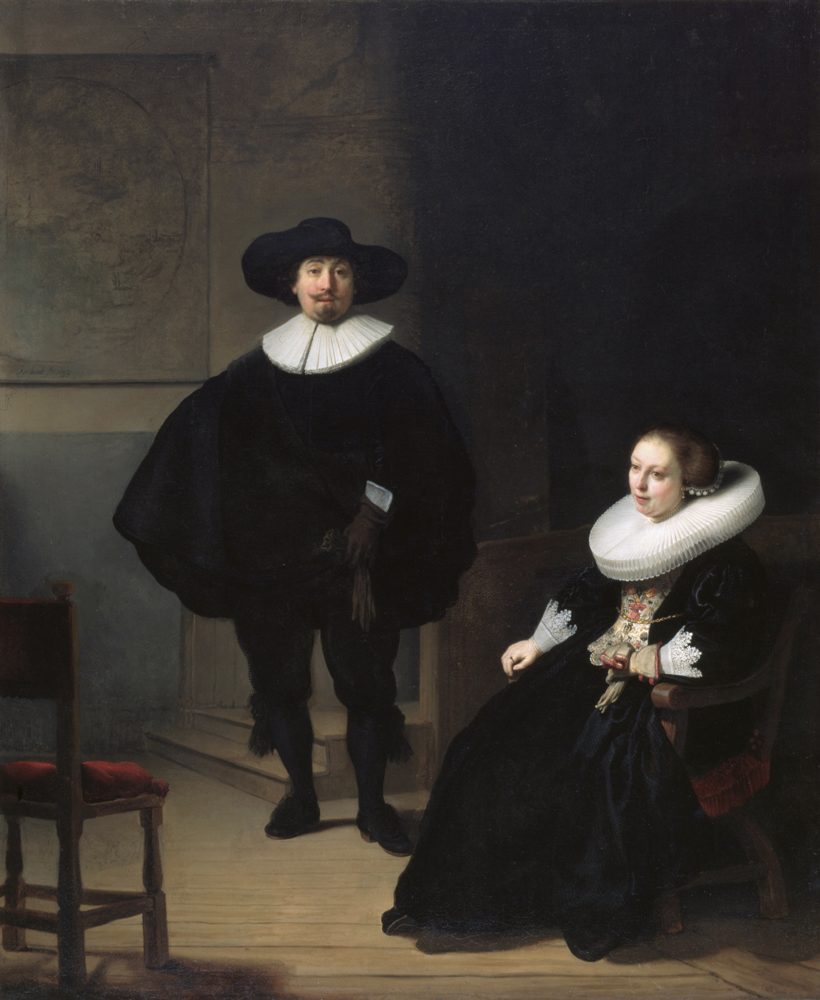
A Lady and Gentleman in Black offers the most sustained portrait encounter in this countdown. Rembrandt painted the work in 1633. A standing man and a seated woman occupy a restrained interior, their dark clothing relieved by bright collars and smaller light accents. The museum’s title identifies their roles generically rather than naming them. We keep that caution and do not invent a marriage, a commission story or a private relationship that the visible image alone cannot prove. What the painting does provide is a carefully differentiated encounter with two people sharing a single pictorial space.
The contrast between standing and sitting establishes the first important rhythm. The man’s vertical form gives the composition height, while the woman’s seated body spreads more broadly across the lower right. Their positions create balance without mirror symmetry. Look at the distance between their faces, then at the larger shapes of their garments. The figures remain connected even though their postures differ. This is a useful way to study a double portrait: ask how the painter makes two people belong to one image without reducing them to a repeated formula or allowing one to become merely an accessory to the other.
How to look and compare
The collars are especially effective points of orientation. Their brightness helps separate the faces from the surrounding dark clothing, but their different shapes also reinforce the distinction between the figures. The eye moves from face to collar to hand, finding small areas of emphasis within broad dark fields. Those fields are not empty. They give the light details their intensity and allow subtle changes of pose to matter. Viewing the reproduction at a smaller size can help reveal this structure. At that scale, the overall relationships remain visible even when individual costume details no longer command attention.
The interior also deserves a slower look. Its architectural divisions and furnishings provide a setting that feels stable enough to support the figures’ formality. Yet the room is not simply a neutral box. A chair edge or a change in the background can redirect the eye and establish how close the subjects seem to the viewer. Compare this measured space with Manet’s café fragment. Both contain a human encounter, but the Rembrandt gives more room to posture and duration. It allows the viewer to inspect the relationship between two bodies and the surrounding order rather than concentrating on one fleeting interruption.
The ranking and its alternatives
Third place rewards that combination of compositional clarity and differentiated presence. A reader who values dramatic action may prefer the storm by a wide margin; someone especially interested in portraiture could make a strong case for putting this painting first. The ranking does not settle that disagreement by appealing to the value of a famous name. It asks what kind of experience the picture sustains. Here, the long look matters. A small shift of emphasis from the collars to the hands or from the standing figure to the seated one can make the same arrangement feel newly active.
The theft adds a painful material dimension: the museum records that this canvas was cut from its frame. That documented action should not be expanded into unsupported claims about its present physical state. We cannot inspect the missing original to know how it now survives. In a reproduction, however, the arrangement still resists becoming a generic emblem of loss. Two individuals remain present through posture, dress and carefully distributed light. The most useful final question is visual rather than biographical: which detail first makes the pair feel distinct to you, and which detail brings them back into a shared space?
Source: Museum object record · Documented theft facts.
Photo: Rembrandt van Rijn · Public domain / faithful 2D reproduction. Rembrandt: A Lady and Gentleman in Black — historical reproduction; not evidence of the original’s present condition. Full source composition retained; resized and recompressed without new crop, colorization or upscaling.

