
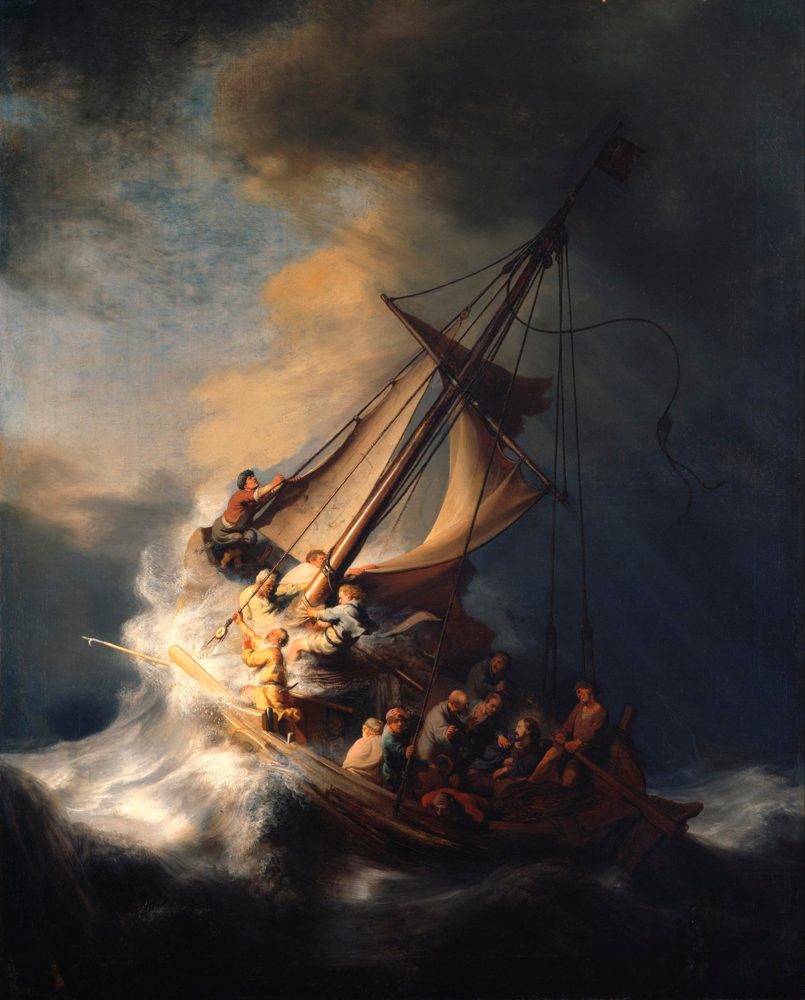
Christ in the Storm on the Sea of Galilee is the most immediately dramatic image in this guide. Rembrandt’s 1633 painting sets a boat at a steep angle against wind, water and a changing sky. The title identifies the biblical subject; the visual experience begins with instability. A viewer can understand the danger before identifying every figure. The great slant of the mast and rigging, the bright collision of water and the clustered bodies make the composition feel as though several forces are acting on it at once. Its power lies in making those forces legible without making the scene feel mechanically simple.
Start with the boat’s diagonal. It provides a strong route through the painting, but other movements challenge it. Rigging stretches in different directions, water strikes the hull, and the figures bend or brace themselves at varied angles. The result is organized turbulence. If everything tilted identically, the image might feel like a diagram of motion. Instead, opposing directions create friction. The eye has to negotiate the scene, much as the depicted figures must respond to different demands. That comparison concerns the picture’s structure; it does not require us to assign a specific emotion to every small face.
How to look and compare
Light gives the danger its strongest emphasis. The illuminated water and sail pull attention toward the most exposed part of the scene, while darker areas contain quieter or less immediately legible activity. Rather than describing every figure in equal detail, the painting makes the viewer move between degrees of visibility. This helps sustain attention after the first dramatic impact. A closer inspection can reveal different responses within the group, but the reproduction cannot settle every identity or gesture. The often-discussed possibility of the artist’s own likeness should be presented as an interpretation, not as a fact required to appreciate the image.
The biblical setting adds another tension: collective alarm and the possibility of calm inhabit the same boat. You can approach that relationship through religious meaning, through dramatic storytelling or through the organization of light and bodies. None of those routes cancels the others. A useful exercise is to trace the brightest areas first, then follow the darker lower grouping. The emotional rhythm changes according to the route. This is why the painting offers more than an illustration of bad weather. Its composition can hold different responses to danger together within a single confined space.
The ranking and its alternatives
Second place is a close decision. The strongest case for putting it first is its combination of immediate impact and sustained complexity. A newcomer can enter through the force of the storm; an experienced viewer can remain with the distribution of gestures, light and competing directions. Vermeer edges ahead under our criteria because his quieter scene makes an equally intricate network feel unusually effortless. That is an editorial preference, not a general law about restraint being superior to drama. If your priority is the transformation of a narrative into physical sensation, Rembrandt has the most persuasive claim to the top position.
The museum records that the thieves cut this painting from its frame. We repeat that documented fact without guessing where it is now or what condition it may be in. The reproduction preserves a view of the composition, but cannot substitute for the original scale, surface or material presence. On a final pass, stop trying to identify everything and notice how quickly your eye is pulled back into the boat. That recurring movement is central to the work’s energy. Does the storm’s greatest force come from the wave itself, the angle of the vessel, or the different ways the people try to inhabit the same danger?
Source: Museum object record · Documented theft facts.
Photo: Rembrandt van Rijn · Public domain / faithful 2D reproduction. Rembrandt: Christ in the Storm on the Sea of Galilee — historical reproduction; not evidence of the original’s present condition. Full source composition retained; resized and recompressed without new crop, colorization or upscaling.

