
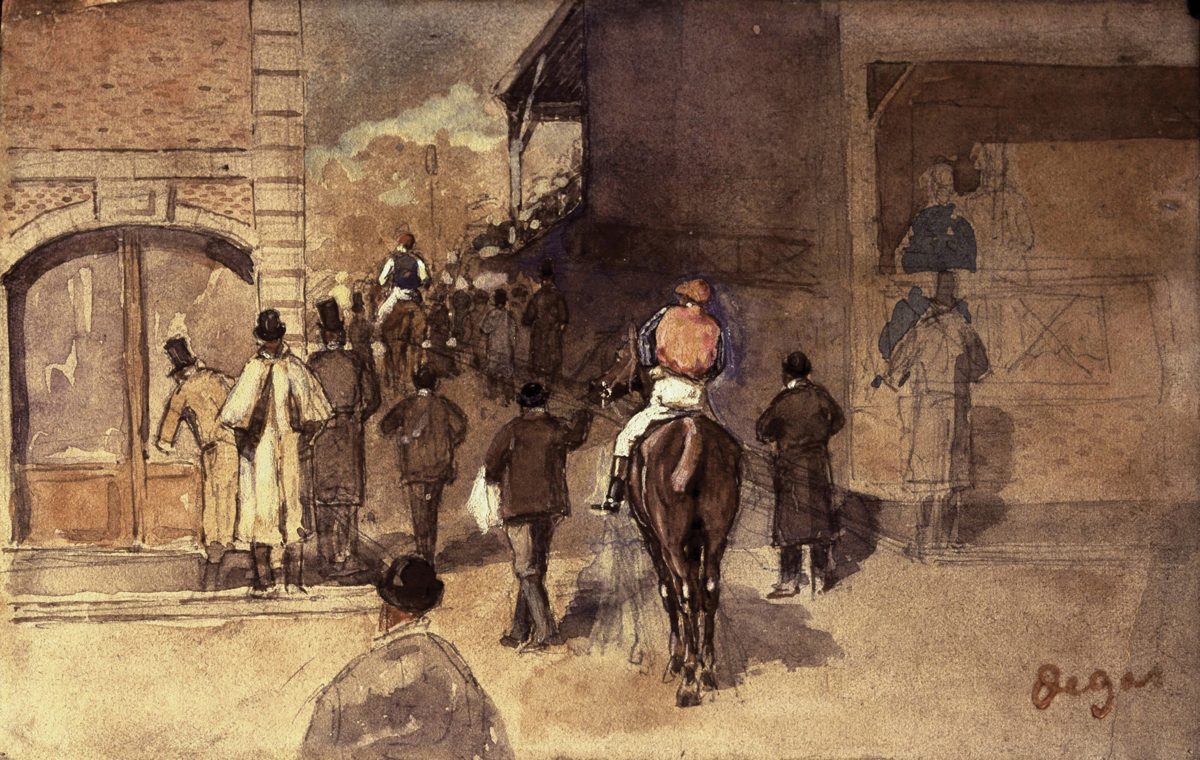
Leaving the Paddock offers a different encounter with horses from the preceding sheet. Instead of separate studies arranged across a working surface, Degas gives us a scene in which riders and other figures occupy a shared setting. The museum identifies the work as a nineteenth-century watercolor and pencil drawing. We retain that broad date rather than assigning an unsupported exact year. In the reproduction, architecture and a passageway help organize the movement of the group. The subject is not simply the speed of a race; it is the transitional activity around horses, people and a place of departure.
Begin with the central mounted figure and then look to either side. The rider does not exist against a neutral background. The surrounding people, the opening in the architecture and the clustered forms beyond create a small network of routes and obstructions. Your eye moves between the individual nearest you and the gathering farther away. That shift makes the image feel inhabited. A scene can suggest a larger event without showing its climax, and a moment before or after the most obvious action can be more revealing than a straightforward depiction of a finish line.
How to look and compare
The architecture contributes more than a recognizable location. Its firm edges contrast with the irregular silhouettes of horses and people. An arch or doorway can collect movement into a smaller space, making a dispersed group appear to converge. Meanwhile, patches of shadow give depth to the setting without requiring every distant figure to become a detailed portrait. The reproduction’s warm tonal field links these elements together. We can appreciate that organization without claiming that the colors on a screen reproduce the original sheet exactly. Material texture and subtle pigment relationships would require direct examination of the missing work.
Try describing the scene without using the word horse. You might notice a figure moving away, a group waiting, an opening that attracts attention and a balance between open ground and dense activity. This exercise reveals how the composition works beyond its familiar subject. Then put the horses back into your description. Their scale and varied orientations make those spatial relationships more specific. They turn an arrangement of patches into a setting where people must coordinate movement. The picture’s energy comes from this combination of formal order and ordinary practical activity, rather than from an easily summarized sporting result.
The ranking and its alternatives
We rank it sixth because it joins the immediacy of a drawing to the coherence of a larger scene. Three Mounted Jockeys may reveal more about isolated pose studies, while Procession near Florence offers a broader landscape rhythm. Leaving the Paddock sits between those possibilities. It gives a viewer a believable place to explore without closing down every detail. Someone who prefers the graphic economy of the programme sheets could reasonably reverse their order. Our ranking favors the density of relationships here, not a rule that more figures or more finished passages always make a better work.
The most productive final question concerns the threshold. What changes as figures move from the darker gathering toward the more open foreground, or as your gaze travels back into that gathering? The answer need not be a hidden narrative. A transition between spaces can be the subject’s main source of interest. This is one reason the missing Degas group deserves attention beyond the shorthand of five drawings. Each sheet organizes movement differently. Here, a place of passage brings people, animals and architecture into a compact conversation. Which part holds your eye longest: the nearest rider, the clustered company, or the route connecting them?
Source: Museum object record.
Photo: Edgar Degas · Public domain / faithful 2D reproduction. Degas: Leaving the Paddock — historical reproduction; not evidence of the original’s present condition. Full source composition retained; resized and recompressed without new crop, colorization or upscaling.

