
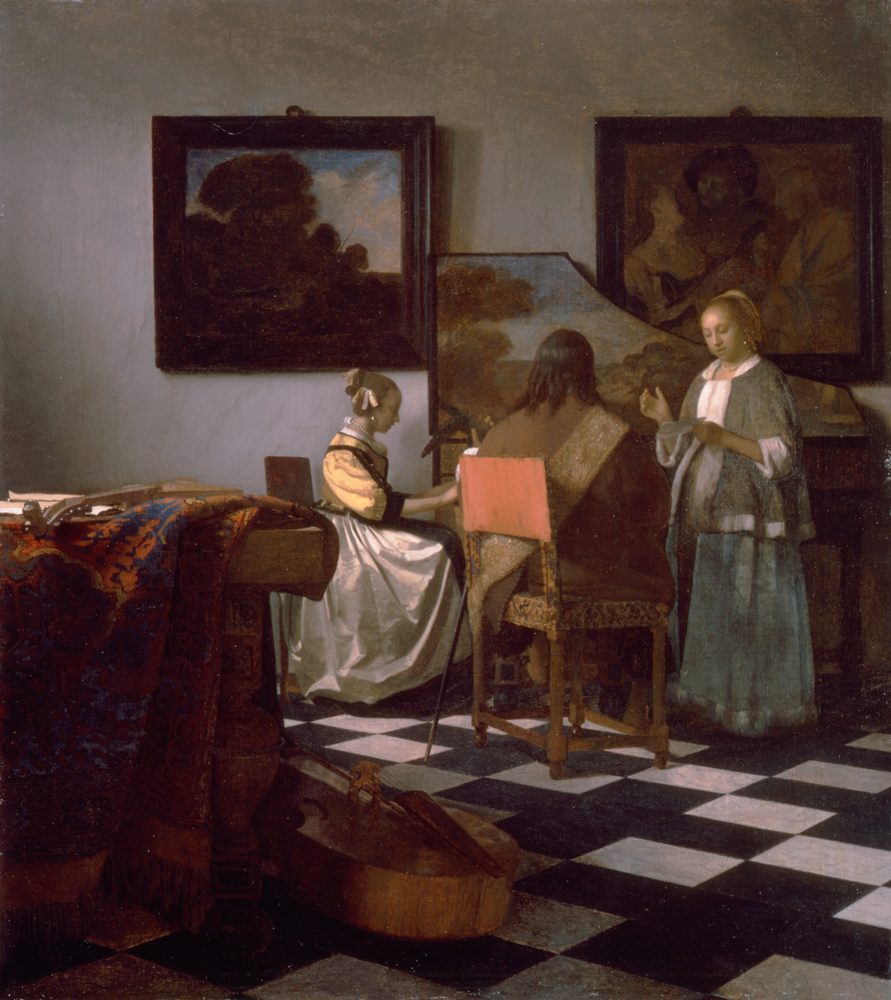
The Gardner theft is often remembered as a crime story with an extraordinary cast of missing names. This guide starts somewhere else: with the pictures. In the early hours of 18 March 1990, thirteen objects were stolen from Boston’s Isabella Stewart Gardner Museum. The museum’s account, checked on 22 October 2026, still describes an unsolved theft. That reference date matters. This is a guide to historical losses and the experience of looking at their reproductions, rather than a report of a new disappearance, recovery or investigative breakthrough. A familiar headline can conceal how different the individual works actually are.
Our ten entries cover all five stolen paintings and all five stolen Degas drawings. The three other stolen objects, a Rembrandt etching, a Chinese bronze vessel and a French eagle finial, fall outside that deliberately narrow scope. Their exclusion does not make them less deserving of return. Nor does the order assign prices, legal priorities or degrees of ownership. We rank the pictures editorially by the richness of sustained looking, the strength of their visual construction and the variety of experiences they contribute to the collection. Those criteria favor an image that rewards repeated attention over an instantly recognizable name alone.
How to look and compare
The countdown moves from two related programme designs toward Vermeer’s The Concert. Along the way, the scale changes from an intimate café encounter to a storm that threatens to overturn an entire boat. A drawing can reveal decisions more openly than a finished painting; an apparent empty area can organize a composition as actively as a face. Look first at the largest divisions between light and dark, then follow the direction of bodies, roads, instruments and glances. Finally ask where your attention stops. That simple sequence makes comparison possible without assuming specialist knowledge or memorizing a chronology of European art.
The images are historical reproductions of the works, not photographs proving their present condition. A scan may flatten the texture of paper, compress shadow or alter the apparent warmth of a painted surface. We therefore distinguish a visible arrangement from an assertion about materials, intention or meaning. The catalogue gives a date or medium; a reader can judge the effect of a diagonal or a gap. Saying that a room feels private is an interpretation. Claiming that its figures represent a documented relationship would require additional evidence. This distinction is especially useful when missing art becomes surrounded by confident online storytelling.
The ranking and its alternatives
Museum object records provide the principal identifications, supplemented by the official stolen-art summary and the museum’s theft account. Some older sources simplify dates or media; we prefer current catalogue wording where available and preserve approximate dates as approximate. Two Degas studies share a title, so this guide distinguishes them by the marked or mostly blank lower-right rectangle visible in the reproductions. It does not invent an order of execution. For the broader criminal-history context, the notorious museum heists guide supplies a different perspective; here the attention stays on what each picture offers a viewer rather than on theories about who took it.
Vermeer takes first place for the unusually close fit between spatial order and human concentration. Rembrandt’s storm has a compelling rival claim if you value dramatic energy above quiet complexity, while the Degas sheets may be your favorites if you enjoy watching an image take shape. Those are credible differences of taste, not errors to be corrected by an auction estimate. Use the countdown as a route through ten distinct kinds of attention, then reconsider its order for yourself. Which loss would most change your understanding of the collection if you could see the original safely returned: the music room, the threatened boat, or one of the less famous drawings?
Source: Museum theft account · Official illustrated stolen-art summary.
Photo: Johannes Vermeer · Public domain / faithful 2D reproduction. Vermeer: The Concert — historical reproduction; not evidence of the original’s present condition. Full source composition retained; resized and recompressed without new crop, colorization or upscaling.

