
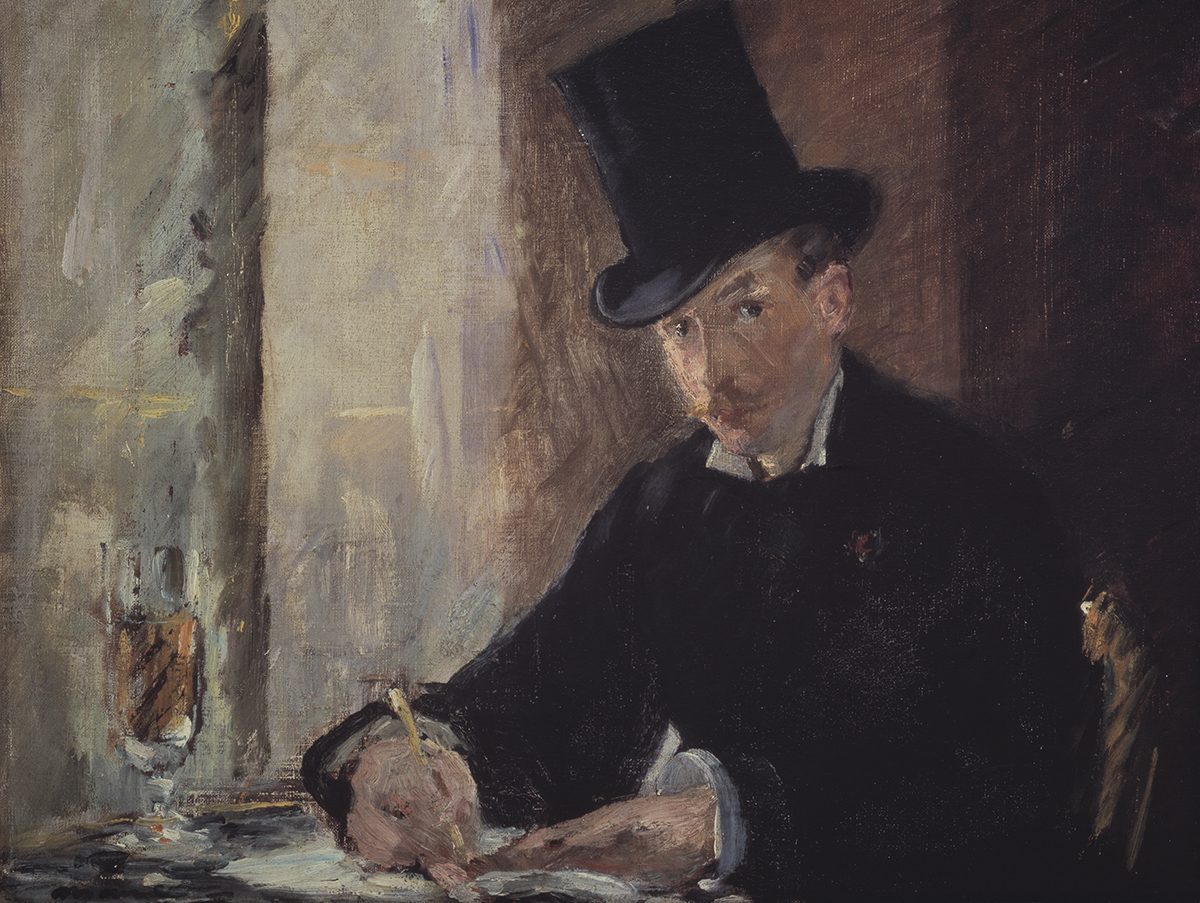
Chez Tortoni makes an intimate interruption feel unusually vivid. Édouard Manet’s small oil painting, dated about 1875 in the Gardner catalogue, shows a man seated at a table with a pencil poised over paper. A top hat and dark coat establish a compact silhouette, while a pale collar and the light falling across the face prevent that silhouette from becoming anonymous. The scene appears simple, yet its attention runs in two directions. The figure has an activity in front of him, but his face also addresses the space of the viewer. That divided concentration is the painting’s central attraction.
Look first at the hands rather than the eyes. They anchor the image in a practical action and keep the encounter from becoming a conventional head-and-shoulders portrait. The pencil supplies a fine directional accent; the paper establishes a small, pale working area within the darker clothing. Then look up to the face. The shift feels like catching someone between continuing a task and acknowledging your presence. We cannot know from the painting alone what is being written or drawn, who the man is with certainty, or what he thinks about being observed. Those uncertainties make the exchange open rather than empty.
How to look and compare
The glass beside him is important because it expands the scene beyond the body. Together with the table and the suggestion of the surrounding interior, it establishes a social setting without requiring a panoramic view of the café. A few ordinary objects can make a place feel specific. The cropped surroundings also make the viewer’s imagined position unusually close. Instead of standing at a respectful distance from a grand portrait, you seem to share the edge of a table. That feeling is an interpretation of the arrangement, not evidence that the picture records a documented encounter between painter and sitter.
The dark hat is worth comparing with the dark garments of the Rembrandt couple later in this list. Both paintings demonstrate that black need not be visually inactive. It can organize a figure, emphasize a face and hold lighter details together. Manet’s compact format makes those relationships particularly direct. To test their effect, reduce the reproduction on your screen. The broad silhouette still reads clearly, even when the details of the hand or glass become harder to see. Then enlarge it again and notice how those smaller elements complicate what initially looked like a simple arrangement.
The ranking and its alternatives
Fifth place reflects the painting’s ability to create a concentrated human encounter with economical means. A reader who values intimacy over spectacle could put it above the larger Dutch paintings. The counterargument is that its tightly cropped scene offers less spatial and narrative variety than the top four. That difference is a matter of experience rather than quality measured in centimeters. The museum records the painting as the only object stolen from the first floor. That historical distinction helps locate it within the theft, but our position in the countdown depends on its visual force, not on an unusual detail of the crime.
For a last look, alternate between treating the man as absorbed in his task and treating him as looking back at you. The image supports a productive tension between those readings. Nothing dramatic has to happen for the encounter to feel alive. A pause can carry as much pictorial interest as a storm or a procession. The missing original would allow viewers to examine the transitions of paint and surface that the reproduction only approximates. Even at this remove, the picture resists becoming merely a famous stolen object. What makes the moment more persuasive for you: the poised pencil, the turn of the face, or the space left outside the frame?
Source: Museum object record.
Photo: Édouard Manet · Public domain / faithful 2D reproduction. Manet: Chez Tortoni — historical reproduction; not evidence of the original’s present condition. Full source composition retained; resized and recompressed without new crop, colorization or upscaling.

