
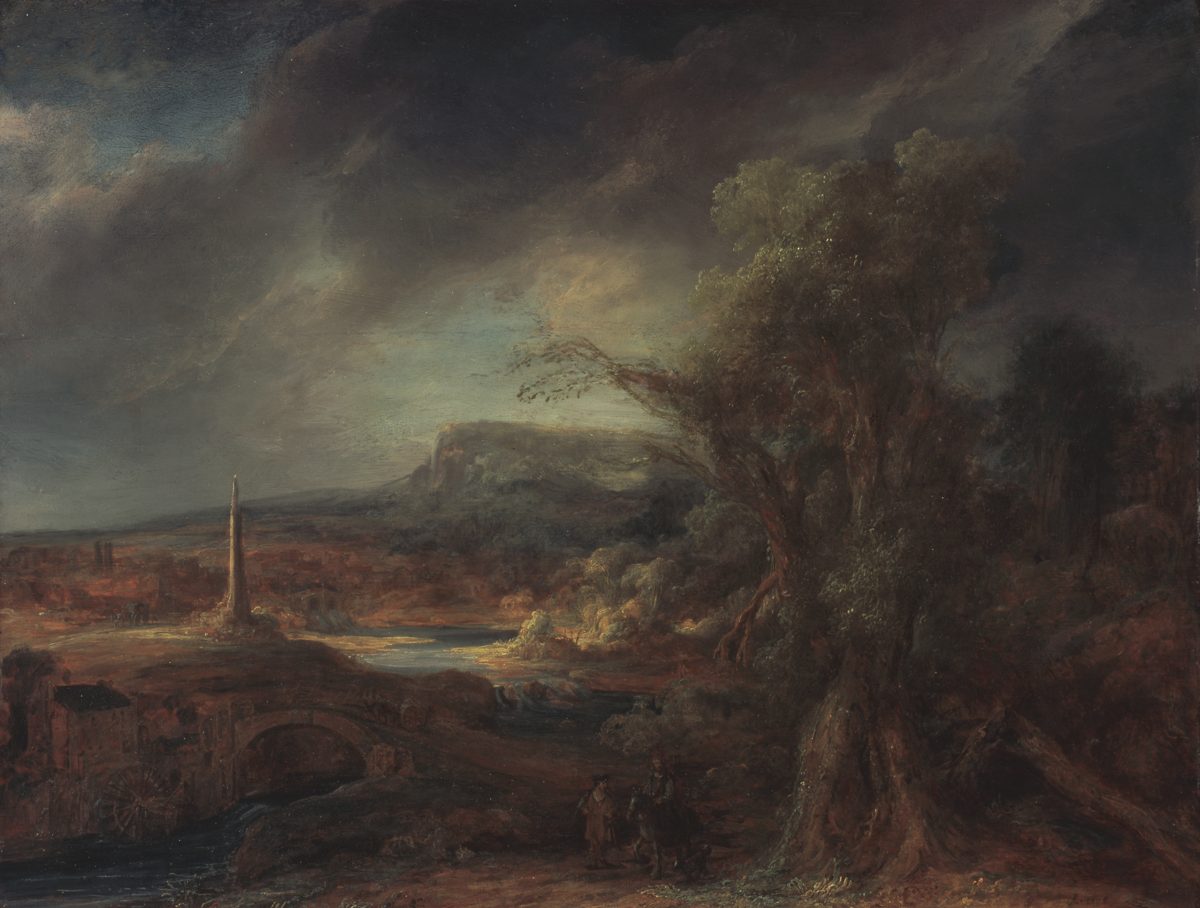
Landscape with an Obelisk asks the viewer to travel before settling on a subject. Govaert Flinck’s 1638 painting spreads a landscape beneath an unsettled sky, with a tree mass on the right and the slender obelisk farther into the scene. The museum attributes the work to Flinck; older association with Rembrandt should not be allowed to obscure that identification. Its place here does not depend on borrowing the prestige of another artist. The painting earns attention through the relationship between near and far, a small vertical landmark and the larger atmospheric field surrounding it.
Begin at the right-hand tree. Its darker mass gives the foreground a substantial anchor and provides a contrast against which the lighter distance can open. Your gaze can then move toward the obelisk, whose relatively thin form remains legible because of its placement within the landscape. It is not necessarily the largest or darkest element, but it has a clear directional identity. This is an effective lesson in emphasis. A subject can become important through difference and position, without needing to dominate every other part of a composition or occupy the center of the image.
How to look and compare
The sky supplies another kind of movement. Its changes in tone do not simply fill an upper strip above the land. They affect the way the lower areas seem illuminated and the mood with which a viewer enters the scene. That mood may feel expectant or unsettled, but we should not turn an atmospheric impression into a documented weather report. Nor should the obelisk automatically become a symbol with a single proven meaning. The visible painting gives us a landmark within a landscape; more specific claims about intention or historical reference require evidence beyond the fact that the object appears there.
Try comparing the obelisk with the tree trunk. Both are vertical forms, but one feels constructed and relatively isolated, the other branching and integrated into a dense mass. Their difference creates a conversation between kinds of structure. Then examine the lower landscape as a set of connected tonal patches. The route your eye follows may change depending on whether you begin with the darker foreground or the brighter distance. A successful landscape can support both readings. It does not have to function like a map, with one mandatory path and a destination that explains everything else.
The ranking and its alternatives
We rank Flinck fourth for the richness of this spatial journey. Readers who prefer a human encounter may place Manet higher; readers drawn to atmosphere and landscape may put Flinck above the Rembrandt portrait. The strongest competing case is that a small landmark in a broad view can be less emotionally immediate than a face or a threatened boat. Yet its relative quiet is also a strength. It encourages sustained looking without demanding an instant narrative response. The work adds a distinct mode of attention to the stolen group, which would be poorer if discussed only through its most recognizable names.
After following the landscape into depth, step back and view it as a flat arrangement again. The dark tree, the changing sky and the obelisk’s fine vertical all contribute to the surface balance as well as the illusion of space. Holding those two experiences together is one of the pleasures of landscape painting. The reproduction can demonstrate that structure while leaving the original surface and precise tonal relationships unavailable. This is why a missing painting cannot be replaced completely by a good digital file. Which aspect seems most essential to this one: the atmosphere, the landmark, or the passage from foreground to distance?
Source: Museum object record.
Photo: Govaert Flinck · Public domain / faithful 2D reproduction. Flinck: Landscape with an Obelisk — historical reproduction; not evidence of the original’s present condition. Full source composition retained; resized and recompressed without new crop, colorization or upscaling.

