
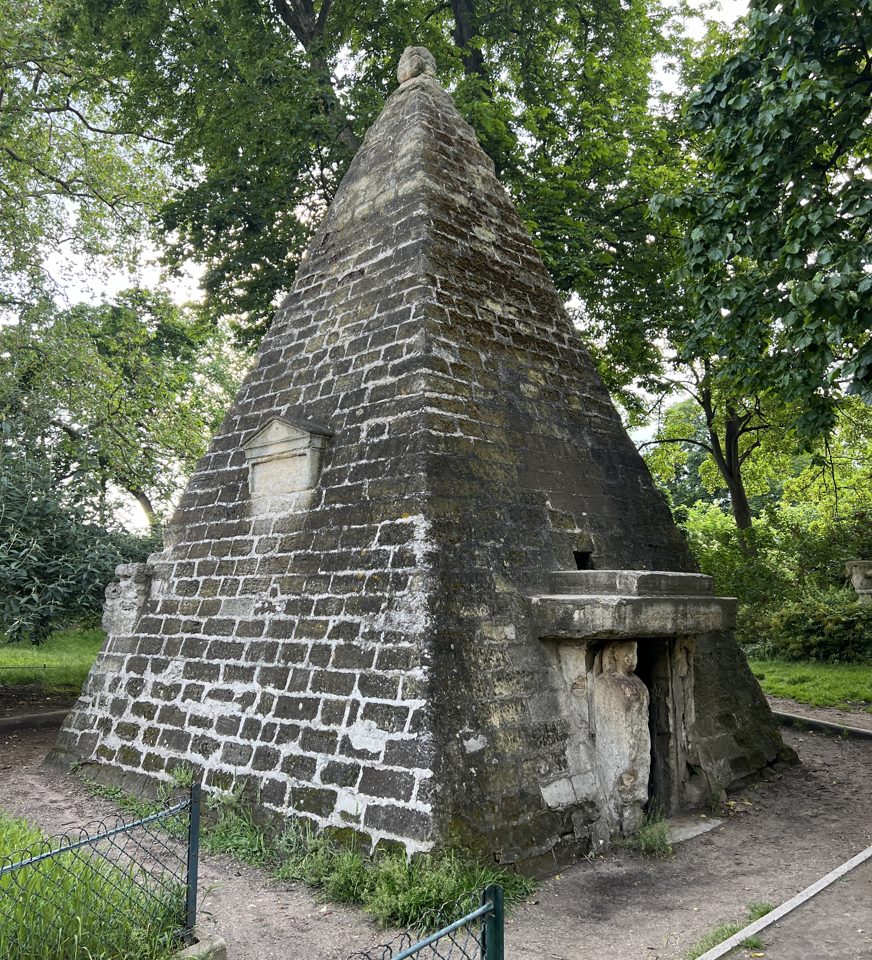
Monceau ranks fourth for a walk that can be read as a sequence of deliberately composed scenes. The City of Paris describes winding paths, notable trees and ornamental structures, including a pyramid that is not an ancient monument. That last distinction matters: a garden can use the appearance of age without every object being a surviving antique. We reward Monceau for encouraging curiosity about how a landscape creates an impression. Its compact visitor purpose makes it a strong alternative to the leading central gardens, provided current access and the intended route fit your day.
A useful way to walk here is to notice when a view appears and disappears. Follow a permitted path, pause at a point that catches the eye and then move on without rushing to explain it. Ask whether the scene depends on a curve, a frame of trees or the contrast between an object and its surroundings. This is a practical observation exercise, not a claim that we have reconstructed the intentions of every designer. It makes a garden interesting even for someone who does not arrive with a detailed history. The sequence of looking is enough to begin.
Ornamental structures also offer an opportunity to practise a useful travel habit: distinguish what you can see from what you know about it. A column, arch or pyramid may suggest an era or place, but appearance is not a date. Use the operator's interpretation when you want the historical explanation. Do not turn a picturesque object into an invented story or repeat a convenient legend because it makes a caption sound better. The walk becomes richer when uncertainty is acknowledged. You can enjoy the visual effect and still be precise about the limits of your knowledge.
Monceau's position also reflects the value of a visit that need not expand into a major expedition. Decide whether you want a simple circuit, a few particular scenes or a place to pause before continuing through the neighbourhood. Leave the exact duration open to the group's pace. If one person is interested in trees and another in ornamental details, agree on a small shared route rather than splitting attention between too many goals. A park does not have to satisfy every interest equally. The purpose of the shortlist is to help make that choice before the walk becomes hurried.
The current-access question is especially concrete here. During our research, the municipal page reported closure for demonstrations on 24 October. That dated notice is not proof that the park remains closed on every later date, and normal hours are not proof that a restriction has ended. Recheck the operator before visiting. The page also distinguishes permitted dog routes from general access, so travellers with animals should read the current details rather than assume that all paths and lawns have the same rule. A photograph of someone using a space is not permission to copy them.
Choose Monceau for the pleasure of noticing how a relatively contained garden stages different impressions. Choose a more open landscape if the main wish is sustained movement with fewer stops, or a botanical garden if plant study is the priority. Fourth place is a strong recommendation under our visitor brief, not a guarantee of availability or quiet. The visit succeeds when the scenes have time to unfold and the practical plan remains flexible. If access is restricted, keep the idea for another day. A good travel recommendation should make changing a plan easier, not encourage completing it regardless of conditions.
Sources: Official reference 1.
Photo: Chabe01 · CC BY-SA 4.0. Parc Monceau · 2024-05-22. Archive illustration, not present weather, foliage, water operation or access. Resized and recompressed without cropping or upscaling; original license retained. No endorsement implied.
