
Robert Englund earns tenth place for Freddy Krueger in Wes Craven’s A Nightmare on Elm Street, released in 1984. This selection concerns that original performance, rather than the accumulated personality of a long-running franchise. Freddy is frightening partly because the film makes sleep unreliable: a familiar daily experience becomes an uncertain boundary. Englund supplies a presence strong enough to make that idea feel personal. Beneath the makeup and recognizable costume, his timing and bodily confidence make the threat seem to enjoy the encounter. He does not need to explain a complete philosophy for the viewer to sense deliberate, predatory attention.
Watch the way he occupies space. Freddy can seem less interested in hurrying toward a victim than in controlling how long the victim has to anticipate him. A slow gesture gives the viewer time to imagine what comes next, while a sudden change of tempo defeats the comfort of prediction. This is a different task from creating naturalistic conversation. The performance belongs inside a nightmare, where exaggeration can express something emotionally convincing even when ordinary physical rules no longer apply. Englund’s contribution is to make that exaggeration feel purposeful, rather than letting the design do all the work by itself.
The performance and its competing case
Voice is another part of that control. Threatening speech can become monotonous if every line arrives at the same intensity. Here, amusement and menace can share a beat, making the listener uncertain whether an apparent joke is a release of tension or its continuation. That ambiguity should not be confused with the more overt comic identity associated with later installments. Our ranking isolates the 1984 film. The useful question is how the original performance makes an encounter unpleasantly intimate, not how many familiar lines viewers can recite from decades of sequels, merchandise, convention appearances or affectionate imitation by fans.
The strong competing case is cultural durability. If a ranking rewards a horror character who can be recognized through movement and voice as well as appearance, Englund could move much higher. Freddy’s identity survives outside the original story, and that recognizability reflects a distinctive performance within a distinctive design. Yet our criteria place emotional complexity and sustained relationships above recognition alone. Several actors higher on this list make us revise our understanding of a person across an entire film. Englund’s assignment is more concentrated: establish a force that destabilizes another person’s experience. Excellence in that assignment does not automatically make it the broadest performance.
What to watch on a return
A fair assessment also leaves room for Craven, the makeup work, sound and the film’s dream imagery. A frightening silhouette is a shared cinematic construction. Try separating the image you remember from what Englund actually changes over the course of an encounter: the angle of a head, a pause, an approach, a vocal inflection. That distinction helps explain the rank without diminishing the result. It also offers a practical viewing method. Rather than counting startling moments, ask how the performer makes anticipation uncomfortable before the film supplies a cut, an effect or a musical signal telling you to react.
Englund sits below Lugosi here because the latter’s formal restraint gives our chosen criteria a slightly richer contrast between social invitation and danger. Viewers who value the invention of a vividly physical nightmare antagonist can reasonably reverse those positions. Neither preference requires pretending that one style is more realistic than the other; realism is not the only route to persuasive horror. This entry is especially useful for noticing the difference between a frightening character design and a performer activating that design over time. Does your strongest memory come from what Freddy looks like, or from the unsettling pace with which Englund lets him behave?
Source: Primary film record 1.
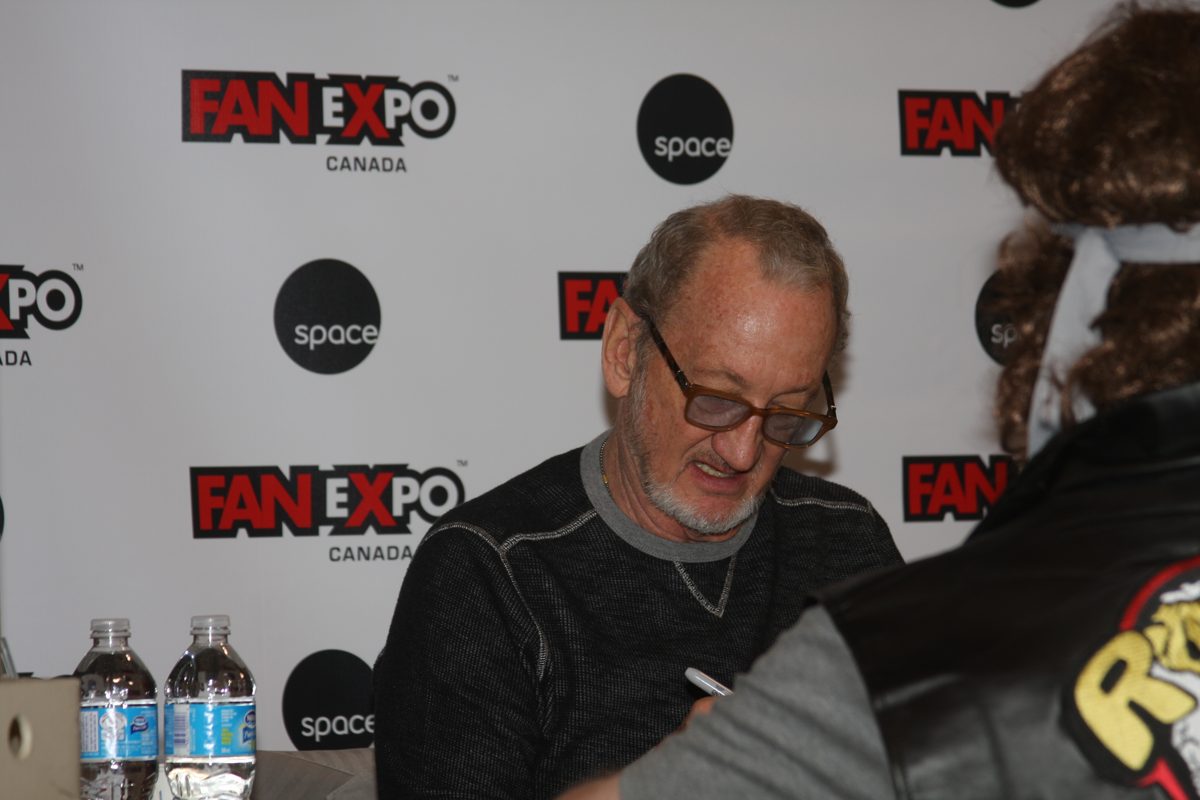
Photo: Derek Hatfield · CC BY 2.0. Robert Englund at Fan Expo Canada, 29 August 2014; historical actor context, not a still from the ranked film. Full source frame retained; resized and recompressed, no new crop, colorization or upscaling.
