
Boris Karloff takes first place as the creature in James Whale’s Frankenstein, released in 1931. Our choice rests on a difficult balance: the figure must be frightening while remaining emotionally legible enough to awaken sympathy. Karloff does not achieve that through a detailed verbal explanation of intention. He works through posture, movement, attention and the uneven discovery of a world that does not welcome him. The performance makes an unfamiliar body feel inhabited. That is why it leads a ranking whose main criteria are emotional specificity, physical and vocal control, and the ability to shape the viewer’s experience of horror from within a film.
Watch the relation between weight and curiosity. A heavy movement can establish the creature’s physical difference, but a small change in attention can suggest a vulnerable attempt to understand what is nearby. Those elements must coexist. If the figure were only imposing, sympathy would depend mostly on the story telling us to feel it. If he were only helpless, the danger would lose force. Karloff makes the tension visible inside the same body. The audience can be concerned about what the creature may do while also recognizing the difficulty of a being whose intentions cannot be easily translated into ordinary social behavior.
The performance and its competing case
The performance is inseparable from Jack Pierce’s makeup and Whale’s direction, and first place does not assign those collaborators’ achievements to Karloff. The design establishes a powerful visual vocabulary; the actor gives that vocabulary duration, variation and response. A photograph can show the shape of a face, but it cannot show how a hesitation changes our understanding of the person beneath it. This is a useful distinction when discussing a performance so often encountered through a familiar image. Our argument depends on behavior across time, not on the assumption that recognizing an iconic appearance proves the greatness of the acting behind it.
The credible counterargument is that Bates or Collette offers more immediate emotional access. Their characters inhabit social situations whose speech and relationships a contemporary viewer may recognize more readily. If that immediacy is your highest priority, Karloff need not be your winner. We put him first because he makes a comparatively restricted expressive vocabulary carry danger, confusion and vulnerability without reducing the creature to a single emotion. The limitation becomes part of the invention. That judgment is editorial and specific to this performance; it is not a declaration that older horror is superior, that practical makeup always outperforms other methods, or that silent physicality automatically beats dialogue.
What to watch on a return
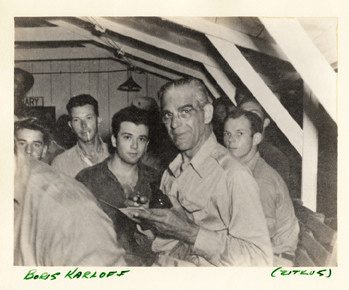
The film’s other performers, framing and editing shape how we judge the creature’s actions. A fair viewing does not isolate sympathy from the situations that provoke it. Instead, follow a short sequence and notice when your attention moves from the creature’s size to his apparent effort to understand another person or object. That movement of attention is central to our first-place case. The accompanying 1945 archival photograph shows Karloff signing autographs after a USO performance, not wearing the Frankenstein makeup. Its modest original resolution is retained without artificial enlargement, and the photograph’s historical setting should not be confused with the 1931 film production.
Karloff finishes above Bates because our balance rewards the creation of an emotionally complex presence through an unfamiliar physical form. Bates remains the strongest alternative for viewers who prize conversational control, while Collette leads the case for exposed family emotion. You can test our result by choosing one small moment from each performance and explaining what changes in your perception during it. That is more informative than declaring an icon untouchable or counting familiar images. Which should matter most in a horror performance: making a threat feel real, making fear feel personal, or making you care about a figure you are also afraid to approach?
Source: Primary film record 1 · Primary film record 2.
Photo: Clell Thorpe; Courtesy of Special Collections, University of Houston Libraries, UH Digital Library · CC BY-SA 2.0. Boris Karloff signing autographs after a USO performance, Kwajalein, 1945; original low resolution retained; historical actor context, not a still from the ranked film. Full source frame retained; resized and recompressed, no new crop, colorization or upscaling.
