
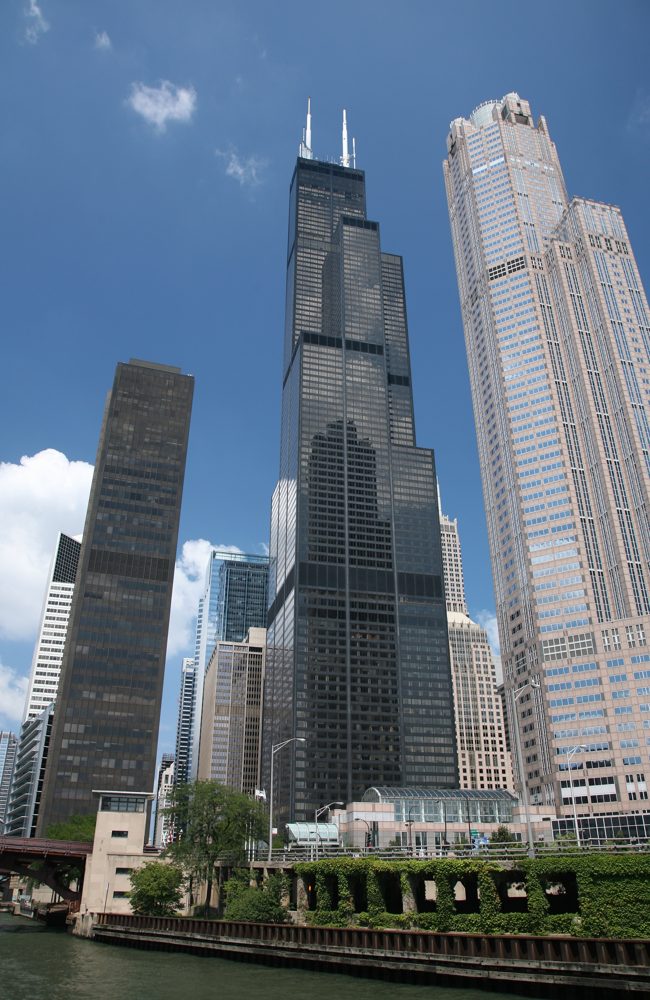
Willis Tower wins this list because its stepped silhouette turns a structural idea into an unusually powerful urban image. The former Sears Tower was designed by Skidmore, Owings & Merrill; the Chicago Architecture Center's project history describes its bundled-tube concept. Rather than treating the building only as a former height record, look at how a group of connected vertical elements terminates at different levels. That is the central observation. The tower gives a first visitor a way to connect an outline visible across the city with a documented explanation of how a very tall building can be organised.
Begin with the mass rather than the antennas. Sketch the broad profile and mark each substantial setback. Then ask whether the tower feels like one object, several objects or both at once. That productive ambiguity is part of its strength. The smaller elements form a larger whole without disappearing completely into a smooth envelope. A skyline photograph can make the idea visible, but changing viewpoints helps you understand why the profile appears different from different directions. You are following the arrangement of volumes, not simply searching for the tallest point in a picture or comparing an unverified figure with another city's landmark.
Connect the concept to the profile
The documented system gives those observations a technical context. Connected tubes act together in the design, and the varying heights are part of the larger architectural and structural arrangement. Keep that explanation at the scale the evidence supports. You do not need to claim that every setback has one isolated purpose or that the building eliminates wind effects altogether. A good introductory account explains the concept without turning it into a miracle. The important connection is between the repeated structural idea and the external form, which allows engineering to contribute to the composition instead of remaining entirely invisible behind it.
The strongest rival is 875 North Michigan Avenue. Its exterior diagonals make a strikingly direct argument that some visitors will find clearer than Willis's grouping of volumes. We choose Willis because the whole building can be read as an arrangement of related parts, with that relationship shaping both its skyline identity and the questions it raises about scale. This is not a claim that one design is objectively more beautiful. It is a reasoned preference under our educational criteria. The comparison is valuable precisely because both buildings are strong enough to support an alternative order without requiring anyone to dispute the underlying facts.
Return from the skyline to the city
Do not let the tower's fame flatten the visit into a photograph of a record-holder. Examine how it meets the surrounding city as well as how it ends against the sky. Present-day entrances, commercial spaces and observation experiences should be checked through current official information, not inferred from older images or this ranking. The building has a history beyond its original commission, and its continuing use belongs to the story too. An exterior study can focus on composition, while a separately arranged interior or elevated visit can answer different questions. One does not automatically substitute for the other.
Willis earns first place for bringing the list's themes together: repetition becomes a system, a system shapes a volume, and a volume becomes an urban landmark. After studying the smaller-scale lessons at Reliance, the Rookery or the Mies towers, you can return to its silhouette with more precise questions. That is the purpose of the ranking. Which would you put first: Willis for its bundled massing, 875 North Michigan for its visible diagonals, or another entry for a richer spatial experience? Explain the feature that changes your decision. The most useful answer is one that makes you look at the buildings more closely, rather than merely defend a famous name.
Source: Chicago Architecture Center.
Photo: Chicago Sears Tower.jpg · Daniel Schwen · CC BY-SA 4.0. Archive photo; resized and recompressed, existing source crop retained where applicable. Image retains source license.
