
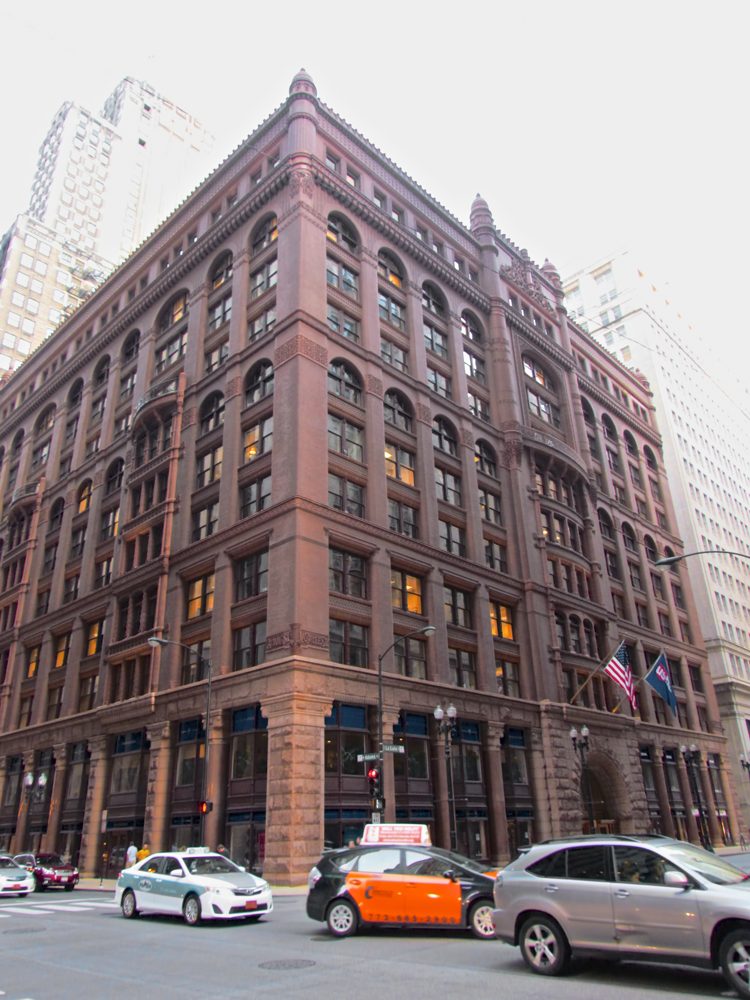
The Rookery ranks fifth for shifting the architectural question from the skyline to the space within. Burnham & Root's office building was completed in 1888, and its light court later received a celebrated redesign by Frank Lloyd Wright. The Chicago Architecture Center's history is particularly helpful for understanding that the interior is layered rather than the work of one unchanged moment. For a visitor, this means the building should be read through both its exterior presence and its internal spatial organisation. The contrast offers a different kind of lesson from a tower whose main public identity can be grasped in silhouette.
Begin outside and notice the relationship between the broad facade and the entrance. Where does the composition direct attention, and how much does the street view reveal about the space beyond? A building can present a substantial outer image while arranging an interior around light. That contrast is more useful than simply praising decoration. It asks how architecture manages a transition between the city and a shared internal place. If current access rules allow you inside, carry that question with you. If they do not, use the documented photographs as a separate study rather than treating a closed door as permission to proceed.
Study the shared interior
The light court provides a way to think about the difference between an opening and a spatial experience. Light does more than make a room bright; it can clarify edges, establish a centre and draw attention upward. Look at the relation among floor, surrounding supports and overhead enclosure in the official imagery or during authorised access. Describe where the eye moves first and what holds it there. This is an interpretive exercise, not a measured daylight-performance assessment. The value lies in noticing how a shared space is organised, rather than reducing the interior to a collection of decorative surfaces photographed separately.
The redesign also makes authorship more interesting. Recognising Wright's contribution should not erase Burnham & Root's building or imply that every part of the interior belongs to the same campaign. Architectural history often involves additions, replacements and reinterpretations. Ask which features you are discussing before assigning a name. That habit prevents the familiar architect from swallowing the entire story. It also prepares you to understand preservation as a series of choices about different layers, rather than a simple attempt to recover one supposedly pure original state. The building is instructive partly because its history resists that easy simplification.
Keep the layers visible
The case for moving the Rookery higher is its spatial richness. A visitor who cares more about interiors than distant profiles could reasonably rank it above either of our leading supertalls. We leave it fifth because this list balances several scales of observation and gives the top positions to buildings whose central lessons remain especially legible across the city. That choice should not be confused with a claim that bigger spaces or taller roofs are intrinsically better. The Rookery demonstrates the opposite: a carefully organised internal experience can contribute more to understanding architecture than another impressive number in a skyline comparison.
Finish by comparing your exterior and interior impressions, keeping actual access separate from what you have studied in photographs. Did the outside prepare you for the court, or did the relationship surprise you? Which detail belongs to the overall spatial order rather than simply making a good close-up? Checking those questions helps turn admiration into understanding. Current visits and tours require their own confirmation, and this ranking does not promise entry. The Rookery belongs in the top half because it broadens the definition of a Chicago landmark: a building can matter not only for the outline it gives the city, but for the shared world it creates inside.
Source: Chicago Architecture Center.
Photo: The Rookery, Chicago, IL.jpg · Marlene Calderon · CC BY-SA 3.0. Archive photo; resized and recompressed, existing source crop retained where applicable. Image retains source license.
