
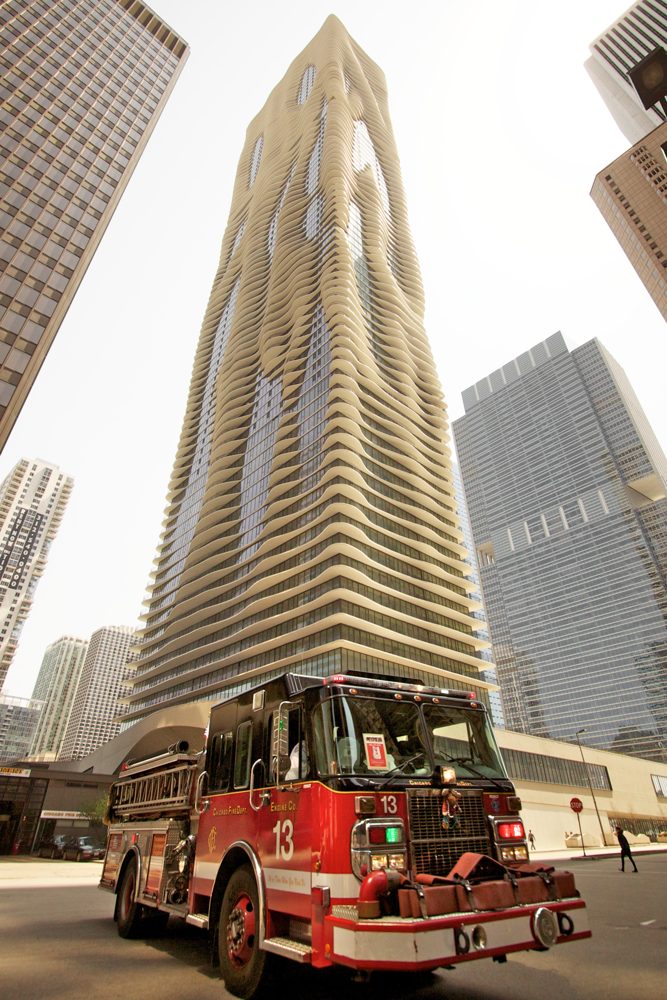
Aqua ranks eighth for showing how a tower's facade can become a field of changing edges. Studio Gang's project is identified by its undulating balconies around a more regular tall-building body. The architect's own account provides the primary reference for the design, while the Chicago Architecture Center explains its place in Lakeshore East. The immediate lesson is visible: a building does not have to change its entire silhouette at every floor to make the surface feel active. Repetition and variation can work together, producing an identity that emerges through many related elements rather than a single ornamental crown.
Begin from a distance where the balcony edges combine into broad patterns. Then move to another public viewpoint and see whether the surface appears more continuous or more fragmented. This is an exercise in perception, not a claim that the tower changes shape. The viewing angle changes which edges overlap and where the glass remains visible. A photograph can freeze one particularly striking arrangement, but a visitor can compare several. That comparison is useful because it shows how architecture is experienced through movement: a facade is not only a flat image, even when most publicity presents it as one.
Follow the individual edges
Look next at the relationship between the dark or reflective openings and the pale projecting slabs. The gaps matter as much as the solid parts. Try describing a small section without using the word wave. You might notice the depth of a shadow, the interval between projections or the way one line seems to continue into another. Replacing a familiar metaphor with precise observation makes the building more interesting. It also prevents a nickname from becoming the whole explanation. An expressive facade can be recognised instantly, but understanding it requires attention to the individual pieces that create the overall effect.
Aqua offers a useful comparison with Marina City. Both make balconies prominent, but their visual systems are different. At Marina City, repeated rounded units help define the towers' overall form; at Aqua, variation along the edges generates a changing surface. That contrast does not require a claim that one arrangement is universally better for residents. It simply gives the observer two ways of organising outdoor space within a tall-building image. Ask which elements repeat exactly, which appear to vary, and how those choices affect the relationship between the individual dwelling and the public appearance of the whole tower.
What the comparison teaches
The strongest argument for a higher rank is Aqua's ability to make a contemporary building approachable through direct looking. It gives visitors something specific to follow without first learning a catalogue of historical styles. We leave it eighth because the higher entries cover a wider range of structural and urban questions in this particular sequence. That does not turn the ranking into a preference for older buildings. Aqua is included precisely to keep the city's architectural story open-ended. Newer work can respond to familiar tall-building problems through a language that is neither a historic crown nor a completely uniform glass surface.
Finish by distinguishing the publicly visible design from private residential experience. A balcony may invite you to imagine life outdoors, but the article does not provide access to it or evaluate individual apartments. Observe from suitable public areas, then use the architect's project page to understand the design claims more fully. The useful takeaway is a method: trace one edge, compare it with the next, then step back to see how many such decisions become a facade. Aqua makes that relationship between small variation and large identity unusually clear, earning a place among the city's most instructive buildings to study.
Source: Chicago Architecture Center · Studio Gang.
Photo: Chicago Aqua 2.jpg · Marcin Wichary from San Francisco, U.S.A. · CC BY 2.0. Archive photo; resized and recompressed, existing source crop retained where applicable. Image retains source license.
