
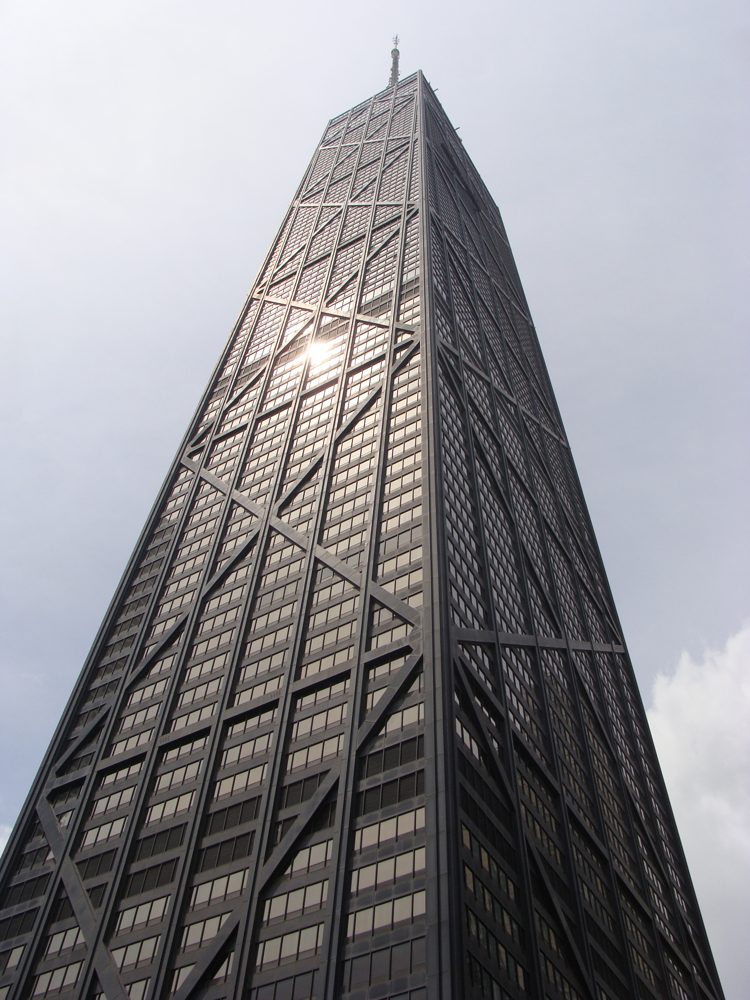
875 North Michigan Avenue, still widely recognised as the former John Hancock Center, takes second for making structural expression part of everyday skyline recognition. The Chicago Architecture Center associates the tower with Bruce Graham and Fazlur Khan at Skidmore, Owings & Merrill and highlights its large exterior X-shaped bracing. For a visitor, the key lesson is immediate: the diagonal pattern is not a small decorative flourish added to an otherwise anonymous surface. It helps establish the building's identity at a scale far larger than an individual window. This gives the tower one of the clearest central ideas in the entire countdown.
Begin far enough away to see several diagonals together. Then compare that broad pattern with the much finer grid of windows. Two scales of organisation occupy the same facade, and the contrast makes both easier to notice. The building therefore offers an approachable introduction to the difference between ordinary floor repetition and a system that works across multiple levels. You do not need to calculate forces to see the hierarchy. The useful question is how the large pattern changes the way the tower is read, and how much of that identity would disappear if you imagined the diagonals removed.
Read the overall outline
Move next to the overall outline. Observe how the body narrows as it rises and how the upper profile differs from a simple rectangular extrusion. Connect that visual observation with the documented structural story, without pretending that every visible shape has only one cause. Architecture combines programme, engineering and composition. A public view can make those relationships interesting, but it cannot establish an exact account of each design decision by itself. The official source supplies context, while your own observation explains why the result is so legible among neighbouring towers, even when you cannot inspect the building closely.
The comparison with Willis Tower is the central contest of the list. Here, a large diagonal pattern gives the facade a remarkably direct identity. At Willis, the stepped grouping of volumes makes the overall mass the most obvious lesson. A visitor might prefer the clarity of a visible pattern to the complexity of a bundled silhouette. That is the strongest argument for reversing our first two positions. It is a genuine architectural disagreement, not a question of who memorised a height figure correctly. Both buildings allow structural ideas to become part of the public image, but they make those ideas readable in different ways.
A credible rival for first place
We keep 875 North Michigan second because Willis provides the fuller combination of massing, skyline reach and a documented structural concept expressed through different-height elements. The margin is editorial, not measured. Readers interested in a single facade's visual force could easily favour this tower. Current observation-deck visits, interior access and guided tours are separate products with their own conditions; none is promised by the ranking. The architectural case stands even if the visit remains outside. That is useful for a first exploration, because it prevents the learning value of a building from depending entirely on purchasing an elevated viewpoint.
Finish by drawing the large diagonals over a simplified outline and then marking the smaller floor rhythm. Explain which pattern you noticed first and why. Repeat the exercise after looking at a different side or a photograph from another angle. The strongest buildings often support more than one reading without losing their identity. This tower earns second because it makes a demanding technical subject visually approachable while remaining a powerful composition. It prepares you for the winner by asking the right final question: when a building's engineering contributes to its appearance, which part of that relationship is most clearly communicated to the city around it?
Source: Chicago Architecture Center.
Photo: John Hancock Center June 6 08 sunlight.jpg · Golbez · CC BY-SA 3.0. Archive photo; resized and recompressed, existing source crop retained where applicable. Image retains source license.
