
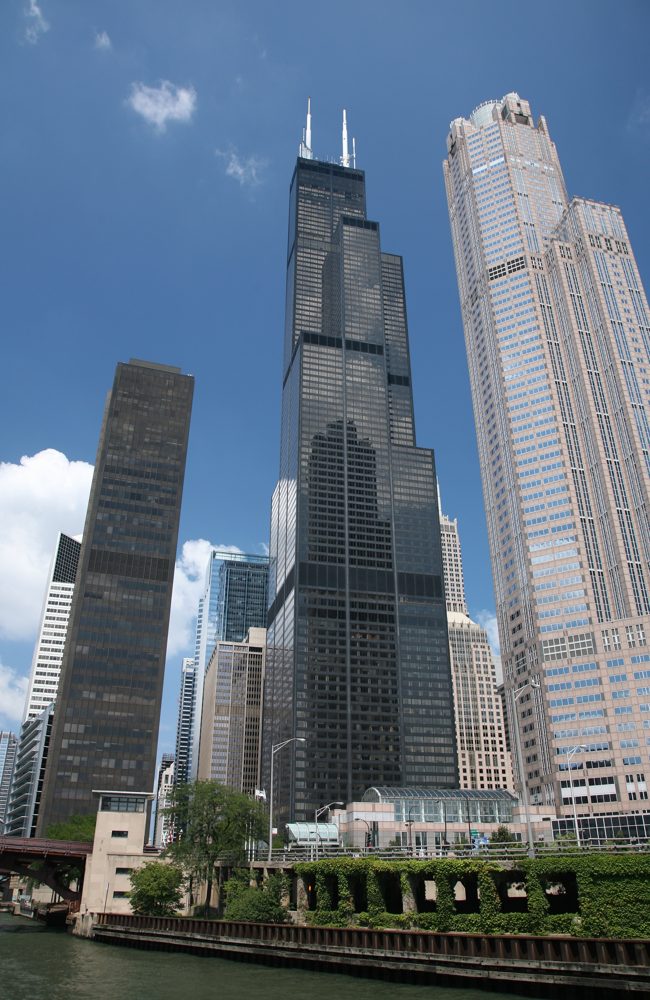
Chicago rewards looking at buildings as arguments rather than objects on a height chart. One facade makes masonry feel powerful, another turns glass into a repeating rhythm, and another lets a structural system shape an entire skyline silhouette. This guide ranks ten buildings and building complexes for a first serious encounter with those ideas. It is written for curious visitors who want something more useful than collecting famous names. You can begin with what is visible from public streets, compare photographs and official histories, and then decide which interiors or observation experiences deserve a separate booking.
The ranking is editorial, reviewed on 17 October 2026. We give priority to buildings that make an architectural idea unusually clear, offer a strong comparison with other entries and reward attention at more than one scale. Willis Tower wins for connecting skyline form with structural thinking; 875 North Michigan Avenue is its strongest rival because its bracing is so immediately legible. This is not a ranking by height, property value, ticket price or a quantified measure of beauty. A lower position means a different balance of teaching value and scope, not that a building is unimportant or unsuccessful.
What the ranking prioritises
The selection covers an accessible downtown conversation, including the Loop, river area, Lakeshore East and Near North Side. It is not a claim to represent every neighbourhood or every tradition in Chicago architecture. Houses, industrial buildings, religious architecture and many important civic projects could support separate lists. Treat the ten entries as a framework for learning to observe, not a complete inventory of the city's achievements. The count also includes complexes, such as the paired residential towers at 860–880 Lake Shore Drive, where the relationship between buildings is part of the architectural lesson.
The timing has a specific context. The Chicago Architecture Center lists Open House Chicago for 17–18 October 2026, and current US Google Trends results show rising queries about the event. That makes architectural exploration timely, but this article is not the festival's official site roster. Inclusion here does not promise admission, a tour, a roof visit or access to a private lobby. Check the organiser's current programme and the individual property's instructions before planning an interior visit. A valuable exterior study remains possible even when the particular space that appears in a photograph is not publicly accessible.
A method for looking
For each stop, use three distances. First, identify the broad silhouette and its relationship to neighbouring buildings. Next, examine the facade: where do openings repeat, where do lines change direction, and what makes the base different from the top? Finally, look for a detail that tests your first impression. A heavy-looking building may contain a more complicated structural story, while a smooth glass volume may depend on carefully proportioned components. Record what you can actually see before reading an explanation, then use the source to distinguish a visual observation from a claim about construction or historical intention.
Plan the outing around current weather, opening information and your own pace rather than the order of the countdown. These are working buildings and residential settings, so observation should fit normal public access and avoid blocking entrances. The archive photographs identify the subjects; they do not establish today's conditions. Our guide to architectural features can help with terms encountered along the way, while this article shows how to use comparisons in one city. The best result is not ten identical photographs. It is leaving with ten different questions you can carry to the next building you encounter.
Source: Chicago Architecture Center · Chicago Architecture Center.
Photo: Chicago Sears Tower.jpg · Daniel Schwen · CC BY-SA 4.0. Archive photo; resized and recompressed, existing source crop retained where applicable. Image retains source license.
