
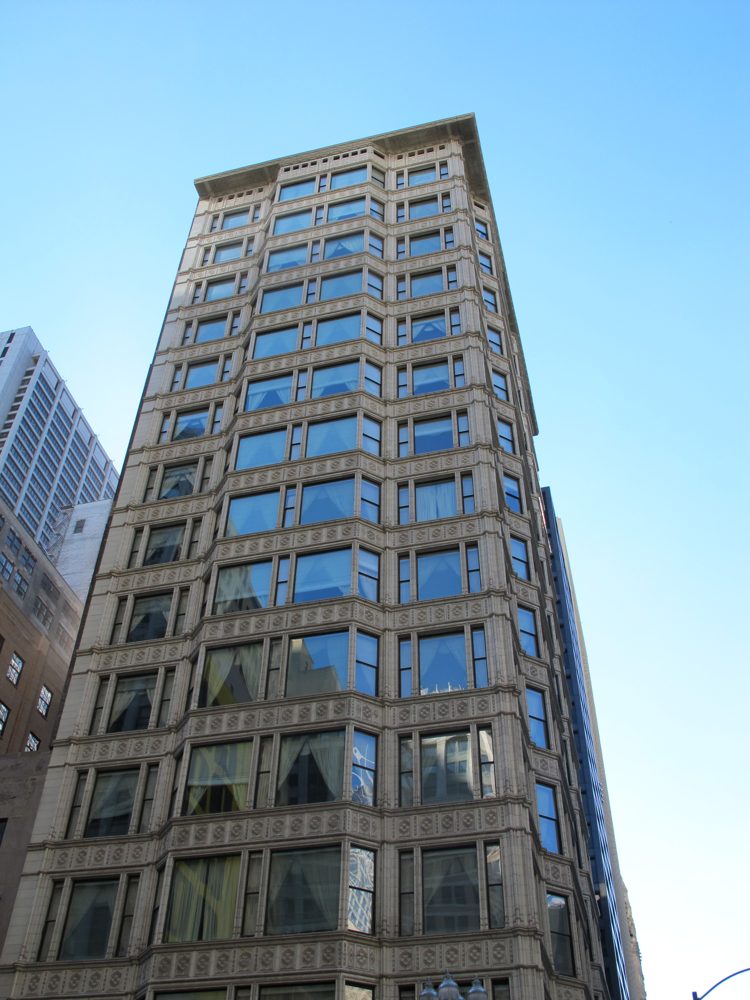
The Reliance Building ranks sixth because it makes lightness a historical question rather than a synonym for newness. Opened in 1895, the building combines broad areas of glass with white glazed terra cotta; the Chicago Architecture Center explains the design's development through Burnham's office and Charles Atwood. For a first visitor, the most useful starting point is the proportion of window to surrounding surface. The building can challenge an expectation that late nineteenth-century commercial architecture must appear uniformly heavy. It also creates a strong comparison with Monadnock, letting two nearby historical examples reveal very different architectural effects.
Begin by tracing a vertical line of windows and then a horizontal floor division. Which seems more visually important? The answer may change with distance and light. From across the street, the glazing can read as a continuous field; closer views reveal how the smaller components organise it. This is a useful exercise because it connects the broad impression of lightness to actual visible relationships. Avoid turning that impression into an unsupported engineering claim. A facade can look delicate while relying on a substantial structure, and a visitor's task is to understand the composition before assigning hidden technical properties to it.
Lightness, detail and reuse
The pale material also invites a more careful reading of ornament. White terra cotta is not simply blank space around windows. Look for how it marks boundaries, frames openings or supplies detail at a scale different from the overall grid. A building can combine decorative richness with an expansive glazed surface, which complicates the idea that glass and ornament belong to opposite architectural camps. Compare this with Wrigley's larger urban image. Both use a pale facade, but the balance of surface, opening and skyline emphasis produces different results. Shared material alone does not make two buildings communicate in the same way.
Reliance is also a useful place to discuss continued use. The official history records restoration and conversion from offices to a hotel. That does not mean every visible element is untouched from the original opening, nor that change automatically destroys historical value. Instead, ask what allows a building to remain recognisable while serving a different programme. The question moves architectural history beyond a frozen photograph. A preserved building must exist in the present city, with practical needs as well as symbolic importance. Current hotel or interior arrangements should be checked directly rather than inferred from a historic description or an archive image.
A historical building in the present
A strong argument for ranking Reliance higher is that it offers several lessons at once: daylight, facade proportions, material detail and adaptive reuse. We place it sixth because the next entries expand more explicitly into interior space, urban living or structural expression. The order is not a chronological ladder in which later always means better. Reliance can look surprisingly fresh precisely because the comparison exposes how many architectural ideas overlap across periods. Visitors who arrived expecting a simple sequence from heavy old buildings to light new ones may find this stop one of the most important corrections in the entire list.
Finish with a small comparison drawing or a pair of carefully chosen photographs, one of the overall facade and one of a window area. Explain how the detail supports or complicates the larger image. If you can describe the building only as old or elegant, look again for a more precise observation about width, depth, repetition or contrast. Those words help you transfer the lesson elsewhere. Reliance earns its place because it turns a historic facade into an active exercise in looking, while its documented reuse reminds us that architectural significance includes the ability to continue participating in the life of a changing city.
Source: Chicago Architecture Center.
Photo: Reliance-Building-Chicago-September-2014.jpg · Acediscovery · CC BY 4.0. Archive photo; resized and recompressed, existing source crop retained where applicable. Image retains source license.
