
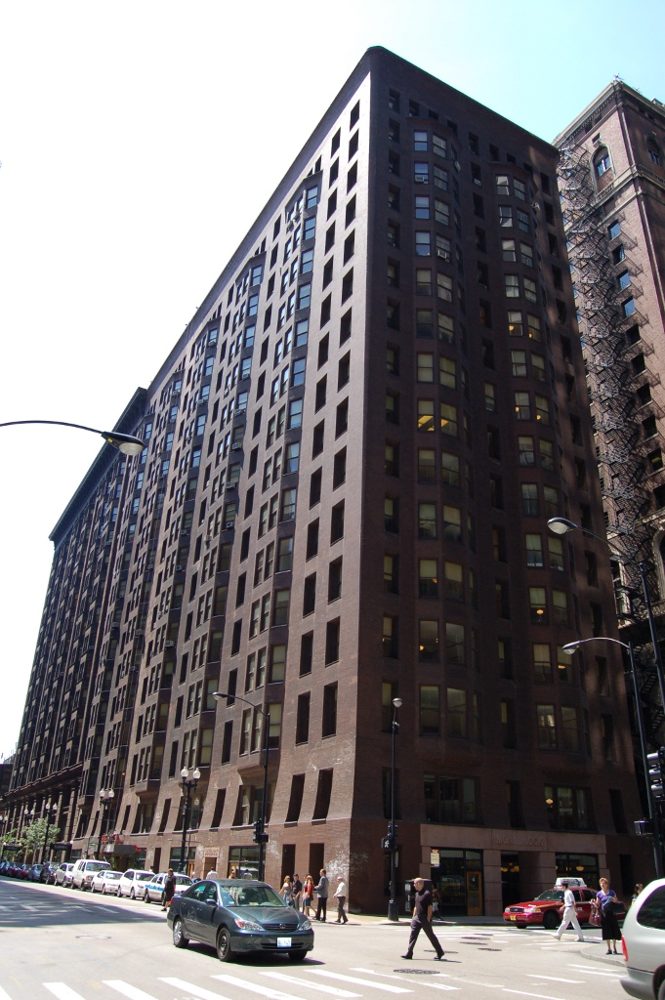
Monadnock takes seventh because it complicates an easy story about the birth of the skyscraper. The Chicago Architecture Center describes its two phases, completed in 1891 and 1893, by Burnham & Root and Holabird & Roche. Their different approaches make one building an opportunity to compare construction and appearance rather than assume that an entire era used one method. The key visitor lesson is caution: what looks plain may contain a complicated technical history, and what looks decorated may belong to a different structural arrangement. This is a particularly useful stop before the glass-dominated examples later in the countdown.
Start with the impression of weight. Look at the base, the depth around openings and the broad relationship between wall and window. Describe what makes the north portion feel substantial without immediately concluding that every visible surface performs the same structural job. Historical construction can combine methods, and the source explains why this building should not be reduced to a slogan about the last brick skyscraper. A good observation begins with appearance but remains willing to be corrected by evidence. The distinction between what you see and what the building actually does is central to learning architectural history responsibly.
Compare the two phases
Compare the two phases as a deliberate exercise. Ask how ornament, window treatment and the expression of the top alter your reading. Try making two short lists of visible features, then identify which differences matter most to your overall impression. The purpose is not to diagnose hidden construction from the pavement. It is to connect a documented historical distinction with details you can inspect. This method works elsewhere too: when a building was extended, altered or completed by another team, the changes can become clues to a more layered history than the single name on a map suggests.
Monadnock also helps separate simplicity from absence of design. A restrained facade still requires decisions about proportion, corners, repetition and the transition to the roof. If the surface does not offer many decorative objects to catalogue, those relationships become more noticeable. Compare that experience with Tribune Tower, where a strong crown and detailed stonework provide different points of attention. Neither response needs to become a universal rule about good architecture. The contrast is valuable because it gives visitors a way to explain a preference in specific terms rather than assume that an unadorned building has less to say.
Evidence before assumptions
Its case for a higher position is historical depth. Few stops on this list make a change in building practice so convenient to discuss within one named complex. We leave it seventh because its most important lesson benefits from prior explanation, whereas the top entries communicate more of their central idea through the skyline itself. That is a judgment about a first visitor's learning sequence, not a claim that visibility is the only kind of value. A reader interested primarily in early commercial architecture could reasonably put Monadnock at the top and build a very different tour around it.
End with a question about evidence. Which parts of your first impression survived reading the source, and which needed revision? Perhaps the building looked more uniform before you noticed the phases, or perhaps the plainness initially concealed how carefully its proportions work. That change in understanding is a successful outcome, not a failure to recognise the right style immediately. Check current access arrangements before expecting an interior visit. The exterior comparison already supports the main point: architectural development is often a negotiation among materials, techniques and appearance, and one building can preserve several stages of that negotiation at the same time.
Source: Chicago Architecture Center.
Photo: Monadnock Building1.JPG · Micael Camozzi · Public domain. Archive photo; resized and recompressed, existing source crop retained where applicable. Image retains source license.

