
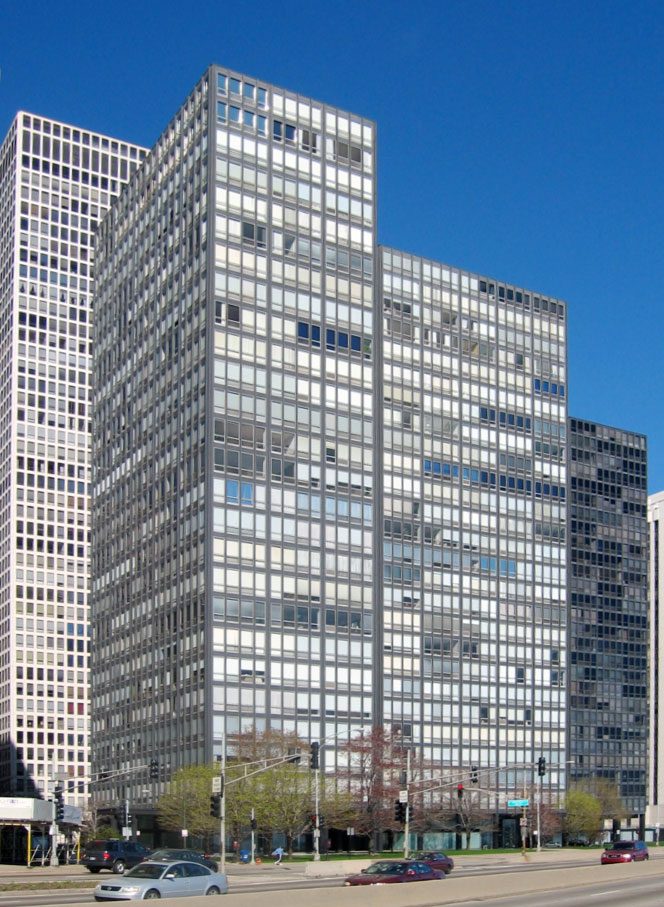
The paired buildings at 860–880 North Lake Shore Drive rank third because they show how much architectural character can emerge from a disciplined set of repeated elements. Designed by Ludwig Mies van der Rohe and completed in 1951, the residential towers are documented by the Chicago Architecture Center as a major modernist example. Their importance does not depend on being the tallest objects nearby. For a first visitor, that is precisely the lesson: proportion, spacing and the relationship between buildings can command attention without a dramatic crown or a highly varied silhouette. This entry is about learning to see order as an active design choice.
Begin by tracing the facade grid. Notice the difference between a single window unit, a vertical run of openings and the building as a whole. A repeated system can seem obvious until you try to explain why one arrangement feels balanced and another might not. Use the visible lines as a starting point, then step back and ask how the same pattern contributes to the overall volume. Avoid assuming that every line you see is a direct diagram of the load path. Architectural expression and structural explanation are related, but careful observation should not turn a facade photograph into an engineering report.
Study the shared setting
The towers' placement adds a second lesson. Their relationship on the site means the spaces around them deserve attention alongside the glazed surfaces. Consider the views between the buildings and how the lower level mediates the meeting with the ground. A good study does not need to enter private residential space. Public viewpoints can reveal the importance of a shared setting, while official images can help with areas you cannot inspect directly. The point is to read a complex as more than two separate objects, even when a map gives the addresses as a simple pair of numbers.
Compare them with Marina City. Both are residential ensembles, yet one emphasises a rectilinear grid and the other a repeated curved vocabulary. Instead of declaring one warm and the other cold as if those were facts, identify the specific features producing your response. Is it the spacing, the outline, the contrast with the sky or the way individual units become visible? This makes criticism more useful. It leaves room for preference while requiring that the preference be attached to something observable. A building can be restrained without being empty of decisions, and expressive without abandoning order.
The case for a higher rank
A strong argument for putting this pair first is influence expressed through clarity. The towers make an economical visual language feel complete, and their lower relative height can help visitors concentrate on composition rather than records. We place them third because the top two add a particularly direct relationship between structural thinking and the skyline at a much larger scale. That is not an assertion that supertall buildings are automatically superior. It reflects the range of lessons this countdown aims to cover, with the Mies pair providing the clearest pause to study repetition, proportion and the space between buildings before the final engineering comparisons.
Finish with a deliberately simple sketch: two volumes, their main divisions and the space they define together. Leave out small details initially, then add only those that change your understanding. The exercise can reveal how much of the composition survives without ornament or a dramatic top. Check present access rules if planning anything beyond public exterior observation. The paired towers earn third place because they reward a slower kind of attention. They teach that architecture is not only the exceptional feature that catches the eye first, but also the carefully sustained system that continues to make sense after that first impression has passed.
Source: Chicago Architecture Center.
Photo: 860-880 Lake Shore Drive.jpg · User:JeremyA · CC BY-SA 2.5. Archive photo; resized and recompressed, existing source crop retained where applicable. Image retains source license.
