
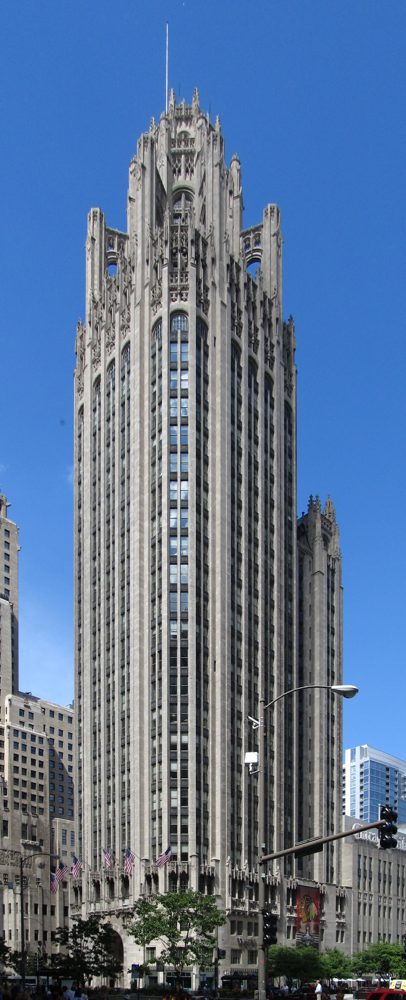
Tribune Tower ranks ninth because it makes the question of architectural identity unusually visible. Howells & Hood's design emerged from the Chicago Tribune's 1922 competition and was completed in 1925. The Chicago Architecture Center identifies its Gothic Revival character and the historic references of its crown. A visitor does not need to know the competition's full history to see the central tension: a modern commercial tower can borrow an older monumental language. The building therefore offers a useful alternative to the assumption that architectural progress must always look like a clean break with the past.
Start by separating the lower body from the top. The repeated openings belong to the everyday task of enclosing occupied floors, while the crown gives the building a more ceremonial identity. Ask whether the top seems to grow from the lower composition or to transform its character. There is no need to declare one answer correct before observing the transition. A side-by-side sketch of the outline and the window pattern can help. It reveals that a tower can communicate through two related systems: the practical order of stacked space and the symbolic emphasis of a distinctive ending.
A competition and a choice
The competition adds a second way to look. Instead of treating the existing building as inevitable, imagine that the same site could have received a very different architectural argument. Competitions expose the distance between a brief and a built outcome. They remind us that a client's public image, commercial requirements and aesthetic preferences are all involved in design choices. This does not mean guessing why every juror voted as they did. It means understanding that the visible tower was one selected answer to a question, not the only form a newspaper headquarters could possibly have taken.
At closer range, examine the relation between carved detail and the larger vertical composition. Do small elements reinforce the upward movement, or do they invite the eye to pause? Both effects can coexist. It is useful to compare this experience with the much quieter surface at Monadnock. That contrast tests an easy misconception: a building with less ornament is not automatically simpler in historical meaning, and one with more ornament is not automatically less technically ambitious. Keep your visual description separate from a verdict about modernity. Detail is one of the instruments through which a building establishes its presence.
Compare two historical images
Tribune's case for moving higher is strongest if architecture is understood as public communication. It turns the headquarters idea into something that can be recognised at skyline distance. Our ninth-place position reflects the list's preference for a broader sequence of lessons, especially those about structure, light and the relationship between towers. The building is not demoted for using an older language. Rather, we use it early to show that multiple architectural attitudes existed alongside one another. That makes the later modernist entries more interesting: they become different choices within a conversation, rather than the inevitable winners of a simple historical race.
End the stop with a comparison across Michigan Avenue to Wrigley. Both can be read through memory and recognisability, yet the materials, crowns and emotional tone are different. Decide which features establish that distinction without relying only on the words Gothic or revival. If interior access is available under current rules, treat it as an additional investigation rather than something promised by this ranking. The exterior already provides a strong lesson: buildings can package commercial activity in a story about authority, tradition or identity, and the most revealing observation is often where ordinary floors meet an extraordinary architectural image.
Source: Chicago Architecture Center.
Photo: Tribune Tower, Chicago, Illinois (9181667444) (cropped).jpg · Ken Lund from Reno, Nevada, USA · CC BY-SA 2.0. Archive photo; resized and recompressed, existing source crop retained where applicable. Image retains source license.
