
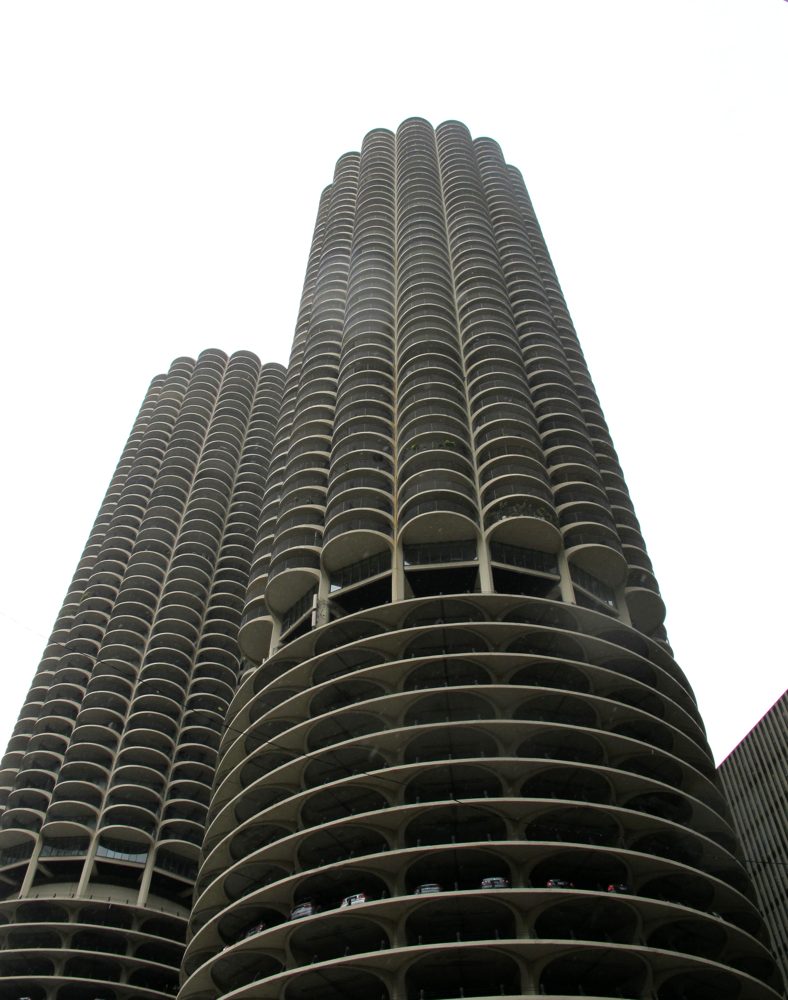
Marina City takes fourth because its paired rounded towers make urban living itself part of the architectural discussion. Bertrand Goldberg's complex is documented by the Chicago Architecture Center as a mixed-use project intended to bring people back toward downtown life. That programme is important, but the first lesson is visible in the repeated curved forms and the relationship between the towers. Instead of treating the complex as an amusing nickname or a recognisable album-cover image, this guide asks what its geometry lets you notice about the organisation of a tall residential environment and the idea of combining activities in one urban setting.
Begin with the repeated units. From a distance, their edges help produce a strong overall silhouette; closer public views reveal the rhythm of individual balconies and the different treatment of the lower portions. Ask what repeats and what changes as you move upward. This exercise separates a distinctive whole from the smaller pieces that build it. It also discourages the idea that an unusual outline must result from an arbitrary sculptural gesture. You can observe an ordering system without claiming to know every aspect of the apartments or the engineering hidden behind what is visible from the river area.
Read the pair, not only one tower
The pair matters as much as either tower alone. Consider the space between them and the way their similar forms create both repetition and separation. A photograph that isolates one tower can be useful for detail, but it misses part of the urban composition. Compare the pair with 860–880 Lake Shore Drive later in the list. Both make a relationship between residential towers central to their public identity, yet the shapes and rhythms are very different. That comparison helps move the discussion beyond a contest between curves and straight lines toward the organisation of multiple buildings on a shared site.
Mixed use is another important question, but it should be handled carefully. Knowing that a project combined different activities does not prove that every original use remains unchanged today or that the arrangement works equally well for every resident. Treat the historic programme as a design proposition and current conditions as something requiring separate evidence. The architectural lesson is that a tower can be conceived as part of a wider daily-life system rather than a single isolated function. That opens useful questions about where people arrive, how different activities meet and what the building contributes to the surrounding streets and waterfront.
Compare two balcony systems
Marina City's strongest case for a higher rank is the combination of unmistakable form and an urban idea that is easy to discuss. We place it fourth because the three leaders offer especially clear comparisons of proportion and structural expression. That does not reduce Goldberg's complex to visual entertainment. Its inclusion is meant to keep the list from becoming a sequence of office towers judged only by technical novelty. Residential architecture also shapes a city's image, and the relationship between a dwelling, its outdoor edge and the public skyline deserves as much attention as the height of a commercial headquarters.
Finish by revisiting Aqua in your notes. What happens when balconies repeat around rounded towers, and what happens when their edges vary around a more regular body? Describe the difference without deciding that one method is automatically more humane or more efficient. Those are larger claims needing other kinds of evidence. From public viewpoints, you can already learn a great deal about rhythm, scale and the organisation of a complex. Marina City earns fourth place because it makes those questions memorable while reminding visitors that Chicago's architectural experiments concern how people live together as well as how high a building can rise.
Source: Chicago Architecture Center.
Photo: Marina-City-Chicago-September-2014.jpg · Acediscovery · CC BY 4.0. Archive photo; resized and recompressed, existing source crop retained where applicable. Image retains source license.
