
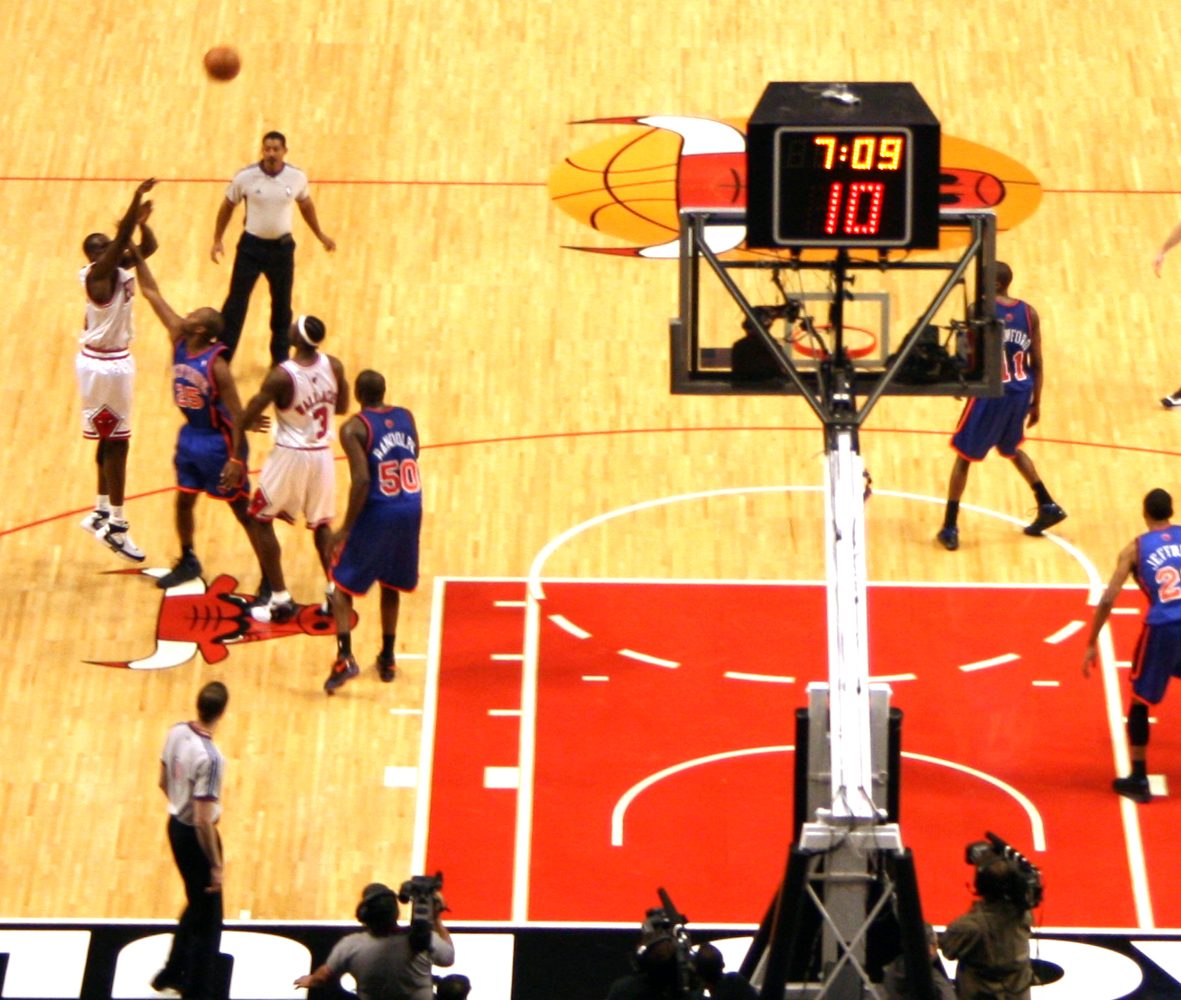
A block records a defender's credited interruption of an opponent's shot. It belongs near the start of this countdown because it is a memorable but narrow event: the ball changes direction, a scoring attempt is challenged, and the crowd notices. The useful first question is whether the play was a shot rather than a pass or a loose dribble. Knocking away an entry pass and rejecting a layup may look similarly forceful in a highlight reel, but they describe different events in a statistical table. BLK should be read as one kind of defensive action, not a count of every successful challenge.
Imagine a defender credited with three blocks in twenty-eight minutes. That line tells you about three recorded events, not the total number of shots the defender discouraged. Perhaps an opponent saw the defender near the rim and passed out without attempting a shot. Perhaps another opponent changed direction and scored elsewhere. Those possessions would require video or more specialised information to interpret. The three is still useful: it identifies something concrete to investigate. It does not justify claiming that the defender saved exactly six points, because the original shots might have missed and the subsequent possessions may have continued.
Follow the ball after a rejection. A block can send it to a teammate, back to the shooter, or out of bounds. These outcomes have different consequences even when the defender receives the same individual block credit. If the attacking team recovers the ball and scores, the block has not by itself ended its opportunity. This is why BLK cannot be added to steals and described as a precise total of possessions won. A steal involves a credited defensive action leading to an opponent turnover; a blocked shot and the recovery that follows are separate parts of the sequence.
Watch the relationship between positioning and the event. A defender might remain near the basket and contest a shot without producing a block, while another might leave an assignment seeking a spectacular rejection. The box score alone cannot tell you which decision was better. Ask whether teammates had to cover an abandoned player, whether the shot was already difficult, and who secured the rebound. These are questions for observation rather than assumptions about a named player's effort. Counting the visible touch is easier than measuring the quality of the entire defensive possession.
For a small comparison exercise, place a hypothetical one-block game next to a three-block game. Keep minutes and opponent attempts in view before making a judgment. If one defender played eight minutes and the other thirty-six, their opportunities were different. If one opponent attacked the rim repeatedly while another relied on outside shots, the chances to register this particular event also differed. None of that makes the totals meaningless. It changes the sentence you can responsibly write: one player recorded more blocks that night, while the broader comparison needs additional evidence.
Blocks rank tenth here because they answer a specific question very well and a general defensive question poorly. A defence can succeed through positioning, communication and forced misses without collecting many of them. Conversely, an impressive block total does not erase fouls, missed rotations or scoring allowed elsewhere. Read the official provider's final record, use the play-by-play to locate the events, and then watch what happened before and after each touch. The reward is a more complete appreciation of shot defence, including useful work that never becomes a dramatic number in the BLK column.
Sources: Jr. NBA: reading a box score · NBA statistical glossary · FIBA statisticians’ manual 2024, separate competition reference.
Photo: Gavin J. Dow (Gavindow); source crop/color correction by HITNOM and Adeletron 3030 · CC BY 3.0. NBA court and shot clock, 14 December 2007; context photograph, not evidence of a specific statistical event. Existing optimized local JPEG reused unchanged. Earlier resizing/recompression retained, with source crop/color adjustments where applicable. The stated license applies to this image; no endorsement or evidence of the invented examples is implied.
