
Rebounds describe credited recoveries after missed shots, with offensive and defensive components separated by which team attempted the shot. OREB or ORB identifies attacking rebounds; DREB or DRB identifies defensive rebounds; REB usually gives the individual total. Reading the split matters because keeping your own attack alive and ending the opponent's opportunity are different tasks. In an ordinary individual line, three offensive rebounds plus seven defensive rebounds produce ten total rebounds. Check the provider's team-rebound accounting before expecting the sum of every player's row to explain every missed shot in a game.
Imagine a missed jumper that bounces to an attacker, who passes out for another attempt. The rebound has extended the team's opportunity rather than directly added points. If the next shot misses, the original rebound still counts; if the next shot scores, the scoreboard changes through that subsequent basket. Calling every offensive rebound two extra points would therefore be an invented conversion. It is better to say that the player created another chance, then examine how the team used it. The distinction between opportunity and outcome is one of the most helpful habits a beginner can learn from this column.
A defensive rebound can look less spectacular because it may arrive uncontested, but the space around the catch can be a team achievement. One teammate might block an opponent's path while another secures the ball. The credited rebound belongs to the player who completes the qualifying recovery, not automatically to everyone who helped make it possible. Watching the preparation reveals work that the individual total does not distribute. Conversely, a high rebound number does not by itself prove exceptional positioning on every possession. Ask who contested the ball, who boxed out and whether the recovery was actually difficult.
Available chances vary with the game. More missed shots can create more rebounding opportunities, while accurate shooting can reduce them. Player position, defensive assignment and time on court also influence where someone is when a miss occurs. A hypothetical guard with six rebounds may have performed an important role even when a centre has twelve. The raw totals answer who was credited with more recoveries, but evaluating relative performance requires context. Avoid comparing different games as though they contained identical numbers of misses, identical shot locations and identical responsibilities for every player involved.
Not every miss turns into an individual rebound. Dead-ball situations, team rebounds and the timing of a period can affect the accounting. A blocked shot can still be followed by a rebound, because the block and recovery describe separate actions. A missed last free throw can also create a rebounding situation when the ball remains live. These details explain why a quick equation based only on field-goal misses and individual rebounds can fail. For an exact reconstruction, use the official play-by-play and the competition's recording conventions rather than forcing all events into a simplified personal tally.
Rebounds rank fourth because they connect shooting results to the next stage of possession. The split helps explain whether a team repeatedly earned another attempt or reliably finished defensive sequences. Read total and components together, then watch how the ball was secured and what happened next. A rebound followed by an immediate turnover has a different attacking consequence from one followed by a controlled outlet pass, even though the rebound remains recorded. This is an excellent column for learning that a useful statistic can identify a meaningful action without describing the entire possession around it.
Sources: Jr. NBA: reading a box score · NBA statistical glossary · FIBA statisticians’ manual 2024, separate competition reference.
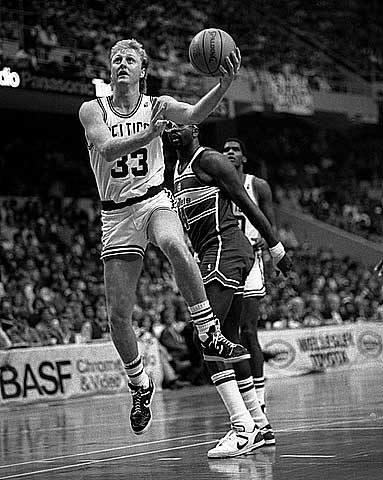
Photo: Steven Carter from Northern New England, USA · CC BY-SA 2.0. Larry Bird attacking the basket; archive game date unspecified, metadata dated 31 March 2006 is not a verified playing date. Existing optimized local JPEG reused unchanged. Earlier resizing/recompression retained, with source crop/color adjustments where applicable. The stated license applies to this image; no endorsement or evidence of the invented examples is implied.
