
A turnover records a lost attacking possession under the provider's statistical rules. It can arise from a bad pass, mishandled ball, violation or offensive foul, among other situations. The first lesson is that not every turnover needs an opposing steal. A ball thrown out of bounds can give possession away without a defender receiving that particular credit. Team totals can also contain events that do not appear as an ordinary individual error in a player's row. Before accusing the table of inconsistency, compare the team-level accounting with the individual lines and check the play-by-play.
Imagine a guard with eight assists and four turnovers. The two numbers together suggest both successful creation and possessions lost, but they do not give a complete balance sheet of decisions. One turnover might come from an ambitious pass that nearly created a layup, another from an avoidable dribble off a foot. Both can occupy the same column. Similarly, an assist depends on a teammate completing a credited scoring play. Treating eight minus four as a precise measure of net value would combine unlike events and ignore their circumstances. The line is a starting point for questions, not an automatic verdict.
Responsibility is often more complicated than the final credit suggests. A receiver may move away from an expected spot, a passer may deliver late, or a defender may close the route unusually well. The official record still needs an attribution, but a viewer discussing the play can acknowledge shared causes. This does not mean inventing excuses for a favourite player. It means distinguishing the recorded event from a claim about intention or blame. Watching the sequence is essential when the discussion turns from how many turnovers occurred to why they occurred and whether a decision was reasonable.
Workload changes the comparison. A primary ball handler usually encounters different decisions from a teammate who mostly finishes possessions after receiving a pass. A hypothetical player with one turnover after handling many attacks has a different task from someone with one turnover during a few brief touches. Traditional TOV does not include the number of difficult passes attempted or every time a player initiated an action. Minutes provide some context, but not the whole role. Avoid ranking ball security solely by the smallest total without checking who was actually responsible for moving and creating with the ball.
The assist-to-turnover ratio can be a useful descriptive companion when its limitations are clear. Six assists and two turnovers produce a ratio of three; three assists and one turnover produce the same ratio from less activity. A zero-turnover game also requires care, because ordinary division by zero does not produce a sensible finite ratio. Read the provider's display convention rather than inventing a number. Ratios summarise selected events, and they should not erase scoring, role or sample size. The raw pair often communicates more clearly to a beginner than an impressive-looking ratio without any denominator.
Turnovers rank sixth because possessions are opportunities to score, and losing them helps explain why a team with attractive shooting percentages might still struggle. Yet a traditional line does not specify the quality of every lost opportunity or the defence that followed. A live-ball mistake and a dead-ball violation can produce different transition situations. Read the event, its timing and its context before describing the cost. The most useful takeaway is practical: pair TOV with assists, minutes and the play-by-play, and keep team accounting separate from a simplistic count of opposing steals.
Sources: Jr. NBA: reading a box score · NBA statistical glossary · FIBA statisticians’ manual 2024, separate competition reference.
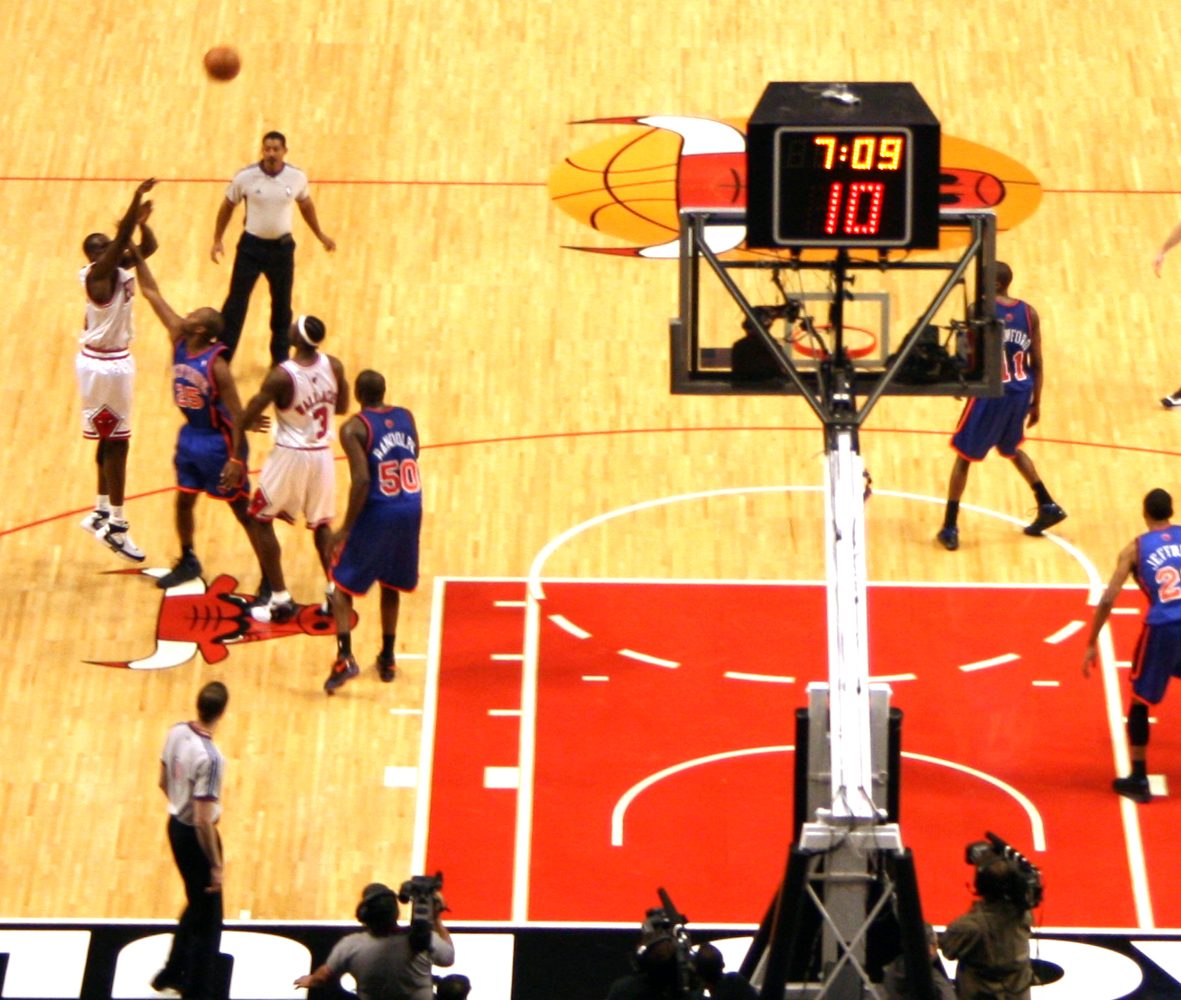
Photo: Gavin J. Dow (Gavindow); source crop/color correction by HITNOM and Adeletron 3030 · CC BY 3.0. NBA court and shot clock, 14 December 2007; context photograph, not evidence of a specific statistical event. Existing optimized local JPEG reused unchanged. Earlier resizing/recompression retained, with source crop/color adjustments where applicable. The stated license applies to this image; no endorsement or evidence of the invented examples is implied.
