
An assist credits a pass that leads directly to a teammate's made basket under the scoring interpretation in use. It is a record of completed scoring connections, not a count of every good pass. A perfectly timed delivery can produce no assist if the recipient misses, while a routine pass may receive one when the teammate finishes the qualifying play. The official scorer's judgment matters around the boundary between a pass-created basket and a score created mainly by the recipient. Avoid treating a fixed number of dribbles as a universal rule across leagues or every situation.
Picture an invented possession in which a guard passes to a teammate cutting toward the basket and that teammate finishes. Now picture the same pass followed by a missed layup. The passer may have made equally useful decisions, but the traditional AST outcome differs because one scoring play was completed and the other was not. This explains both the value and the limitation of the statistic. It documents a real contribution to made baskets, yet it does not independently measure the quality of every opportunity the passer created. A highlight collection of assists also leaves out the useful passes that ended in misses.
Assists and points are overlapping descriptions of the same scoring event, not separate additions to a team's score. A two-point basket following a credited pass adds two points to the scoreboard; it does not add two for the shooter and another two for the passer. The assist belongs to the passer's row as a different kind of contribution. This distinction matters when a fan tries to build a homemade impact total. Adding points, rebounds and assists may create a convenient summary number, but that number has no automatic claim to being a complete or correctly weighted measure of basketball value.
A high assist total can reflect skill, role, teammate finishing and the style of the attack. The player who makes the final pass may benefit from an earlier pass that shifted the defence. A screener might create the opening without receiving traditional assist credit. These possibilities should encourage curiosity about the possession rather than cynicism about the statistic. Watch where the advantage began, who moved the defence and whether the final pass required unusual timing or accuracy. The box score records one visible connection; the full action can contain several worthwhile contributions that do not fit that single column.
Compare hypothetical lines of ten assists with five turnovers and six assists with one turnover. The first player has more credited scoring passes, while the second gives away fewer recorded possessions. You cannot decide which game was better from that pair alone. Minutes, scoring, defensive work and the difficulty of each role still matter. Even an assist-to-turnover ratio is only a description of selected events. Keep the totals visible when using it, and resist projecting one game's balance into a permanent label such as safe passer or reckless creator without a broader sample and supporting observation.
AST ranks fifth because it helps a beginner see offence as cooperation rather than a collection of individual shooting totals. It also offers a useful bridge to watching movement away from the ball. On the next possession, try following the eventual recipient before looking back at the passer. Notice the cut, screen or space that makes the delivery possible. Then compare the recorded outcome with the decisions you observed. The statistic is most informative when it opens this conversation, giving credit for completed creation while leaving room for valuable passing and teamwork beyond the final assist.
Sources: Jr. NBA: reading a box score · NBA statistical glossary · FIBA statisticians’ manual 2024, separate competition reference.
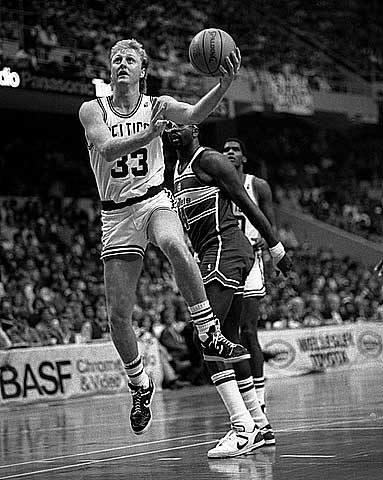
Photo: Steven Carter from Northern New England, USA · CC BY-SA 2.0. Larry Bird attacking the basket; archive game date unspecified, metadata dated 31 March 2006 is not a verified playing date. Existing optimized local JPEG reused unchanged. Earlier resizing/recompression retained, with source crop/color adjustments where applicable. The stated license applies to this image; no endorsement or evidence of the invented examples is implied.
