
Three-point makes and attempts describe the long-range part of field-goal shooting. The crucial bookkeeping rule is that these baskets are already included in total field goals. If a player makes seven field goals and three of them are threes, the player has four two-point baskets and three three-point baskets, not seven two-pointers plus three extra baskets. Some providers use 3P and 3PA, others 3PM and 3PA, and combined fractions are common. Read the labels carefully, then remember that this is a subset of field-goal shooting rather than an independent additional collection of made baskets.
Take an invented line of 7–15 from the field, including 3–8 from three, with 2–2 on free throws. Four two-pointers produce eight points, three threes produce nine, and the free throws add two. The total is nineteen points. You can check the same result with twice the field goals made, plus three-pointers made, plus free throws made: fourteen plus three plus two. That extra three supplies the additional point for each long-range basket. This arithmetic check is especially helpful when a table compresses several shooting columns into a small mobile display.
Three-point percentage needs its attempt count attached. One make in two attempts is fifty percent, while four in ten is forty percent. The first percentage is higher, but the second player made more threes and generated more points from those makes. Which performance was more useful depends on the wider game, including alternatives available on those possessions. Do not replace that question with a slogan about percentages alone. Over a larger sample, keep makes and attempts together so that a brief hot spell is not mistaken for a settled description of a player's shooting ability.
The column does not describe shot difficulty. An open catch-and-shoot attempt and a contested late-clock attempt can have the same recorded outcome. Teammates may create the space through passing, screening or driving, while the traditional table assigns the make to the shooter. Video can show the help surrounding the statistic. This is also why a player can influence spacing without recording a three: defenders might remain close to a respected shooter, opening a different route to the basket. Such an explanation requires observation, not merely the assumption that every low-volume shooter created valuable space.
Shot selection introduces a tradeoff rather than a universal answer. In a hypothetical calculation, making four of ten threes yields twelve points from those attempts; making five of ten twos yields ten. That comparison illustrates scoring value, not a guarantee that any player should take more threes. It ignores fouls, rebounds, turnovers and the practical availability of each shot. A mathematical example can clarify a relationship while remaining too simple to prescribe a team's strategy. Keep that boundary visible when discussing why three-point shooting changes the way fans read a box score.
This category ranks seventh because it explains both scoring composition and an important source of confusion in shooting totals. Use it to ask whether a player's points came through volume, accuracy or a mixture of the two. Then check the full field-goal line and free throws before announcing an efficient or inefficient scoring game. A long-range surge can dominate the visual memory of a night while other possessions tell a different story. Reading the subset correctly gives you a better starting point for that discussion, without turning a handful of attempts into a complete theory of basketball.
Sources: Jr. NBA: reading a box score · NBA statistical glossary · NBA scoring and timing rules.
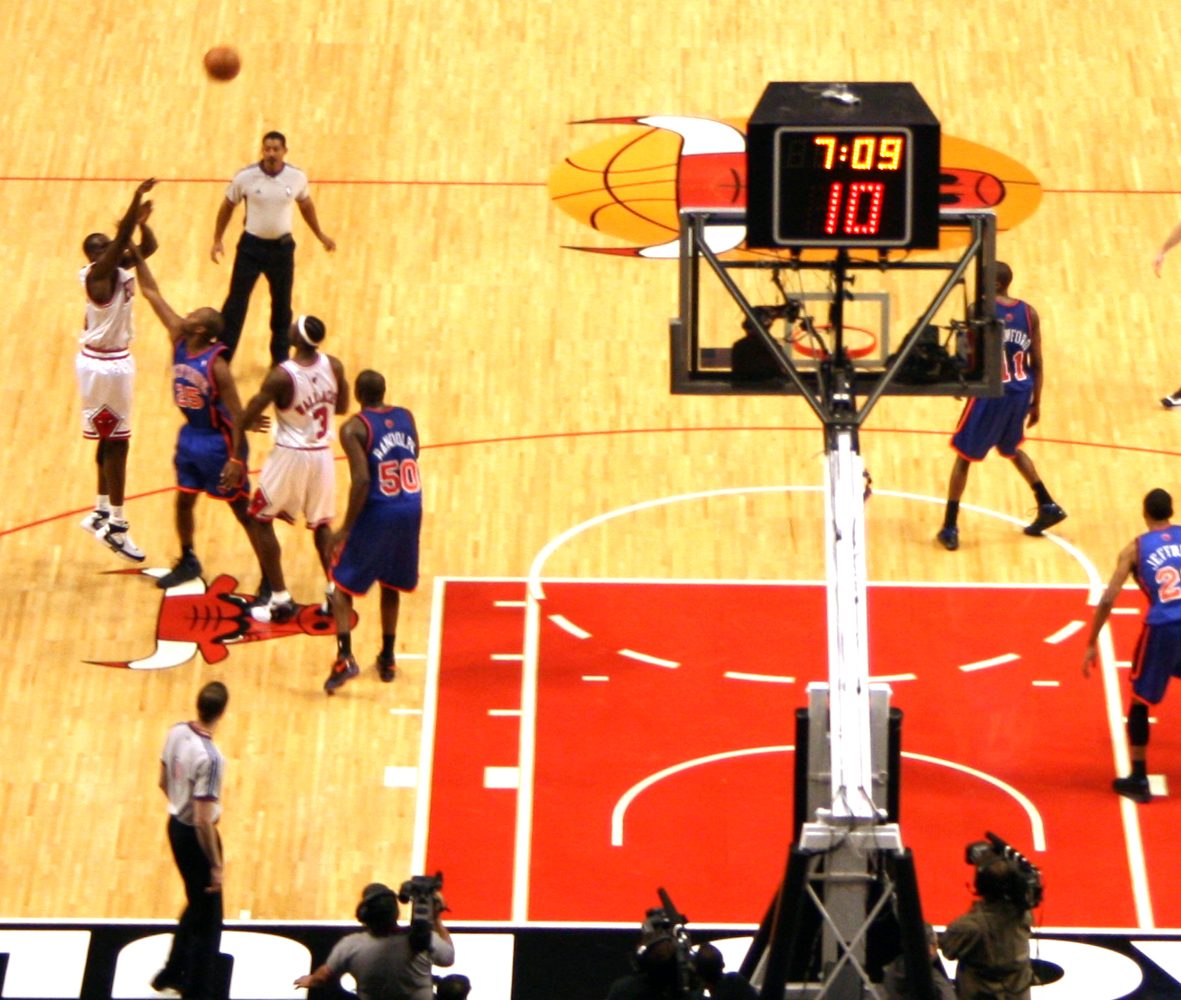
Photo: Gavin J. Dow (Gavindow); source crop/color correction by HITNOM and Adeletron 3030 · CC BY 3.0. NBA court and shot clock, 14 December 2007; context photograph, not evidence of a specific statistical event. Existing optimized local JPEG reused unchanged. Earlier resizing/recompression retained, with source crop/color adjustments where applicable. The stated license applies to this image; no endorsement or evidence of the invented examples is implied.
