
FTM and FTA separate successful free throws from attempts. Read a line such as six out of eight as six makes in eight recorded tries, not six points plus eight additional opportunities still to come. Each successful free throw contributes one point. Free throws sit outside field-goal totals, so they provide a separate route into the scoring arithmetic. A player can have a substantial scoring contribution while making relatively few baskets from live play. Looking at this pair before judging a low field-goal total can prevent a mistaken description of an otherwise productive scoring night.
In a hypothetical example, a player makes five field goals, all worth two points, and eight of ten free throws. The field goals contribute ten points and the free throws another eight, producing eighteen overall. The two missed free throws do not subtract points already scored; they are unsuccessful chances. FT percentage would be eight divided by ten, or eighty percent. A table might display 8–10, separate FTM and FTA columns, or 80.0 in a percentage field. Check the heading before interpreting a number, because the same digit can represent a total or a rate.
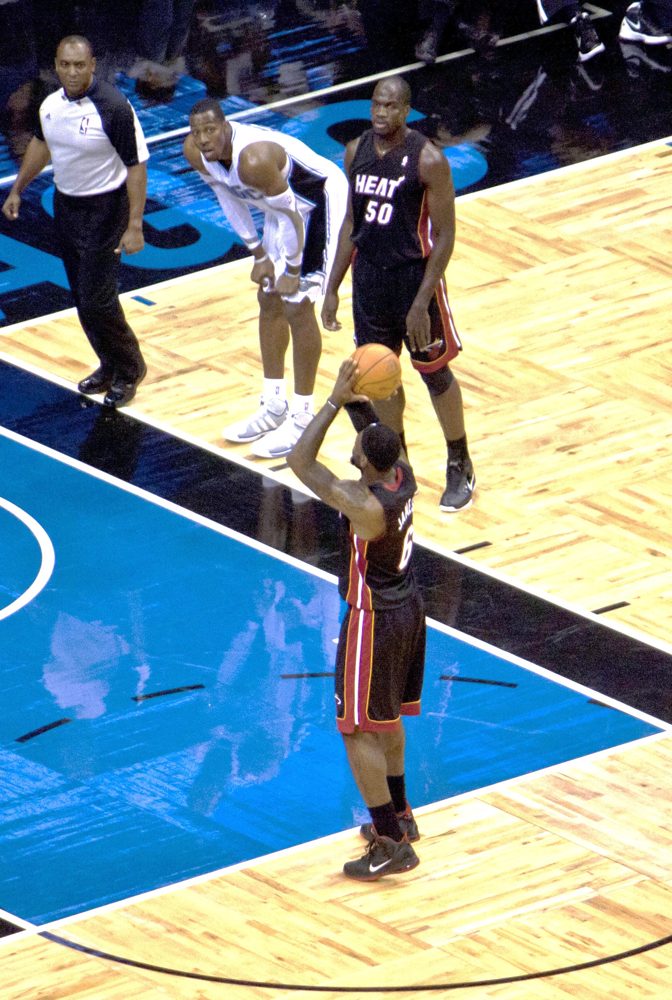
Attempts help you understand scoring composition, but they do not independently explain every whistle. Shooting fouls, team penalties and technical situations can lead to free throws under different conditions. The traditional box score is not a complete referee's report. If you want to explain why a player reached the line repeatedly, consult the play-by-play and relevant rules rather than infer a single cause from FTA. Likewise, a photograph of a player shooting at the stripe can illustrate the setting but cannot establish how many attempts that player earned in a particular game.
The denominator becomes especially important in small samples. A player who makes two of two has a perfect percentage for that game; another who makes nine of ten has a lower percentage but contributes more made free throws. Those statements can both be true. Neither tells you enough to forecast the next attempt with certainty or rank the players' long-term shooting ability. To make a broader comparison, expand the sample and retain the competition and date filters. Avoid averaging individual game percentages without considering attempts, because a two-shot game should not automatically carry the same weight as a ten-shot game.
Free throws also complicate casual ideas about shot attempts. A missed basket attempt during a shooting foul generally does not enter FGA in the same way as an ordinary missed shot, while a made basket with a foul can still count. Beginners should therefore resist reconstructing all attacking possessions by simply adding FGA and FTA. Some trips contain multiple free throws; other possessions continue after a miss and rebound. This guide deliberately avoids a possession-estimation formula, because learning what the columns mean is more useful at this stage than inserting an unexplained coefficient into a calculation.
The practical reading order is makes, attempts, percentage, then context. Ask how many points arrived at the line, how many chances were used, and whether the game situation explains unusually high or low volume. A strong percentage is one useful description of execution, while attempts describe opportunity and scoring style. Neither is a moral judgment about how attractive the game looked. Free throws rank eighth because they explain an easily overlooked part of the scoreboard and reveal why a field-goal-only account can misrepresent scoring. They become most informative when read beside the other shooting columns.
Sources: Jr. NBA: reading a box score · NBA statistical glossary · NBA scoring and timing rules.
Photo: RMTip21 · CC BY-SA 2.0. LeBron James attempting a free throw in a preseason game, 21 December 2011; not the hypothetical stat line. Existing optimized local JPEG reused unchanged. Earlier resizing/recompression retained, with source crop/color adjustments where applicable. The stated license applies to this image; no endorsement or evidence of the invented examples is implied.
