
Minutes tell you how much playing time sits behind a player's recorded production. They rank second because nearly every counting statistic becomes easier to interpret when opportunity is visible. Twenty points in a short appearance and twenty points across a full workload are the same scoring total with different context. MIN does not measure effort, fitness or tactical importance directly. It records participation time. A player can spend valuable minutes creating space or defending without accumulating many visible events, while a short burst can generate an unusually dense line that is difficult to sustain.
The NBA plays four twelve-minute regulation periods, giving forty-eight minutes of game time before any overtime. With five players on court for each team, an ordinary team's player-minute total is two hundred forty in regulation. Each five-minute overtime adds twenty-five team player-minutes. This is useful bookkeeping, not a demand that a rounded public display always adds perfectly. Providers can show minutes with seconds or as decimals, and rounding may affect the visible sum. Check the format before interpreting 24:30 as though it meant twenty-four point three minutes; it represents twenty-four minutes and thirty seconds.
Compare two hypothetical players with twelve points each. One plays twelve minutes and the other thirty-six. A simple points-per-minute calculation gives one point per minute and one-third of a point per minute, respectively, but that does not prove the first would score thirty-six if given thirty-six minutes. Matchups, fatigue, role and shot opportunities could change with a larger workload. Rate calculations describe what happened in the observed time; projections add assumptions. Keeping the two separate is particularly helpful when discussing reserves, late-game appearances or a small sample that produced an eye-catching number in limited action.
Low minutes can have many explanations. Rotation choices, fouls, game situation and an early exit are possibilities, but the table alone does not establish the reason. Do not infer an injury or a disciplinary issue from a short appearance. Consult a reliable report if the cause matters, and describe uncertainty honestly when it remains unresolved. The same caution applies to a player who does not enter the game: a non-participation label is not the same as a played game with zero production. Read the provider's status notation alongside the numerical columns.
Minutes also help you distinguish totals from averages. A season table may show average minutes per game, total minutes, or a filtered stretch. Pairing a player's total points with average minutes as though they belonged to the same unit creates a meaningless comparison. Keep filters consistent across the columns and players you are comparing. If you change from regular season to playoffs or from totals to per-game values, check the headings again. A surprising result often reflects a changed view rather than a sudden discovery about a player's actual role or performance.
MIN is a context tool, not a shortcut to ranking players by coaching approval. More time creates more chances to record events, but does not guarantee that every additional minute was effective. Less time can reflect a specialist role rather than a lack of usefulness. Start your reading with the workload, continue through shooting and other contributions, and finish by asking what the game demanded. That habit keeps a dramatic small-sample performance in proportion without dismissing it, and helps explain why two identical counting totals can tell very different stories once their playing-time context is restored.
Sources: Jr. NBA: reading a box score · NBA statistical glossary · NBA scoring and timing rules.
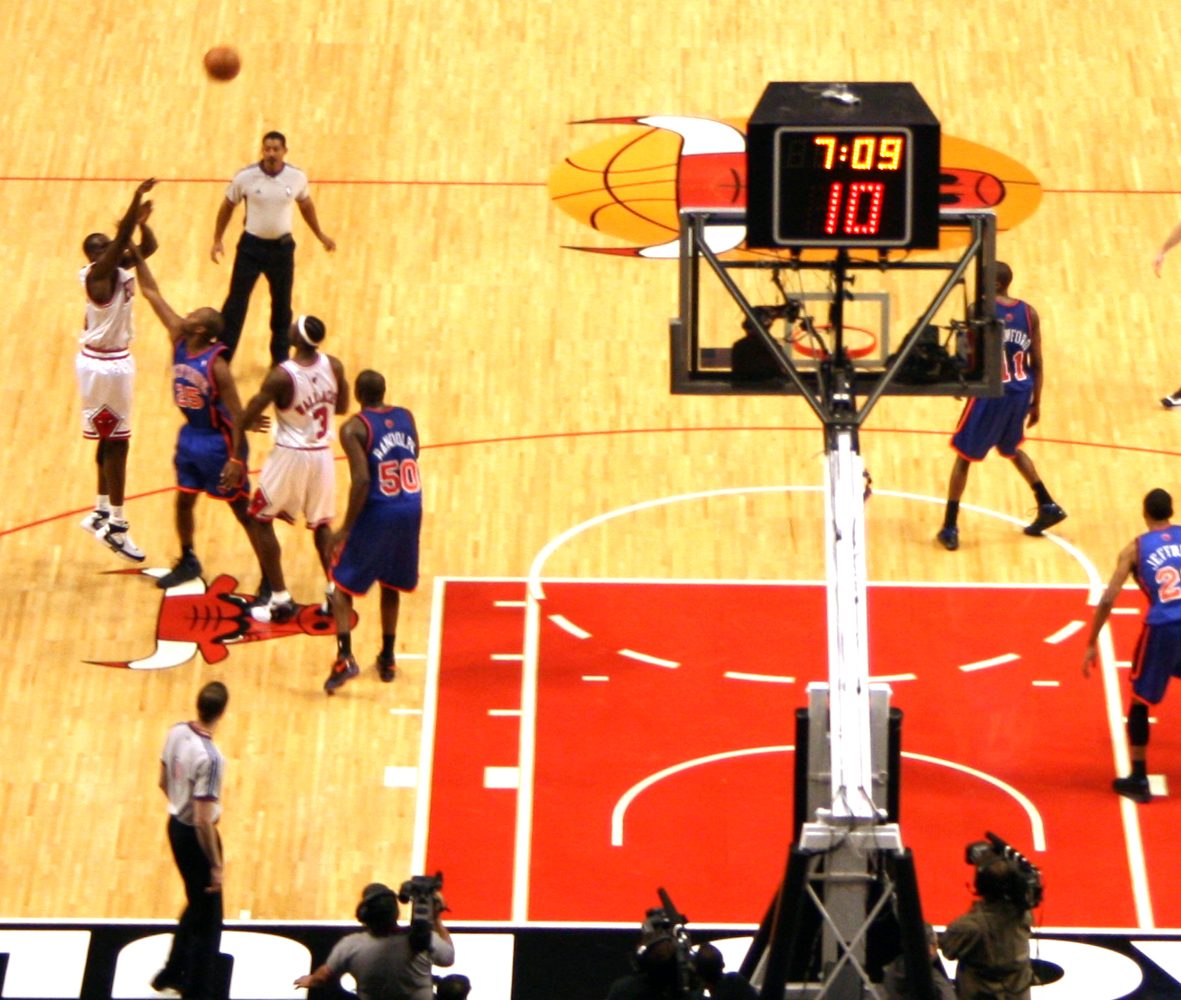
Photo: Gavin J. Dow (Gavindow); source crop/color correction by HITNOM and Adeletron 3030 · CC BY 3.0. NBA court and shot clock, 14 December 2007; context photograph, not evidence of a specific statistical event. Existing optimized local JPEG reused unchanged. Earlier resizing/recompression retained, with source crop/color adjustments where applicable. The stated license applies to this image; no endorsement or evidence of the invented examples is implied.
