
Field goals are baskets and attempts from play, including both two-point and three-point shots. Free throws belong in their own columns. FGM counts makes, FGA attempts, and FG percentage divides the former by the latter. A line of eight makes in sixteen attempts therefore shows fifty percent shooting from the field. Read the pair before the percentage, because the attempt count tells you how much activity sits behind the rate. This category ranks third because it supplies the essential denominator missing from a points-only account of a player's scoring performance.
Work through an invented comparison: one player makes four of eight field goals and another makes eight of sixteen. Both shoot fifty percent, but the second player makes twice as many baskets on twice as many attempts. The percentages alone conceal that difference. Now suppose the first player's four makes are all threes while the second player's eight are all twos. Their field-goal percentages remain equal, but the scoring from those baskets is twelve and sixteen respectively. Makes, attempts and shot value answer related questions; none can simply replace the others when describing what happened.
FG percentage is not the same as a complete scoring-efficiency measure. It treats a made two and a made three as one successful field goal each, even though their scoreboard values differ. It also leaves free throws outside the calculation. Advanced measures can adjust some of these issues, but a beginner does not need to memorise them before understanding the traditional line. First identify the shot mix and the separate free-throw contribution. You can then say precisely what a percentage describes, rather than using a familiar number to support a broader claim that it was never designed to settle.
Some apparent shots do not become ordinary recorded attempts. A missed try during a shooting foul generally differs from an unfouled miss, while a made basket can count with an additional free throw awarded. A shot released after a period expires is another situation where what a spectator sees and what enters the official line may differ. Avoid counting every ball sent toward the hoop as an FGA without checking the ruling. If the numbers surprise you, look for fouls, timing decisions and other play-by-play context before assuming an arithmetic or recording error.
Shot difficulty and creation remain outside a simple fraction. An uncontested finish after a teammate's pass and a contested attempt as the shot clock runs down can both become one make or one miss. The fraction does not reveal who created the opening, whether an alternative was available, or how much time remained to choose it. A fair discussion pairs the recorded result with observation. It is possible to acknowledge a difficult role without erasing misses, and to recognise accurate finishing without attributing the whole possession's success to the final shooter alone.
When comparing a stretch of games, total the makes and attempts before calculating the overall percentage. Averaging fifty percent from one game and one hundred percent from another without weighting attempts can mislead. For example, one make in one attempt plus one in three gives two in four overall, or fifty percent, despite the two individual percentages averaging differently. This simple exercise captures why denominators matter. Use FGM and FGA as the foundation, add three-point and free-throw context, and only then move toward a larger judgment about the quality or usefulness of the scoring performance.
Sources: Jr. NBA: reading a box score · NBA statistical glossary · NBA scoring and timing rules.
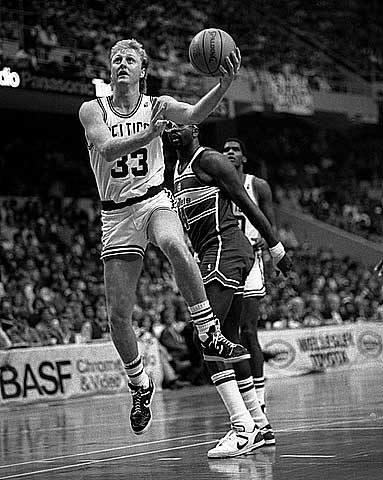
Photo: Steven Carter from Northern New England, USA · CC BY-SA 2.0. Larry Bird attacking the basket; archive game date unspecified, metadata dated 31 March 2006 is not a verified playing date. Existing optimized local JPEG reused unchanged. Earlier resizing/recompression retained, with source crop/color adjustments where applicable. The stated license applies to this image; no endorsement or evidence of the invented examples is implied.
