
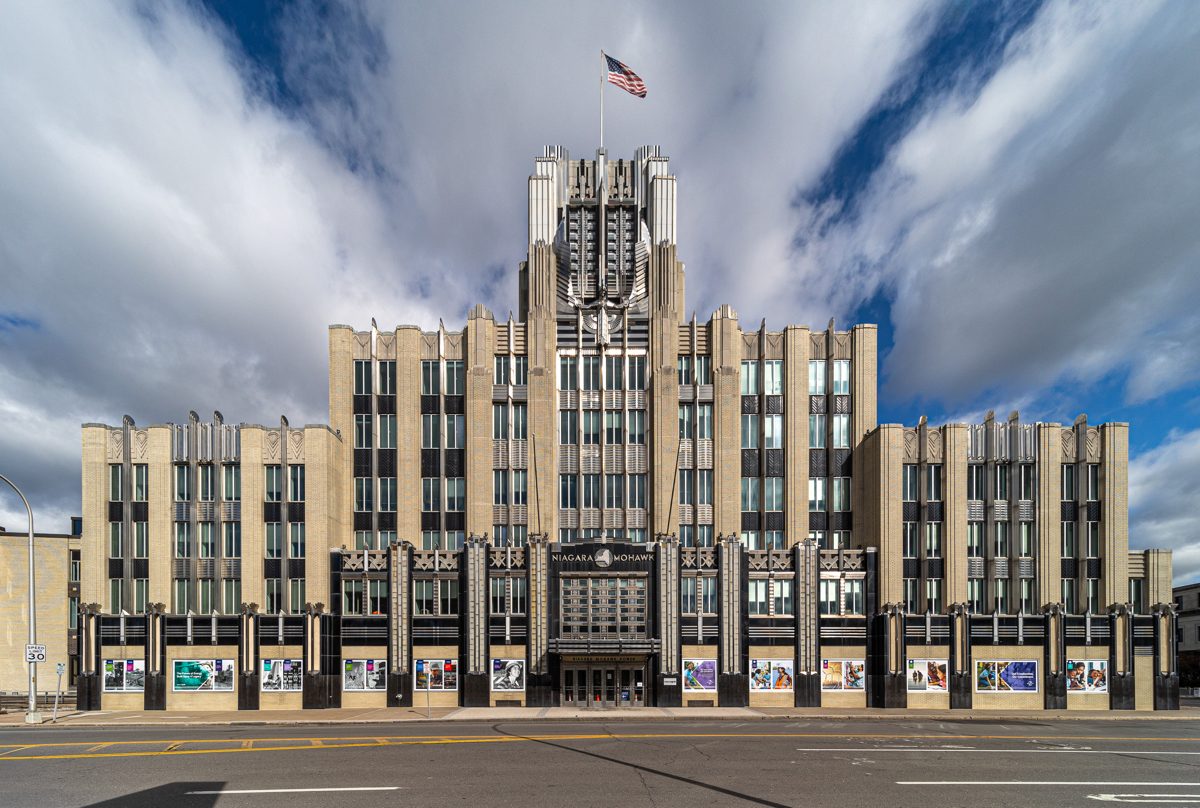
Syracuse's Niagara Mohawk Building opens the countdown because it makes a particularly clear connection between an institution and its architectural image. The National Park Service describes the building, originally Niagara Hudson's headquarters, as an Art Deco expression of the age of electricity when constructed in 1932. Its stainless-steel Spirit of Light figure and emphatic facade give a utility office a public identity far beyond an ordinary workplace. We rank it tenth because the buildings above it develop their ideas more expansively through tower form, materials or interior space. Yet this is an important opening entry: it shows how a comparatively compact building can make an exceptionally direct visual statement.
The central figure should be read as part of a composition, rather than as a sculpture that happens to sit above an entrance. It marks a focus, while the symmetrical facade and repeated vertical elements establish the setting in which that focus works. In our interpretation, the building turns an otherwise invisible service into something that can be pictured. Electricity is normally understood through what it powers; here, architecture gives the industry a recognizable face. That is a more specific design idea than simply decorating an office in a fashionable style. The building's identity and its original institutional purpose remain closely connected in the visual argument.
Material is essential to the effect. The NPS restoration account discusses stainless steel, glass, terra cotta and related exterior elements, showing that the facade's character depends on surfaces and reflectivity as well as outline. A flat black-and-white diagram would retain the symmetry but lose part of the impression. Compare how light behaves on metal and on less reflective neighboring surfaces. This does not require a claim that every finish visible in a historic photograph is original. In fact, the restoration history is valuable precisely because it explains that preserving an architectural effect may involve repair, replacement and the recovery of earlier patterns.
That history also provides a caution about using an archive photograph as current evidence. The owner, National Grid, announced a multi-year restoration project in 2025. The image in this article was made in 2023, so it cannot establish the progress or completion of that later work. We do not infer present scaffolding, lighting arrangements or public access from it. The historical design can be evaluated while acknowledging that its current appearance may be affected by maintenance. A useful architecture article should make that distinction explicit, especially when an older image seems to show a building in apparently finished condition.
The strongest case for moving Niagara Mohawk higher is the clarity of its institutional symbolism. If a successful Art Deco building should give the machine age an immediately readable image, this one is a serious contender. We nevertheless favor the richer overall compositions above it. Louisiana turns a whole civic building type into a tower; Buffalo connects massing and a broad public program; Carbide and Carbon creates a particularly sustained material contrast. Niagara Mohawk's most celebrated feature carries a larger share of its identity. That concentration is powerful, but under our criteria it is slightly less complete than the broader architectural arguments that follow.
For a thoughtful comparison, cover the central figure in a photograph for a moment and study the remaining facade. Then restore it and ask how much the meaning changes. The exercise reveals both the strength and the limitation of our tenth-place choice: a single focus can animate an entire building, but it can also dominate the way that building is remembered. Appreciate the exterior from permitted public space and respect its continuing office function. Niagara Mohawk earns its place because an ordinary institutional purpose becomes an unmistakable architectural story. The higher entries have to beat that clear idea, not merely rise farther into the sky.
Source: Architectural record 1 · Architectural record 2.
Photo: Kenneth C. Zirkel · CC BY 4.0. Niagara Mohawk Building, 8 October 2023; predates the 2025 restoration announcement. Historical photograph; current access and conditions may differ. Resized/recompressed, source framing retained; original license or dedication retained. No endorsement.
