
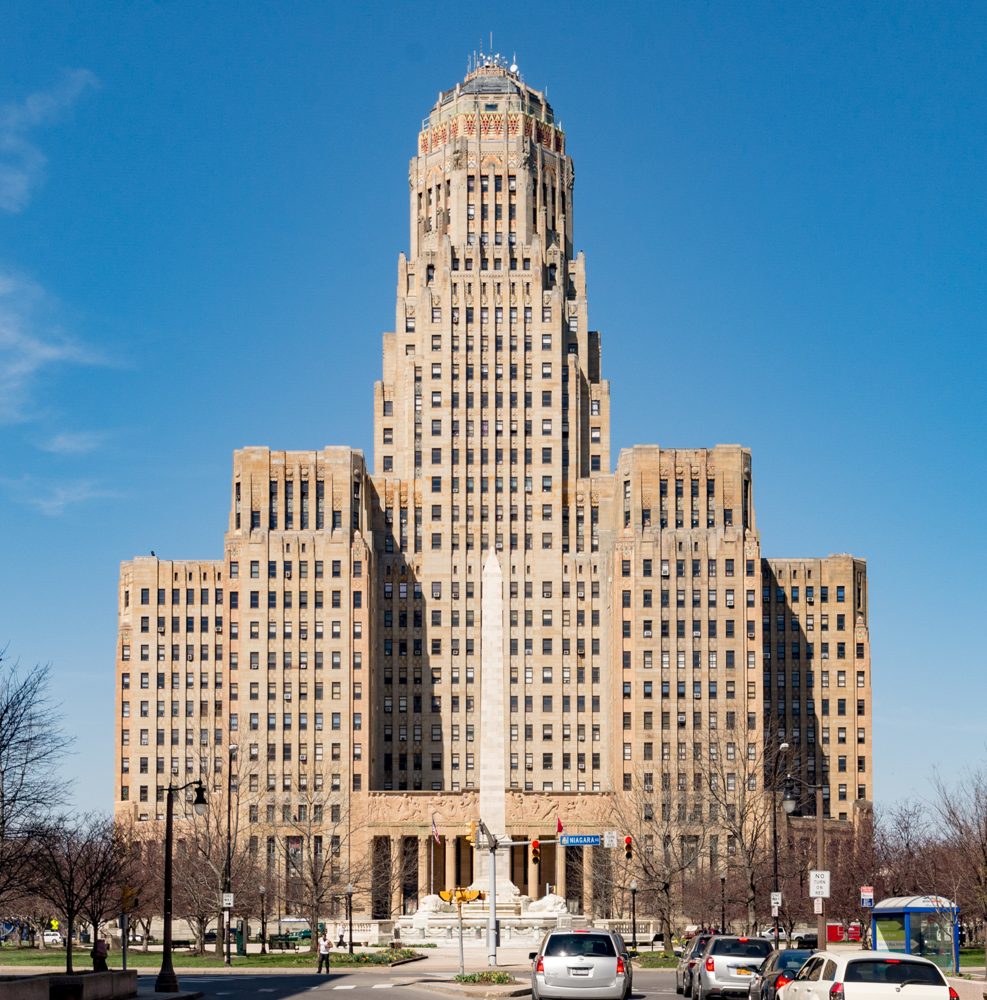
Buffalo City Hall is eighth because it gives Art Deco a civic role rather than simply a commercial one. Its tower commands Niagara Square, while its entrance and decorative program communicate the work and aspirations of a city. The municipal history distinguishes completion for occupancy in November 1931 from dedication in July 1932. Those dates describe separate milestones, not rival answers to a trivia question. We rank the building above Louisiana's capitol because its relationship with its urban setting and its detailed public face make a particularly integrated argument. It remains below Carbide and Carbon because the Chicago building's visual idea is more concentrated and immediately distinctive.
Start with the setting. A municipal building facing a square has a different obligation from a tower fitted into a dense commercial street. It can act as an organizing presence for the surrounding public space, not merely another object on the skyline. Buffalo's massing makes that relationship central to the experience. Look at the broad lower portions and the tower rising above them, then consider how the approach establishes a front. The building is useful for comparing civic monumentality with commercial height: both can be large, but their public relationships and the meanings attached to an entrance need not be the same.
The city's historical account describes an industrial decorative theme. At the entrance, elements refer to tools, machinery and local work, extending the architectural language beyond an abstract arrangement of steps and lines. These details should be read as a designed statement about community identity, not as a complete or neutral account of everyone who lived in Buffalo. A public building's imagery selects what to emphasize. Studying it can therefore involve two questions at once: how effectively do the forms fit the architecture, and what vision of the city do they present? Recognizing that selection makes appreciation more thoughtful without requiring agreement with every historical message.
The distinction between structural form and symbolic detail also matters. Art Deco is sometimes reduced to a recognizable pattern on a surface, but Buffalo shows how a tower, a broad base and a decorated entrance can reinforce one another. The lower parts create an approachable field of detail, while the upper mass gives the building a presence at a larger scale. Neither alone explains the entire effect. A photograph tightly cropped around a motif would miss its place within the composition; a distant skyline view would miss much of the civic story. The building rewards switching between these different ways of looking.
Why only eighth? Under our criteria, its considerable richness is a slightly less focused architectural statement than those above it. The leading commercial towers and designed interiors create exceptionally clear individual identities through their chosen forms or material systems. Buffalo has a broader task and a more expansive symbolic program. Some readers will see that as a reason to move it up, particularly if they value architecture's role in everyday public life above skyline recognition. We acknowledge that argument. Our rank does not imply that a striking private headquarters contributes more to a community than a useful city hall; it compares design character within the scope we set.
The photograph is an archive view from 2016, already cropped at its source. We retain that framing and do not use it as proof of current observation-deck access or interior opening hours. A civic building is a working place, and security or public business may shape a visit. The comparison can begin from ordinary public space: consider the route toward the entrance, the scale of the base and the tower's relationship with the square. Buffalo earns its place because its architecture makes government visibly present in the city. The question for the ranking is how much weight that civic presence should carry beside the concentrated drama of a commercial landmark.
Source: Architectural record 1.
Photo: xiquinhosilva · CC BY 2.0. Buffalo City Hall, 18 April 2016; source crop retained. Historical photograph; current access and conditions may differ. Resized/recompressed, source framing retained; original license or dedication retained. No endorsement. Source already cropped.
