
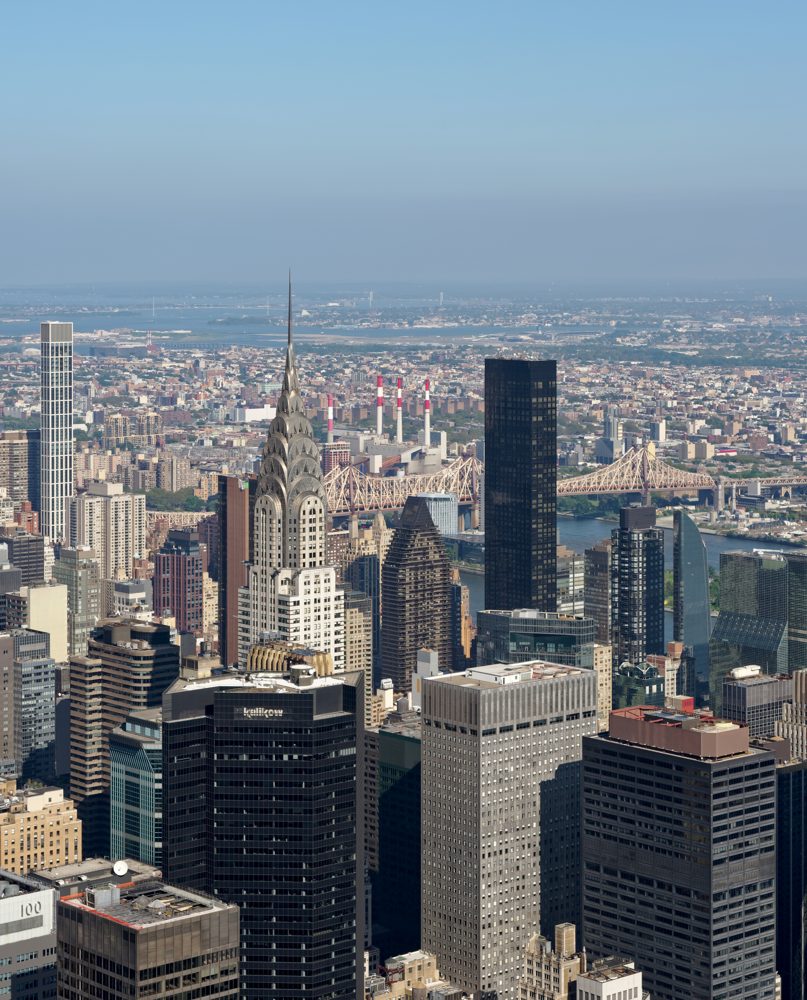
The Chrysler Building takes first place because its most distinctive features belong to one coherent architectural image. William Van Alen's tower, built in 1928–30, does more than end in a recognizable spire. The stainless steel crown, the changing outline and the imagery connected with the motor age give the building a character that remains specific even when you remove its name. New York's Landmarks Preservation Commission identifies the building as a major Art Deco work and describes its innovative use of steel and exterior ornament. Our judgment begins with that documented design, but the ranking is our interpretation of how successfully those elements work together.
Look first at the transition from the office tower to the crown. A tall building has to stop somewhere, and many solve that problem with a cap that feels separate from the repeated floors below. Here the upper profile turns the ending into the central event. The successive changes in shape make the eye anticipate a final upward movement. That is not an engineering measurement or a claim that every observer experiences the same emotion. It is a reason to prefer this composition: the top transforms the meaning of the whole. A silhouette alone carries an extraordinary amount of the design's identity.
The metalwork makes the argument more particular. The commission's account connects the tower's decoration with Chrysler's automotive world, rather than treating every unusual detail as a generic medieval gargoyle. In our reading, that association gives the building a useful tension. It is an office tower tied to a commercial personality, yet its imagery has become larger than a single business purpose. The details are not important simply because they are expensive or intricate. They matter because they help explain why this tower looks like itself. Compare that result with a building whose decoration could be moved elsewhere without fundamentally changing its identity.
Empire State offers the strongest objection to our first place. Its quieter, more disciplined form can seem more assured, particularly when seen at a distance. A crown that commands attention might also be accused of making the upper section more interesting than the rest. We do not dismiss either criticism. Chrysler's victory depends on valuing architectural invention and expressive unity more heavily than restrained massing. If your ideal skyscraper should create maximum effect through proportion and repetition, Empire State may be the better choice. Our ranking asks which building makes the richest case for this particular style, rather than which one has the cleanest outline.
Its history also needs careful separation from present-day expectations. Chrysler was the world's tallest building when completed in 1930, but that brief record is not why it wins here. Historic accounts describe a competitive building culture and an ambitious patron; they do not establish the current availability of a viewing platform or permission to enter a particular interior. The accompanying photograph looks toward the tower from Empire State in 2023. It helps compare the building with its urban surroundings, but it cannot establish today's restoration conditions. Use the historical source to understand the work and current operator information for any access decision.
What finally puts Chrysler ahead is the way a practical office building becomes an unmistakable piece of visual storytelling. The crown is memorable, the material treatment supports the theme, and the historical association is visible without needing a long label beside the facade. Guardian may beat it for color and craft, while Radio City may win if interior experience is your first priority. Empire State remains the most credible alternative for the top position. Which would you place first: Chrysler's expressive metal crown, Empire State's disciplined silhouette, or an Art Deco building whose strongest argument begins closer to the ground?
Source: Architectural record 1.
Photo: Jakub Hałun · CC BY 4.0. Chrysler Building viewed from Empire State, 1 October 2023. Historical photograph; current access and conditions may differ. Resized/recompressed, source framing retained; original license or dedication retained. No endorsement.
