
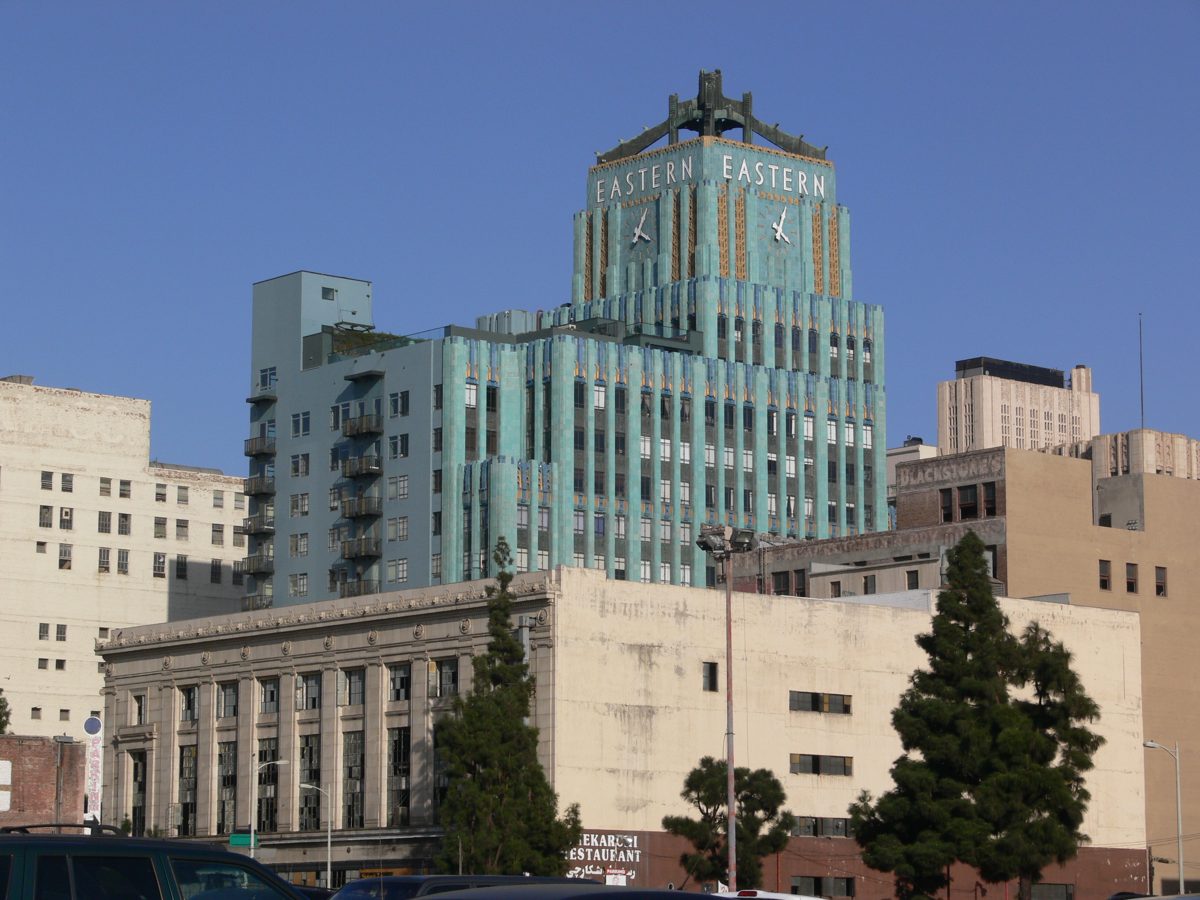
Eastern Columbia takes fifth place because few buildings in this selection make such a direct argument through color. Claud Beelman's Los Angeles landmark opened in 1930 as headquarters for the Eastern and Columbia outfitting companies. The Los Angeles Conservancy identifies its turquoise terra cotta, contrasting blue and gold details, geometric decoration and clock tower as defining features. Those elements establish the subject, but our ranking favors the relationship among them. A bright surface alone would not be enough. Here, vertical emphasis, decorative pattern and the prominent top give the color a composition to inhabit, making the whole more memorable than a collection of individual motifs.
Compare the building with the pale or dark office facades nearby in an exterior view. Its color immediately separates it from its setting, yet the repeated openings and vertical lines keep the surface from becoming a shapeless block of turquoise. That balance is the first reason it sits above Fisher. Fisher has a deeper case in craft and interior richness, but Eastern Columbia produces an especially concise public image. You can describe it with a few features without losing its identity. This is not a claim that the building is universally more beautiful. It is a preference for a distinctive design whose principal choices reinforce one another at street and skyline scale.
The clock tower deserves more than a quick identifying photograph. A tower can finish a building, announce a business, provide a useful public reference or do all three at once. At Eastern Columbia the name and clock help turn the upper section into an urban sign, while the facade's vertical organization prepares the eye for that conclusion. Compare this approach with Chrysler's more intricate crown and Empire State's increasingly slender outline. All three solve the problem of ending a tall mass differently. Eastern Columbia's position recognizes how effectively it achieves a recognizable result without needing the extraordinary height of its Manhattan rivals.
Closer to the pavement, the Conservancy describes geometric motifs and patterned terrazzo sidewalks. Those details broaden the design's reach beyond the top that appears in distant photographs. They also offer a useful distinction between applied decoration and integrated design. A pattern becomes architecturally interesting when its placement changes how a person reads an entrance, a boundary or a route. You do not need to assign every shape a grand symbolic meaning to notice that effect. Look at the relation between the recessed entry and the larger facade, then ask whether the change in scale feels like a continuation of the same idea or an unrelated flourish.
The strongest objection to fifth place is that our own criteria should perhaps favor Fisher's interior craftsmanship more heavily. That is a fair countercase. Eastern Columbia's exterior does a great deal of its persuasive work, and our archive photograph cannot show every part of the building. We give it the edge because of the unusually clear unity between color, vertical emphasis and the clock-tower identity. Guardian remains higher because its combination of material expression and interior experience is broader. A reader who prefers richness discovered gradually to an immediately readable exterior could reverse Eastern Columbia and Fisher while keeping our central Chrysler–Empire debate intact.
Current use must shape respectful observation. The building was converted to residences in 2006, and the Conservancy explicitly identifies it as a private residential property. That means no assumption of lobby entry, interior touring or access to residential areas. The accompanying photograph dates to 2008 and shows a historic exterior view rather than current conditions. Appreciate the architecture from ordinary public space without disturbing residents or blocking entrances. Eastern Columbia wins its place through the strength of its designed public face. You do not need to enter somebody's home to understand why turquoise, geometry and a well-judged tower make such a powerful architectural combination.
Source: Architectural record 1.
Photo: Andreas Praefcke · CC BY 3.0. Eastern Columbia Building exterior, October 2008; private residences. Historical photograph; current access and conditions may differ. Resized/recompressed, source framing retained; original license or dedication retained. No endorsement.
