
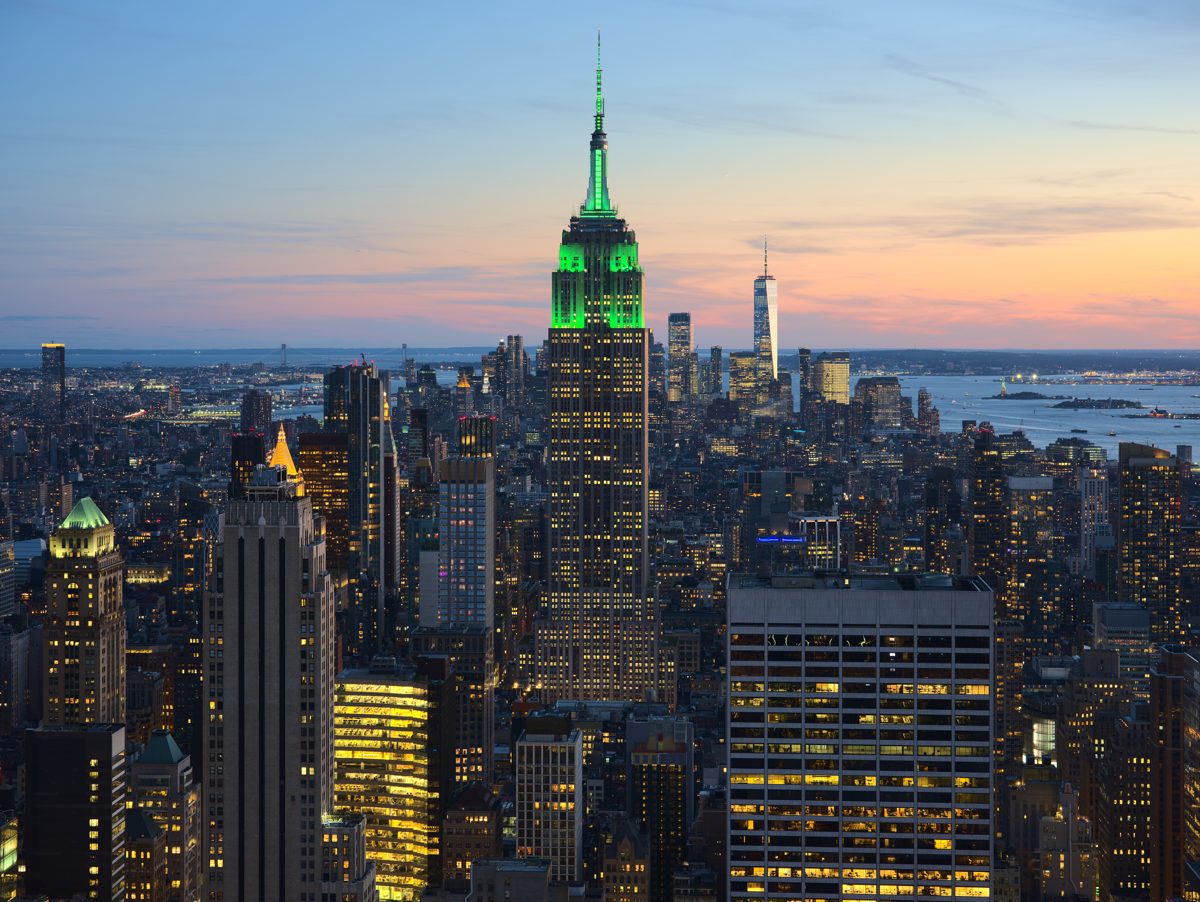
Empire State finishes second because it makes an unusually strong architectural argument with a relatively disciplined form. Opened in 1931 and designed by Shreve, Lamb & Harmon, the building combines repeated office floors with a sequence of setbacks and a narrow upper tower. Its operator identifies the structural steel frame and the limestone and granite facade, accented with aluminum and stainless steel. Those are the basic facts; our reason for putting it so high is compositional. The building is immediately legible as a large mass that becomes more concentrated as it rises. The transition feels deliberate rather than simply the point at which useful floor area runs out.
The comparison with Chrysler is best made before looking at any height figure. Draw the outlines of the two towers with the fewest possible lines. Empire State's power comes from the relationship between a broad lower body and an increasingly slender top. Chrysler makes a more elaborate event of its crown. Neither approach is inherently superior, and the relative clarity of Empire State is precisely why some readers will place it first. We give the advantage to Chrysler's more individual integration of form and ornament, but Empire State's restraint keeps the difference narrow. Second place here means the most convincing alternative winner.
The facade deserves attention beyond the familiar skyline image. Repeated openings and vertical elements organize a very large building into readable parts. Stone contributes a different visual weight from a glass wall, while the metal details introduce a finer scale. Consider how much of the tower's effect survives when the light changes or the famous top is partly hidden. A strong architectural composition does not depend on seeing every feature at once. This is one reason we prefer Empire State to several more exuberant buildings lower in the ranking: a recognizable idea remains present across distance, scale and ordinary changes in the view.
The interior also complicates the idea that Empire State is simply an austere rival to a decorated Chrysler. The operator describes a restored Art Deco lobby with celestial imagery and metallic detail. That historical and restoration context matters, but it should not become a promise that every visitor can enter every space freely. A designed arrival sequence is part of a building's architectural character even when current access is controlled. Our ranking considers that broader work rather than judging only the experience of buying an observation-deck ticket. The best view from a building and the best view of that building are different questions.
Our photograph records the tower in 2021, illuminated in green, and should be understood as a dated image rather than tonight's lighting schedule. The skyline around it is also a historical snapshot. The building's continuing fame does not make every photograph current, and its past height record should not be confused with an unqualified contemporary tallest-building claim. Readers interested in visiting should consult current official information. Here, the useful exercise is to study how the tower holds its identity among neighboring buildings, not to infer present ticket prices, access arrangements or a particular event from an archive photograph.
A lower placement would undervalue just how difficult this balance is: enormous size, repeated commercial space, a strong profile and a memorable arrival environment. A higher placement would be entirely defensible if proportional control were our first criterion. We keep Empire State second because Chrysler's crown and motor-age references create a more distinctive statement of Art Deco's expressive possibilities. Yet the two buildings illuminate each other. Look at Empire State after the more colorful Eastern Columbia or Guardian and notice how much it accomplishes with less overt visual variety. That economy is its strongest argument, and the reason our choice of another winner remains open to debate.
Source: Architectural record 1 · Architectural record 2.
Photo: Dllu · CC BY-SA 4.0. Empire State Building in green lighting, 20 September 2021. Historical photograph; current access and conditions may differ. Resized/recompressed, source framing retained; original license or dedication retained. No endorsement.
