
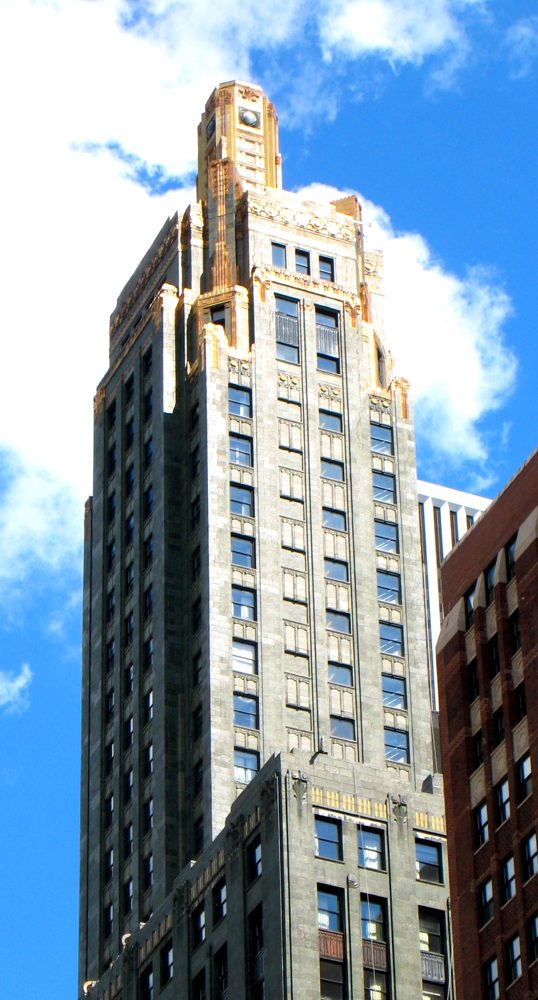
The Carbide and Carbon Building is seventh because the contrast between its dark facade and golden top produces an especially focused architectural identity. Completed in Chicago in 1929 by the Burnham Brothers, the building combines green and gold terra cotta with polished dark stone and carefully worked metal details. The City of Chicago's landmark account identifies the same distinctive palette and records its designation in 1996. Our position recognizes how much character can come from choosing a few materials and using them decisively. It ranks below Fisher because the latter offers a broader argument through a complex interior, but above Buffalo for its tightly concentrated visual idea.
Begin with the effect of the dark body rather than the glitter at the top. A dark facade can recede among paler neighbors, making the decorated upper section seem more intense by comparison. Yet that effect depends on the proportions of the whole: a gold detail in isolation would tell you very little about whether the building works. Look at how the repeated windows establish a vertical field, then how the top interrupts and concludes it. The strength of the design, in our reading, is that the contrast is easy to understand without making the main body architecturally irrelevant. The restrained palette provides a foundation for the flourish.
The famous champagne-bottle story should be handled as a story. Chicago's landmark description explicitly presents the idea that the colors were inspired by a bottle as a popular legend, rather than established documentary fact. It is tempting to turn a memorable anecdote into a definitive explanation, but that would weaken an otherwise useful comparison. The building does not require the legend to justify its success. You can evaluate the relationship between green, dark stone and gold directly. If you mention the story, retain its uncertainty and do not let it replace the documented designers, completion date and material description.
The entrance and lobby add another scale to the case. The city's account highlights fine bronzework and black marble, features that connect the larger palette to the pedestrian experience. A tower that looks distinctive from afar can disappoint if its base feels unrelated; here the supporting material language offers continuity. That is not a guarantee of unrestricted interior entry, and later hotel use should not be confused with a completely unchanged historic interior. The point is to consider what the historical entrance contributes to the composition. Color can establish identity at a distance while texture, reflectivity and detail enrich the same idea closer to the ground.
A good counterargument is that our placement undervalues this economy. Someone who prefers a compact and disciplined design statement could put Carbide and Carbon ahead of the more elaborate Fisher or Guardian. We retain seventh because the leading buildings develop their architectural ideas across a wider range of form, materials or interior space. Still, the difference is qualitative, not a fabricated score. The building is a useful reminder that a restrained material selection can be more memorable than a long catalog of ornaments. Its position would rise in a ranking focused primarily on how successfully a commercial tower establishes a recognizable external personality.
Our archive photograph was made in 2007, before the current hotel branding. It identifies the building and its upper form, but does not establish today's interior arrangements, facade condition or visitor services. Consult the current operator for those matters. For architectural comparison, use the image to follow the relationship between the dark vertical field and the decorated cap rather than assuming the building's colors will appear identical under every light. This seventh-place selection earns its distinction through deliberate contrast. The most useful question is not whether it resembles a bottle, but whether the effect remains convincing when the anecdote is taken away.
Source: Architectural record 1.
Photo: La Sequencia · CC BY 2.0. Carbide and Carbon Building, 12 July 2007; historical photograph. Historical photograph; current access and conditions may differ. Resized/recompressed, source framing retained; original license or dedication retained. No endorsement.
