
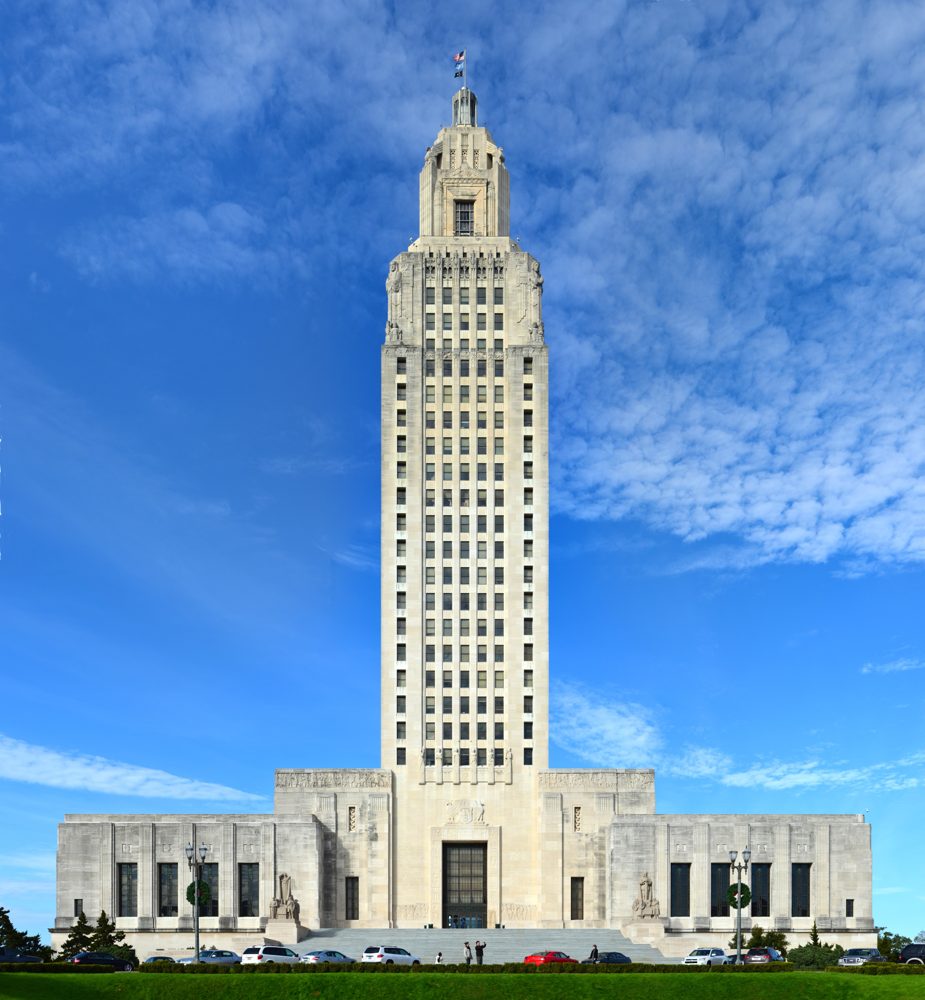
The Louisiana State Capitol ranks ninth for turning the familiar image of a statehouse into a tall, emphatic tower. The National Park Service identifies the Baton Rouge building as an Art Deco/Moderne work of Weiss, Dreyfous and Seifert, constructed in 1930–32. Its form stands apart from the dome-and-portico image many readers associate with American capitols. That difference matters architecturally: an established building type can convey continuity through familiar forms, or announce a new identity by departing from them. Louisiana's tower makes the second choice unusually clear. We place it above Niagara Mohawk for the power of that larger compositional statement, while Buffalo's closer connection between setting and detail earns eighth.
Look at the relationship between the vertical tower and the lower base. The base anchors the composition, allowing the central rise to become the dominant event without seeming to begin directly at the pavement. This is a different balance from Empire State, whose repeated commercial floors lead through a sequence of setbacks. The capitol must also establish a ceremonial front and a relationship with its grounds. Those needs help explain why a shared language of vertical emphasis can produce very different kinds of architecture. Calling both buildings Art Deco should begin a comparison, not imply that one is simply a smaller version of the other.
The public function gives the architecture particular symbolic weight. A capitol is a place where government presents itself, and a monumental tower can communicate ambition, permanence or administrative power. Those are interpretive possibilities, not evidence that the building achieved every political aim associated with its construction. The NPS guide connects the project with Governor Huey Long, but architectural admiration need not become an endorsement of a politician. Our ranking evaluates the building's form and design character. Readers can recognize the clarity of the visual statement while asking separate historical questions about the power, institutions and decisions it represented.
Its ornament should also be considered in relation to that purpose. On a civic monument, decoration can help organize an arrival and provide a narrative about the state. But more symbolism does not automatically make a building better, and a detailed image cannot substitute for understanding the whole mass. Compare the tower from a wider view with the entrance at a closer distance. Ask whether the change in scale provides a meaningful transition or merely a larger quantity of decoration. This approach keeps the building within our stated criteria rather than judging it only by political association, record height or the size of a public commission.
A reader might reasonably put Louisiana ahead of Buffalo. The central tower is unusually emphatic, and its departure from traditional state-capitol imagery makes a strong case for architectural ambition. We prefer Buffalo's urban relationship and more extensively integrated public face, while regarding Louisiana's overall silhouette as its greatest strength. Ninth place also reflects how demanding this particular shortlist is: the higher entries connect a memorable form with especially rich material or spatial ideas. The difference is not a claim that a statehouse ought to resemble a theater or a corporate headquarters. It is a comparative judgment about how fully each building develops its own chosen language.
The accompanying photograph dates to December 2012. It shows the tower and its grounds, not present-day security arrangements or a guarantee of access to an interior or viewing level. The building remains a place of government, so check current official information before planning an interior visit. For this architectural discussion, the exterior already supplies the central question: what happens when a state chooses a skyscraper-like form for its most recognizable civic building? Louisiana's answer earns a place in the ten because it is clear, ambitious and distinct. Its rank remains open to readers who think that transforming a familiar public building type deserves more weight than decorative or spatial richness.
Source: Architectural record 1.
Photo: Chrismiceli · CC0. Louisiana State Capitol, 30 December 2012. Historical photograph; current access and conditions may differ. Resized/recompressed, source framing retained; original license or dedication retained. No endorsement.
