
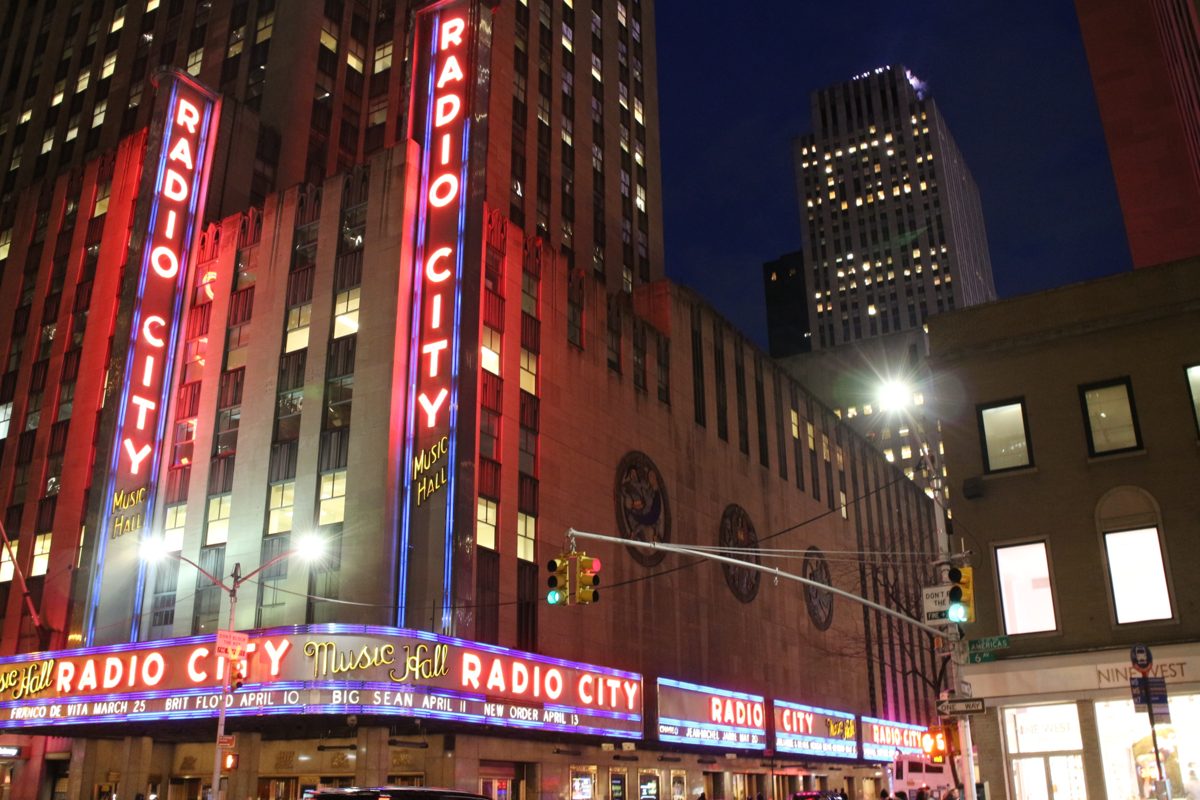
Radio City Music Hall ranks third because it takes the comparison away from the skyline and into a designed environment. The theater opened on 27 December 1932 as part of Rockefeller Center. Its architecture and interiors are associated with Edward Durell Stone and Donald Deskey, and the interior's landmark history underscores that the important work extends far beyond the famous exterior sign. An office tower can impress a person who never enters it; a theater must also organize anticipation, circulation, gathering and attention. Radio City's position rewards the way those different experiences can form a coherent architectural whole rather than a sequence of unrelated decorative rooms.
The strongest part of the case is spatial drama. A theater interior has to establish a relationship between a large audience and a stage without making the surrounding architecture compete with every performance. Art Deco's geometry offers a powerful way to create that frame. Repetition, curves and changes in scale can guide attention while preserving a sense of occasion. This is our interpretation of the designed environment, not a claim that the building guarantees a good seat or a particular acoustic experience at every event. The architectural question is how a large room produces a clear direction and an emotionally legible center.
Arrival matters too. A public entertainment building begins before a visitor takes a seat, and its supporting spaces should not feel accidental. The preservation record treats the public interiors as a major achievement, rather than identifying only one spectacular view. That breadth makes Radio City more persuasive than a theater that relies on an ornate ceiling while neglecting the rest of the journey. In comparing photographs or documented interiors, notice the transitions: exterior to entrance, entrance to gathering space, gathering space to auditorium. Ask whether each change prepares the next. A great theater makes movement part of the experience instead of merely a logistical necessity.
Guardian is the obvious rival for third place. Its combination of brick, tile and crafted interior surfaces may offer a richer lesson in material integration, especially to someone who finds theatrical scale overwhelming. We put Radio City narrowly ahead because the experience of an entire entertainment environment adds a dimension that an exterior-focused skyscraper comparison can miss. That is not a judgment about the quality of the performances or a recommendation of a particular show. It is a preference for architectural space as an active organizer of a shared experience. A materials-first ranking could reasonably reverse these two entries without abandoning the rest of our method.
The building's preservation story also matters, although survival alone does not decide its rank. Radio City faced a serious threat in the late 1970s, received interior landmark protection in 1978 and underwent a major restoration in 1999. Those milestones remind readers that the appearance of a historic interior can involve careful repair and recreation. Preservation is not the same as leaving everything untouched. At the same time, an account of a restoration should not be used to invent claims that every surface visible today is original or that the theater has never changed. Distinguish the original design, later intervention and current operating conditions.
Our image shows the exterior in March 2017. It identifies the venue and its street presence; it does not illustrate the auditorium or prove current show dates and tour availability. Consult the operator for access, and do not confuse a ticket to entertainment with permission to photograph every interior space. Radio City's third place rests on the total architectural idea: a building that turns a large audience's movement and attention into part of its design. The two skyscrapers above it have more commanding profiles, but neither can make exactly the same case for a collective interior experience. That difference is why a theater belongs in this ranking at all.
Source: Architectural record 1 · Architectural record 2 · Architectural record 3.
Photo: Suicasmo · CC BY-SA 4.0. Radio City Music Hall exterior, 14 March 2017; not an interior view. Historical photograph; current access and conditions may differ. Resized/recompressed, source framing retained; original license or dedication retained. No endorsement.
