
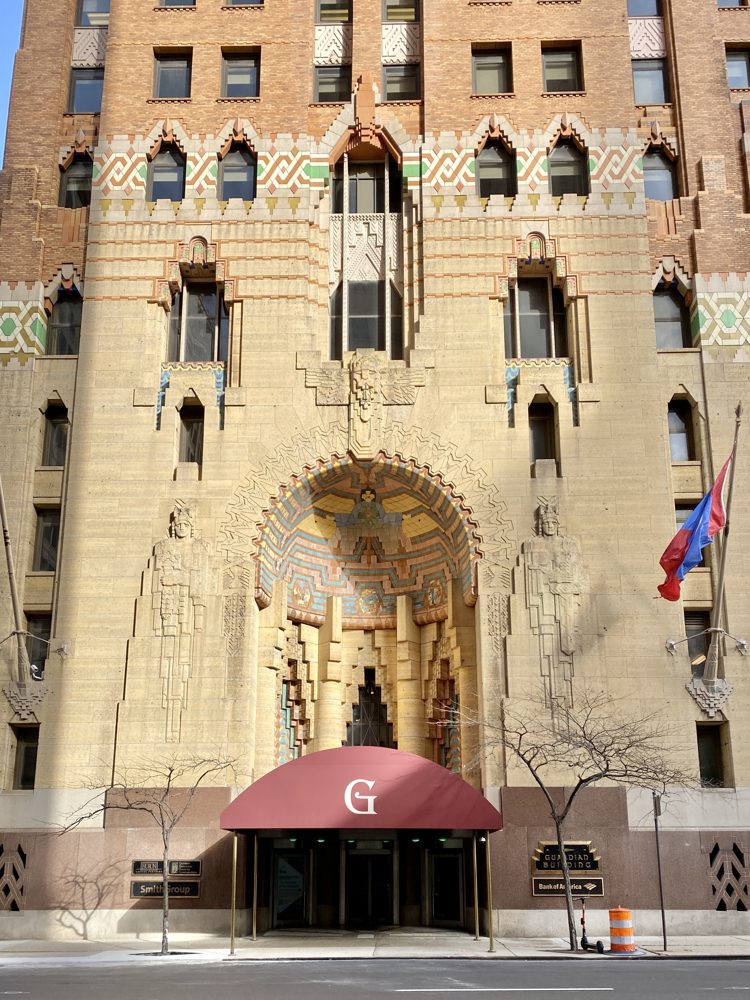
Detroit's Guardian Building is fourth, and it is the entry most likely to challenge our preference for the New York leaders. Designed by Wirt C. Rowland at Smith, Hinchman & Grylls and completed in 1929, the former Union Trust headquarters makes color and craft fundamental to its architectural identity. The building's own historical account describes its distinctive orange brick, polychrome terra cotta and collaboration with Michigan artists and artisans. We rank it ahead of Eastern Columbia because its argument extends especially strongly from the exterior into the interior. It is not merely a tower with a colorful surface; material choices help create an entire architectural character.
Start with the brick rather than the tower's height. The warm color changes how the building relates to neighboring streets and to the idea of a financial institution. A bank headquarters might express seriousness through pale stone and classical restraint; Guardian offers a much more vivid public identity. That does not establish what every original customer thought, and it should not be turned into a claim that color makes a business trustworthy. The architectural point is visible and narrower: a large commercial building can communicate presence through a deliberate material palette, not only through scale or a monumental entrance.
The treatment of detail is equally important. The owner describes purposefully enlarged terra-cotta decoration on the upper stories, intended to register from below. That relationship between distance and detail is a useful test for the whole ranking. Ornament that works in a close photograph may disappear from the street; ornament that reads clearly from far away may feel coarse at the entrance. Guardian's variety invites comparison between those different viewing conditions. Look for the way large patterns establish a rhythm and smaller crafted elements reward a closer view. The appeal lies in their relationship, rather than in counting how many materials or motifs appear.
The historical account credits Mary Chase Stratton's Pewabic tile and work by artists including Ezra Winter and Corrado Parducci. These names help resist the habit of discussing architecture as the achievement of a single celebrated designer. Buildings also depend on collaboration and skilled making. At the same time, sources' broad descriptions of cultural influences need care. It is better to identify a documented maker, material or pattern than to reduce very different Indigenous and ancient traditions to a vague claim about exotic decoration. An appreciative reading can recognize a period's visual borrowing while still describing its limitations and the difference between influence and identity.
Why does this rich building remain below Radio City? Our preference is narrow and explicitly editorial. Radio City creates a particularly strong sequence of shared spaces around a large public event; Guardian's strongest evidence is the integration of materials and craft in a commercial setting. Someone who values the latter more highly could put Guardian third or even first. We keep it fourth because the leading three combine their individual design ideas with an especially commanding overall form or spatial experience. Guardian is nevertheless a more compelling whole, in our view, than several buildings whose best-known feature is a single decorative top.
The photograph here records the exterior and entrance in 2022, not the full interior or today's operating arrangements. Office use, events and security can affect access, so architectural appreciation should respect the working building. Use the historical source to understand what is significant rather than assuming unrestricted entry. Guardian's lesson survives without a tour: look at a familiar building type and ask how strongly materials can change its public personality. Compared with Empire State's relatively restrained exterior or Eastern Columbia's turquoise surface, it makes a persuasive case that architectural color is not a secondary accessory. It can be the structure of the visual argument itself.
Source: Architectural record 1.
Photo: w_lemay · CC BY-SA 2.0. Guardian Building entrance, 19 November 2022. Historical photograph; current access and conditions may differ. Resized/recompressed, source framing retained; original license or dedication retained. No endorsement.
