
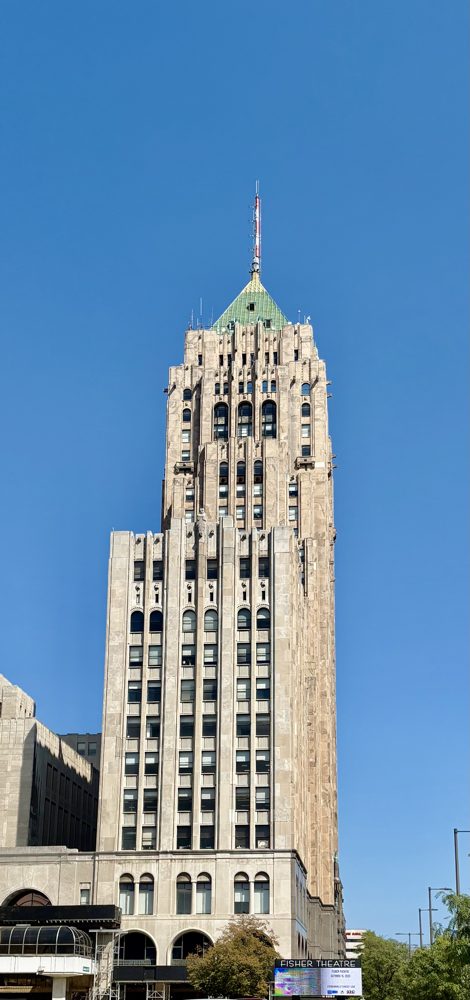
Fisher ranks sixth because its strongest argument is the sustained quality of an architectural environment, rather than a single unforgettable silhouette. Albert Kahn's Detroit building was completed in 1928 for the Fisher brothers, whose automotive manufacturing success financed an exceptionally ambitious commission. The building's historical account emphasizes marble, bronze, mosaic and a richly treated arcade. We put it below Eastern Columbia by a small margin: the Los Angeles building produces a more concise and distinctive exterior image, while Fisher's case accumulates through materials and detailed spaces. Readers who value that gradual accumulation more than immediate visual identity have a strong reason to reverse them.
The exterior helps explain the difference. Fisher's pale surfaces and vertical organization create a substantial civic presence, but it is not simply trying to win attention with a brilliant new facade color. Its richness is more connected to the handling of familiar materials and the movement from the outside into a crafted interior. This makes it an important corrective within a list dominated by memorable tops. A building can be architecturally persuasive without depending on the one feature most easily recognized in a distant photograph. In Fisher's case, the question is how a large commercial development turns ordinary movement through it into an experience worth noticing.
The arcade is central to that argument. The owner describes a three-story, barrel-vaulted ceiling with hand painting, mosaic work and extensive bronze detail. Those are documented features, but the useful comparison is about scale and continuity. A vaulted public passage can provide a sense of direction while offering opportunities to pause and look upward. Rich surfaces can make that passage feel like a destination rather than merely a connection between businesses. This does not prove that everyone uses it in the same way, or that every decorative surface remains unchanged. It explains why the building's interior contributes to our evaluation of the whole.
The tower's historical appearance needs special care. The building is associated with a golden top, yet its own history explains that the original gold-leaf tiles were covered during the Second World War and later replaced with green terra cotta, illuminated to appear gold at night. Do not infer from a glowing evening view that the entire present roof is covered in gold. This distinction is a useful example of how architectural identity can continue through changing materials and treatments. A building may preserve a familiar image while the physical means of producing that image change. History gives the appearance a more interesting story than a simple label can convey.
Fisher's strongest claim against the buildings above it is craftsmanship carried through a complex rather than concentrated in a striking exterior. It also provides a particularly clear reason to acknowledge patrons, designers and makers together. Kahn's authorship matters, but so does the ability to bring skilled work and a large architectural program into one project. We keep the building sixth because the five above it make more immediately distinctive overall arguments under our priorities. That is a judgment about comparative architectural character, not an attempt to measure the quality of individual craftspeople or reduce the commission to a cost comparison.
The photograph shows Fisher's exterior in September 2025. It is not a survey of the arcade or evidence of current opening arrangements, and a working building's interior should be visited only under normal permitted access. If you compare it with Guardian, notice that Detroit offers more than one way to make an Art Deco commercial building feel like an important public presence. Guardian's emphatic color earns our higher place; Fisher answers with a layered richness that rewards attention. Its sixth place leaves a real debate: should a building that reveals itself gradually outrank one whose image is instantly understood from the street?
Source: Architectural record 1.
Photo: TheWxResearcher · CC0. Fisher Building exterior, 11 September 2025. Historical photograph; current access and conditions may differ. Resized/recompressed, source framing retained; original license or dedication retained. No endorsement.
