
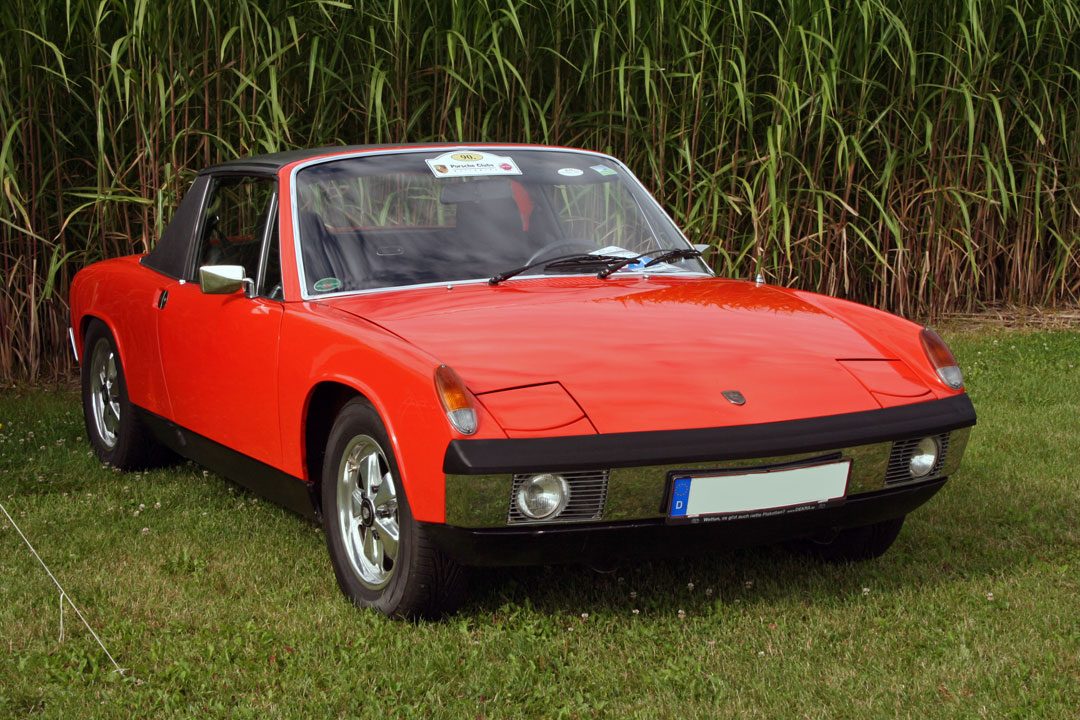
The 914 ranks tenth because it is an unusually direct introduction to a question that runs through Porsche history: must a recognizable brand always put its engine in the same place? Presented in 1969, the model was developed in collaboration with Volkswagen. Its engine sits ahead of the rear axle, unlike the familiar rear-engine arrangement of the production 356 and 911. The range included Volkswagen-powered four-cylinder cars and the Porsche six-cylinder 914/6. Treating those versions as interchangeable hides part of the story. They shared an overall concept while occupying different places within the joint project and its commercial presentation.
Start with the body rather than the badge. The low nose, angular central cabin and removable roof panel establish an identity noticeably different from the curved 911 silhouette. That difference makes the 914 useful in a historical collection: it shows an alternative interpretation of a compact sports car, not an unsuccessful attempt to draw exactly the same shape again. A reader can compare the side profiles and locate the passenger compartment relative to the wheels. The exercise reveals how packaging can influence appearance without requiring a road test, a claim about cornering limits or an assumption that one layout must always win.
A different body and a joint project
The Volkswagen relationship deserves precise language. Collaboration does not mean the car can be understood by dismissing it as a rebadged object without examining the engineering. Conversely, a Porsche crest does not make the four-cylinder and six-cylinder versions mechanically identical. The official design history describes the development of the mid-engine project and the choices behind its appearance. Read that account alongside the model designation on a photographed example. A 914/6 photograph illustrates one branch of the family; it should not silently supply the engine specification for every 914, just as an unusual prototype should not define an ordinary production version.
The roof adds a second useful comparison. A removable panel changes the relationship between an open car and a fixed-roof coupé without making it the same design as a conventional folding-roof roadster. Look at the retained structure around the cabin and the way the body continues behind it. The point is to understand the package, not to infer crash performance from a photograph. Comparing the 914 with the later Boxster helps separate two ideas often bundled together: placing the engine centrally and offering open-air motoring. They can occur together while producing very different bodies and different historical roles.
Open-air design and historical identity
Our tenth place reflects the wider influence of the models above it, rather than a judgment that the 914 is unworthy of attention. For a beginner interested in collaboration, packaging or the variety of Porsche design, it may be the best first stop. Its value lies partly in preventing a narrow reading of the brand as a single shape and a single engine position. The photographed car is an identified historical example, not evidence of how every surviving vehicle is equipped today. Keep the source's original date and the photograph's much later date separate when connecting the object with its place in the chronology.
The lasting lesson is that a lower-ranked car can clarify the entire list. Once the 914 has made the mid-engine distinction visible, the Boxster and Carrera GT become easier to place, while the rear-engine 911 appears as a particular choice rather than a universal Porsche rule. Begin by writing one sentence about what sits where, another about which variant you are studying and a third about why the body takes its form. That small set of questions offers a stronger introduction than arguing about authenticity before looking at the car. The 914 earns its place by making those assumptions available for examination.
Photo: Porsche 914 example, Classic Days Schloss Dyck, 4 August 2012. Abehn · Public domain. Resized and JPEG recompressed; no cropping added. Source image license retained.
