
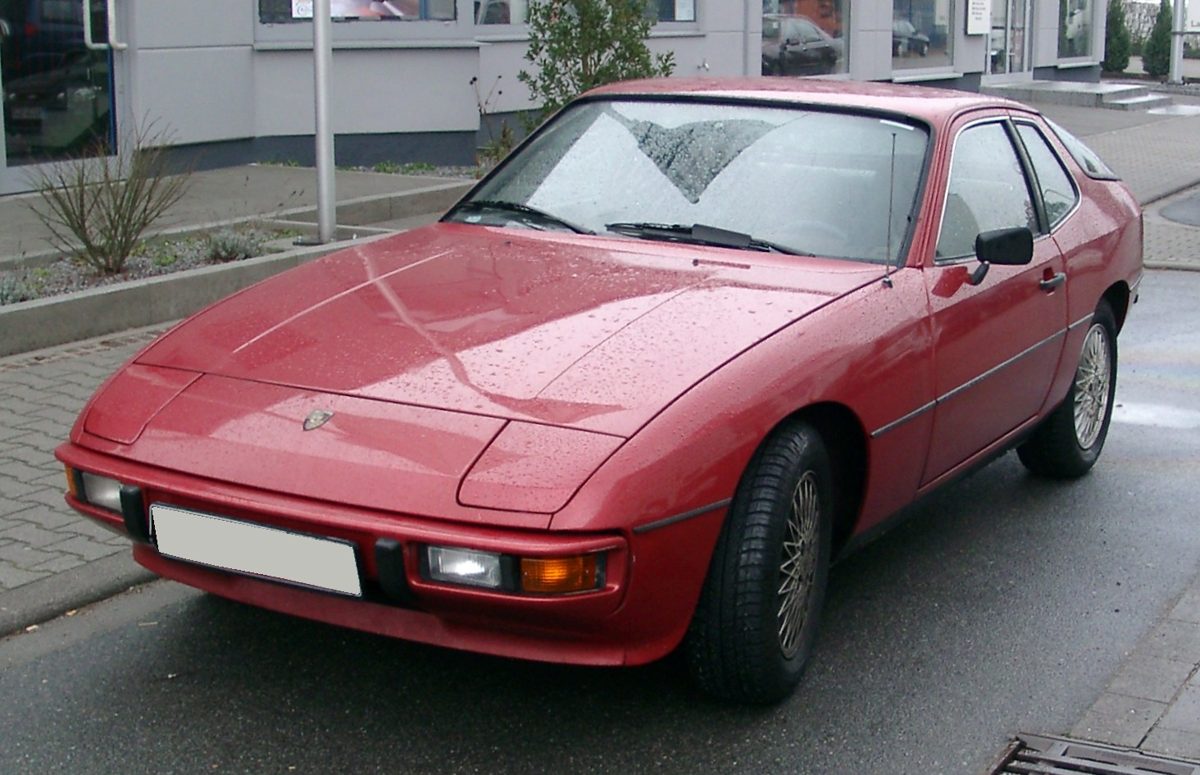
The 924 takes ninth place as the clearest entry into Porsche's transaxle era. Series production began in 1976 after a pre-series presentation in late 1975. The engine is at the front and the gearbox at the rear, connected through the drivetrain. This is not another name for a rear-engine car. Porsche's 2026 historical coverage marks fifty years of the project and explains how a vehicle originally conceived for Volkswagen became a new direction for Porsche. The important change is architectural and strategic: an additional way to build and sell a sports car alongside the 911, rather than simply a smaller version of it.
Look at the proportions. The long, low front section, cabin and large rear glass create a different visual balance from the 914's compact mid-engine body or the 911's descending roofline. The rear hatch also makes the relationship between style and everyday use visible. These observations explain why the 924 belongs in a guide to the marque even when a visitor initially recognizes only the 911. The body communicates an alternative brief. A useful comparison asks what each design allocates to engine space, people and luggage, without turning a photograph into a claim about dimensions that have not actually been measured.
What transaxle means
The transaxle term is worth learning because it is more specific than front engine. Moving the gearbox rearward is part of the distribution of major components, not a promise of perfect handling in every situation. A diagram can show the arrangement; it cannot by itself tell you the condition of an individual car or the experience of driving it. Our ranking values how clearly the 924 introduces this idea. Place it beside the 928 and ask how a similar broad architecture could support a different kind of product. Engineering common ground does not eliminate differences in ambition, materials, engine choice or the intended customer.
The collaboration behind the project also resists a simple purity test. Porsche's historical account describes Volkswagen withdrawing and Porsche carrying the car forward. The lesson is not that component origins are irrelevant, but that a car's meaning comes from the whole project, including the decisions that assemble those components into a finished product. Read the chronology before attaching a slogan to the vehicle. The 924 helps explain why a manufacturer can change direction in response to commercial conditions while still developing a recognizable identity. That is a more useful historical question than assuming every meaningful model must begin from an entirely isolated technical starting point.
Names, variants and the wider legacy
The photograph on this page shows an example of the model, not the precise pre-series car presented in 1975. Later variants and competition derivatives should also be kept separate from the introductory road car. In particular, a 924 Carrera GT is not the mid-engine V10 Carrera GT discussed farther up this countdown. Similar words can conceal very different machines. This is an excellent place to become comfortable with full model names and dates: the extra context prevents an attractive image or a famous badge from quietly moving between two unrelated explanations of Porsche history.
Ninth place recognizes the opening of a major branch while reserving higher positions for models with broader identity or technological influence under our criteria. The 924 can move much higher if the subject is affordable access to the brand or the logic of the transaxle period. Its legacy also continues through the later 944 and 968, which are outside this deliberately limited selection. The most useful takeaway is an architectural one: a Porsche need not have its engine behind the cabin to tell an important Porsche story. Once that is understood, the larger 928 becomes a meaningful comparison rather than a surprising exception that has to be explained away.
Photo: Porsche 924 example, 31 December 2007. Rudolf Stricker · CC BY-SA 3.0. Resized and JPEG recompressed; no cropping added. Source image license retained.
