
The 911 wins because no other road-car family connects Porsche's recognizable identity with such a long story of continuous reinvention. It debuted at Frankfurt on 12 September 1963 as the 901, intended to succeed the 356; the 911 name followed. The original combined a rear-mounted, air-cooled flat-six with a compact two-plus-two body. Our first-place choice concerns that family and its continuing significance, rather than a claim that one early version defeats every later car in a performance comparison. The historical achievement is the relationship between a persistent idea and the many changes needed to keep developing it.
Start with the profile. The cabin, front wings and descending rear line make the car recognizable without requiring every generation to be identical. A photograph of an early model is useful precisely because it lets a reader identify the basic visual relationship before comparing later changes. Put it beside the 356 and then a different-generation 911. Ask what remains legible and what has been revised. This is a more revealing design exercise than assuming continuity means a manufacturer simply repeated the same drawing. Recognition can survive substantial changes in proportions, materials, equipment and mechanical construction.
Continuity through substantial change
The family also teaches the difference between model name and internal generation code. A 911 may carry a code such as 964, 993 or 996 without becoming an unrelated model merely because the number changes. Conversely, using the same 911 name does not imply identical cooling, drive systems or transmissions. The 996's move to water cooling is an especially clear example of major change within a familiar identity. Read the date and generation before applying a specification. That discipline prevents an air-cooled early car and a much later derivative from being treated as interchangeable illustrations of one unchanging machine.
The rear-engine arrangement connects the original with a continuing technical tradition, but it is not the sole definition of Porsche. The rest of this countdown has shown front-engine transaxle cars, mid-engine roadsters and flagships, an SUV and an electric saloon. Their presence makes the 911's place more interesting. It is a central reference around which alternatives developed, not proof that alternatives were impossible. The strength of the winner is therefore relational: knowing the other cars helps explain what the 911 preserved, what it changed and why those choices remained significant in a range that expanded far beyond one sports-car format.
A central reference, not the only Porsche
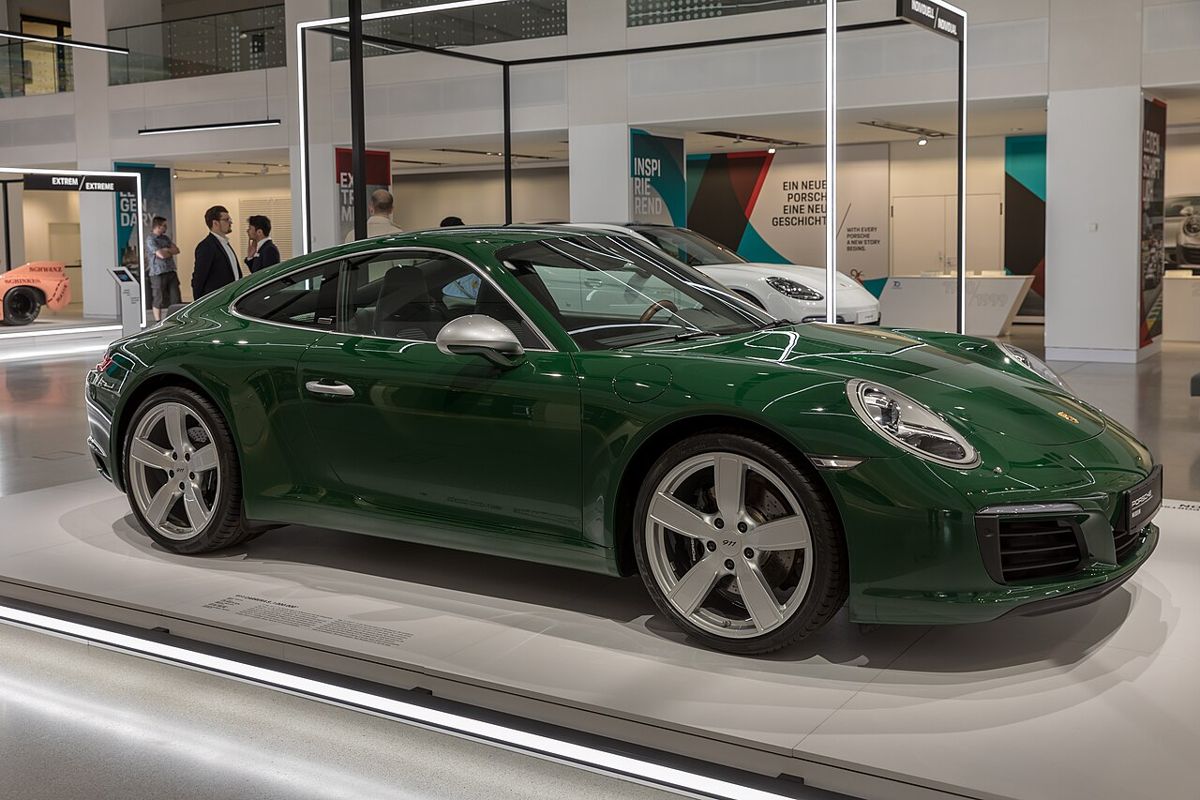
Our image shows the millionth 911 displayed in Berlin in 2018, a later generation rather than the original 1963 car or its public unveiling. The source and photographic date are preserved separately from the model's historical date. Our iconic-car-design guide provides a wider comparison, while the European car-museum guide suggests another way to explore the physical record. Treat display photographs as invitations to look closely, then use the dated archive for specific claims. We do not infer originality, mechanical condition or a particular chassis's racing history from an attractive view. The model's influence is substantial enough without adding an undocumented story to the example illustrated.
First place rewards the combination of longevity, recognizable form and repeated engineering adaptation. The 356 can win on foundational importance, the 959 on technological concentration, and the Cayenne on widening the company's commercial possibilities. Each is a credible alternative because importance is not one measurable quantity. Our preference is for the car that makes continuity itself a changing engineering project. Would you keep the 911 first, or promote one of those challengers? A useful answer names the criterion it values most, then returns to the documented cars. That turns a ranking into a conversation about history rather than a contest between unsupported superlatives.
Photo: Millionth 911 displayed in Berlin, 15 April 2018; later generation, not the 1963 debut. Matti Blume · CC BY-SA 4.0. Existing optimized local image reused; no new modifications. CC BY-SA 4.0 retained.
