
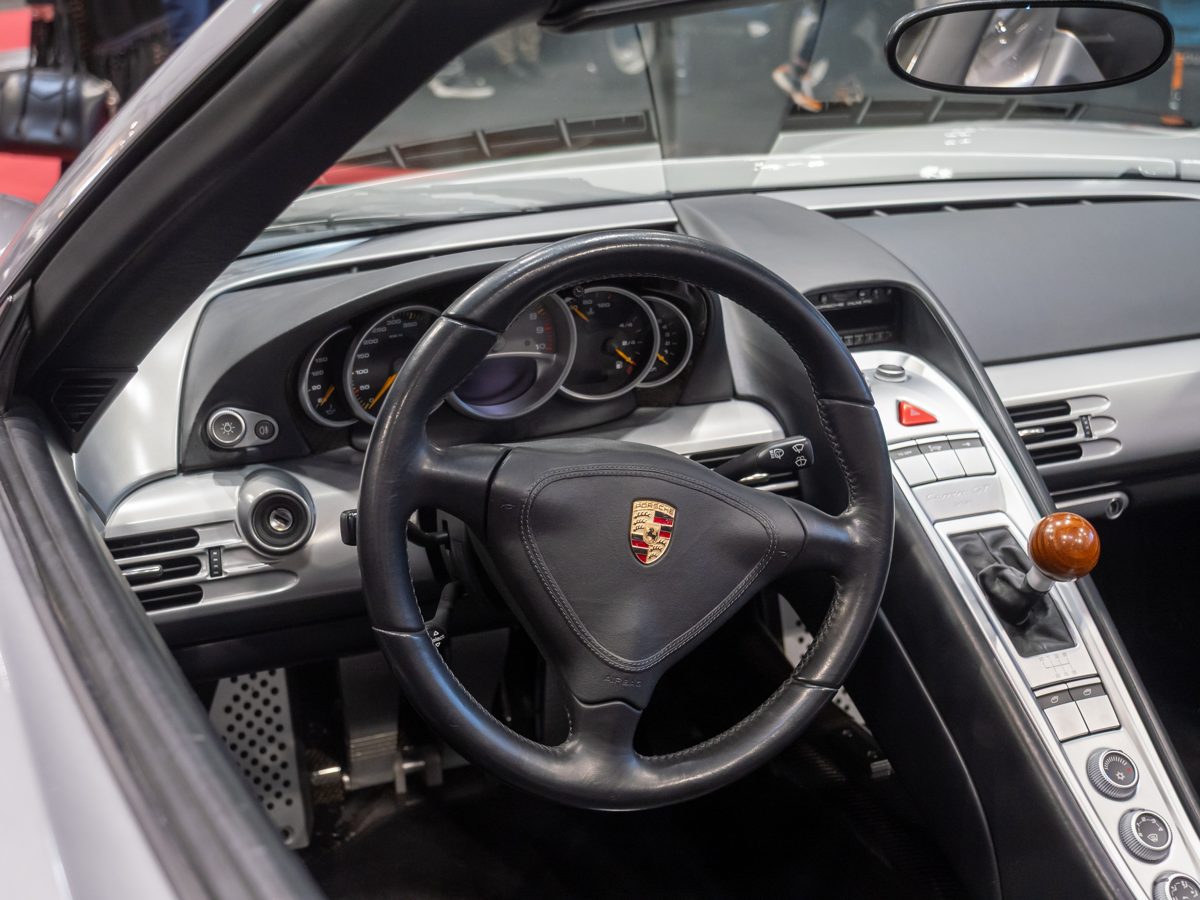
The Carrera GT takes fourth place as a concentrated statement of a particular kind of Porsche road car: a mid-engine machine organized around a naturally aspirated V10 and a carbon-fiber structure. The concept was shown in Paris in 2000, while the production version appeared at Geneva in 2003. The distinction matters because the production engine displaced 5.7 liters rather than the concept's 5.5 liters. These are historical specifications, not evidence that a modern modified example has the same equipment. The model earns its position for the coherence of the whole engineering package, rather than for a single performance statistic detached from its context.
The layout places the power unit behind the occupants but ahead of the rear axle. That makes it a useful comparison with both the much earlier 914 and the Boxster. The shared phrase mid-engine does not make the cars equivalent. It describes one major decision, around which very different structures, powertrains and intended roles can be built. A beginner can place the three side profiles together and ask how much space is devoted to the cabin and the engine area. That comparison explains more than treating every car with an engine behind the seats as one undifferentiated category of exotic machine.
Structure and a different flagship brief
Carbon-fiber construction supplies a second route into the car. The significance is not simply a visible weave associated with expensive trim. Structural material choices belong to the way a vehicle is designed and manufactured. Distinguish a load-bearing structure from a decorative surface before drawing conclusions from a photograph. The Carrera GT is a good reminder that a road car's technological importance can lie beneath the bodywork. A carefully identified interior image can therefore be useful alongside exterior photographs, provided it is not offered as direct proof of every hidden component or as a substitute for the primary technical description.
The manual transmission and the V10 give the model a different historical character from the 959's densely integrated turbocharged showcase or the Taycan's electric architecture. This is a comparison of engineering approaches, not a claim that less electronics automatically makes every driver faster or safer. Likewise, an evocative engine description cannot establish a driving experience we have not tested. The useful question is what the designers chose to prioritize and how the major elements support that aim. That preserves the interest of the mechanical choices without turning a history guide into instructions for exploiting a high-performance car.
Names and stages of development
Keep names and dates explicit when following the archive. This Carrera GT is not the earlier 924 Carrera GT, and its 2000 concept is not the same object as the 2003 production version. A modern display photograph belongs to the car's later public life. The caption identifies the view and the photographic date, allowing the image to support recognition rather than manufacture a launch scene. Porsche's retrospective supplies the production context. Read that dated record before combining figures from different presentations, since a plausible number can still be wrong when transferred to the wrong stage of a project's development.
Fourth place reflects an exceptional engineering statement whose rarity and focused brief limit its wider influence compared with the leading models. Enthusiasts who prioritize this combination of construction, layout and powertrain could reasonably place it first. Our order favors the 959's broader demonstration of coordinated systems, the 356's foundational role and the 911's continuing identity. The Carrera GT remains essential because it shows that Porsche's history contains more than one vision of a flagship. Its lasting question is not merely how fast a car can go, but how clearly an ambitious set of choices can be expressed in one complete road-going design.
Photo: Carrera GT cockpit, Techno-Classica Essen, 9 April 2025. Matti Blume · CC BY-SA 4.0. Resized and JPEG recompressed; no cropping added. Source image license retained.
