
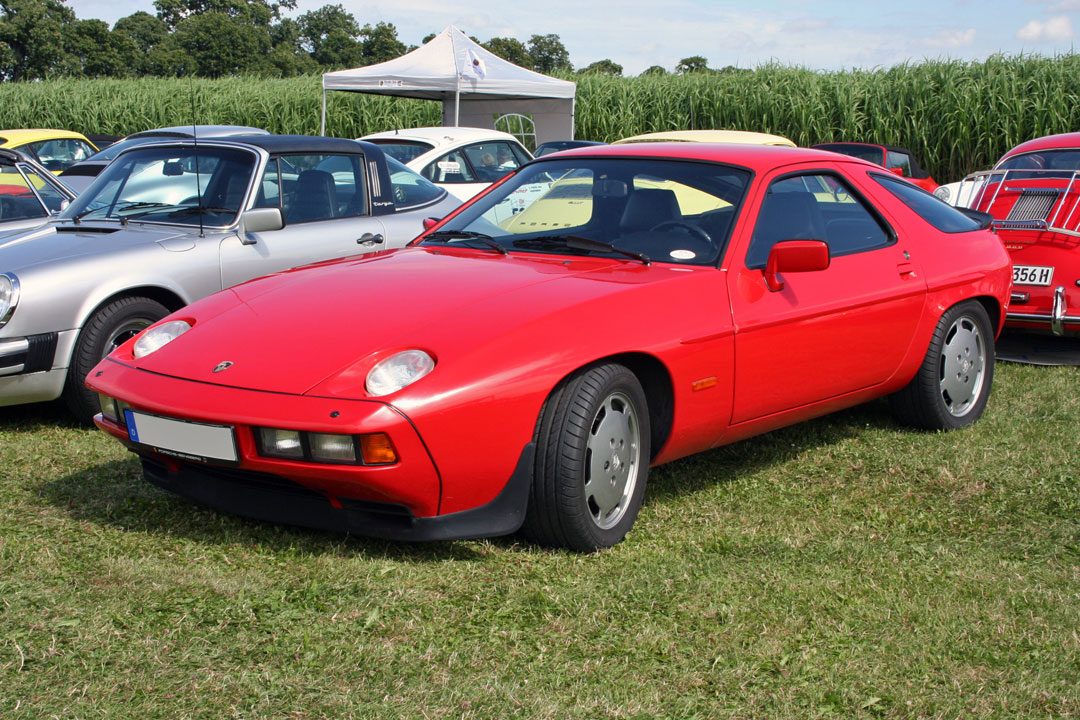
The 928 ranks eighth for showing how far Porsche was prepared to reinterpret a fast road car. Its world premiere took place at the Geneva Motor Show in March 1977. A front-mounted, water-cooled V8 and rear transaxle gave it a different foundation from the air-cooled, rear-engine 911 of the period. The idea was a grand tourer, combining sustained travel with sports-car ambition. That distinction is central to its place here. The 928 is not best understood as a 911 with a longer bonnet; it is a different answer to the question of what a sophisticated Porsche road car should provide.
Its appearance makes that different brief approachable. The broad glass area, rounded body and long front section offer an immediate contrast with both the angular 924 and the more familiar 911 outline. A side-by-side view can explain why shared transaxle thinking did not require identical styling. Look at the relationship between the roof, rear hatch and cabin rather than concentrating only on the unusual headlamps. The car is useful to a beginner because its form invites questions about long-distance use, passenger accommodation and the packaging of a large engine without pretending that appearance alone establishes comfort or performance.
A grand-touring alternative
The V8 also provides a clean lesson in engine terminology. Cylinder count, cylinder arrangement, cooling and engine position describe different properties. Saying V8 does not automatically tell you where it is installed or which wheels it drives. Put those categories into separate lines before comparing the 928 with a flat-six 911 or a mid-engine Carrera GT. This prevents the catalogue of model names from becoming a catalogue of vague sounds. The point is not to memorize a specification sheet, but to understand why a change in the basic arrangement can alter the whole vehicle and its intended role.
Porsche's archive presents the 928 as a serious new direction at a moment when the future of the 911 was debated internally. The subsequent survival of the 911 should not reduce the 928 to a failed prediction. A model can leave a substantial design and engineering record even when it does not replace another family permanently. Read the car in the context of the choice being made at the time. That approach avoids judging every historical project only by whether its exact layout dominates the present catalogue, a test that would erase many useful experiments from automotive history.
A later variant and a different possible future
The pictured car is a later 928 S, so its details should not be described as the exact specification of the Geneva debut. The family developed over time, and engine outputs and equipment differ by year and market. This guide avoids attaching a single performance number to every 928. The dated archival sources are a better starting point than a modern photograph for understanding the introduction. The image remains valuable for recognizing the overall form and the continuation of the design. Captioning the variant honestly makes the comparison more informative, not less impressive.
Eighth place rewards the clarity of its alternative to the 911, while the models above it offer stronger claims through lasting identity, technological concentration or the opening of a new market. Anyone interested in grand touring could reasonably move it upward. Compare the 928 with the Cayenne to see two very different attempts to broaden what customers might expect from Porsche, and with the 924 to see how a broad engineering concept can support distinct ambitions. Its enduring lesson is that history contains genuine alternatives. The route eventually taken was not the only route engineers and designers were capable of imagining.
Source: Porsche.
Photo: Later Porsche 928 S, Classic Days Schloss Dyck, 4 August 2012. Abehn · Public domain. Resized and JPEG recompressed; no cropping added. Source image license retained.
