
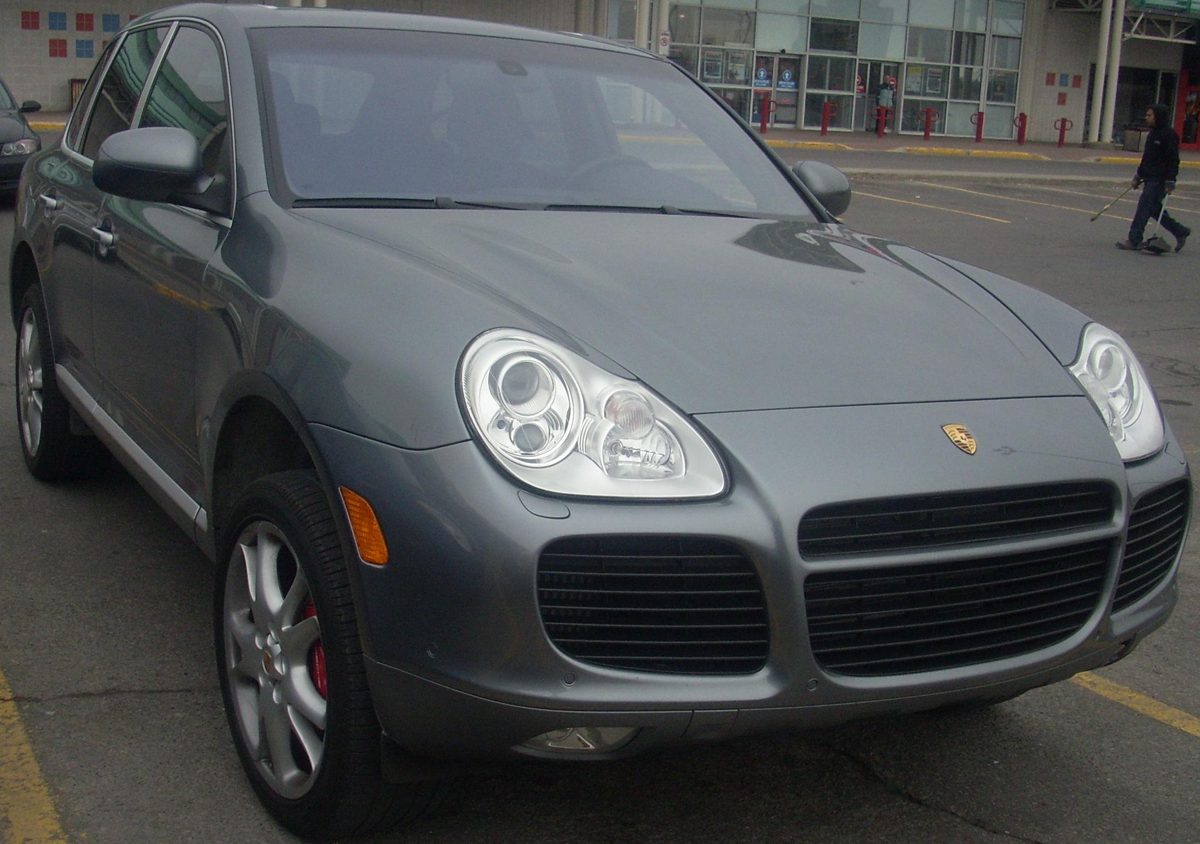
The first-generation Cayenne ranks seventh because it made the expansion of Porsche's identity impossible to ignore. Its world premiere was at the Paris Motor Show in September 2002. An SUV placed passenger space, luggage and a broader range of uses at the center of a product from a manufacturer strongly associated with two-door sports cars. The car's historical importance does not depend on calling it a 911 in a taller body. It matters because Porsche tried to carry its identity into a different brief, with different packaging demands and a different relationship between the vehicle and the people using it.
The project also provides a practical example of collaboration. Porsche and Volkswagen developed the Cayenne and Touareg on a shared platform through the project known as Colorado. Their vehicles were not mechanically identical in every respect: the official history describes separate engine choices and chassis development within that common architecture. For a learner, this is a useful middle ground between two simplistic accounts, one in which a shared platform means precisely the same car and another in which a prestigious badge implies complete isolation from other manufacturers. The interesting work lies in the choices made on top of the common foundations.
Shared foundations, distinct choices
The first Cayenne's proportions make those choices visible. Compare the height of the passenger compartment, the rear doors and the luggage area with the compact cabins elsewhere in the list. A vehicle designed around different uses cannot be assessed only by whether its outline resembles a favorite coupé. The exercise is not an assertion that every compromise was successful or that an SUV should be everyone's preferred Porsche. It explains why historical influence and personal taste can point in different directions. A car you would not choose for yourself may still be essential to understanding how a manufacturer changed.
Porsche's retrospective describes the Cayenne as a major support of its commercial development. That is the strongest reason someone might put it near the top of this ranking. Our order gives greater weight to the continuity and technical identity represented by the leading sports cars, but it does not dismiss the commercial case. A useful discussion separates those criteria openly. Otherwise a disagreement about seventh place becomes an argument in which one person is measuring financial influence and another is evaluating design or engineering, without either acknowledging that they are answering different questions.
Why commercial influence changes the argument
The illustration shows a first-generation Cayenne Turbo example photographed years after the debut. It does not establish the specification of every Cayenne or of the current range. Later generations, hybrid derivatives and electric developments belong to their own dates and technical contexts. That distinction matters especially when a familiar model name spans a long period. A feature described in a modern update should not be projected back onto the 2002 launch car. Historical comparison becomes easier once the generation is identified before reading the equipment list, rather than treating a badge as a promise of unchanged engineering.
Seventh place rewards a change in the boundaries of the marque. Put the Cayenne beside the Boxster: one broadened the customer brief through a new vehicle type, while the other reworked the accessible two-seat sports-car proposition. Put it beside the Taycan to see another kind of expansion, centered on propulsion rather than simply body format. The Cayenne's lasting lesson is that identity has to be expressed through a whole vehicle, not just its engine or silhouette. Whether you regard that expansion as the most important chapter depends on what you want a history of Porsche to explain.
Source: Porsche.
Photo: First-generation Cayenne Turbo, photographed 26 March 2009. Bull-Doser · Public domain. Resized and JPEG recompressed; no cropping added. Source image license retained.
